
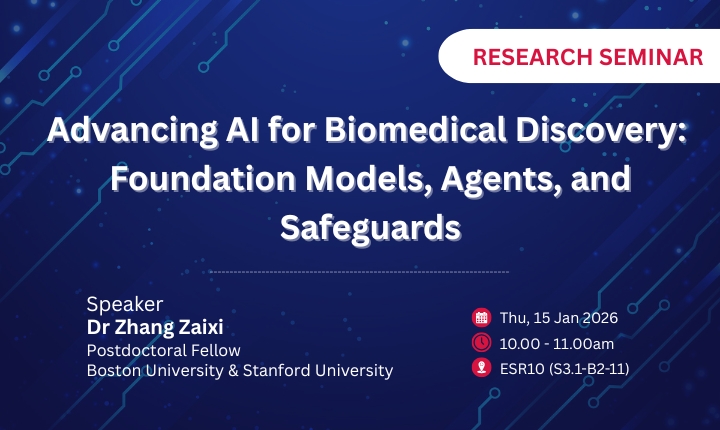
Advancing AI for Biomedical Discovery:Foundation Models, Agents, and Safeguards by Dr Zhang Zaixi
Abstract
While AI models like AlphaFold and RosettaFold have revolutionized life science research, realizing the full potential of AI for biomedical discovery remains a significant challenge. Current approaches face three critical challenges: (1) existing AI models are less accurate for controllable design and therapeutic applications; (2) the long-horizon scientific
research pipeline is quite complex and exceeds the capabilities of isolated models; and (3) there is an absence of built-in safety mechanisms to prevent dual-use risks. To bridge this gap, in this seminar, I will introduce
PocketGen and RNAGenesis as controllable generative models for therapeutic protein/RNA design; STELLA as a self-evolving agent for autonomous scientific discovery that discovers novel targets and enzyme
variants; and GeneBreaker and DNAMark for evaluating dual-use risks of DNA models and tracking AI-designed DNAs for biosafety. I will conclude with my vision for the next generation of AI for Science: building biomedical world models and integrating agents with physical lab automation to accelerate the cycle of discovery.
Biography
Zaixi Zhang is a Postdoctoral Fellow at Princeton University and Stanford University, advised by Professor Mengdi Wang and Professor Le Cong. His research interests lie in AI for Science and AI safety, with a specific focus on generative models and autonomous agents for biomedicine. Zaixi has authored papers in top-tier scientific and machine
learning venues, including Nature Machine Intelligence, Nature Biotechnology, NeurIPS, ICML, ICLR, and CVPR. He is the recipient of Princeton AI2 Postdoctoral Fellowship, NSFC PhD Fellowship, and the Special Award of CAS President's Award. He is also a Leading Organizer of the NeurIPS 2025 Workshop on Biosecurity Safeguards for Generative