
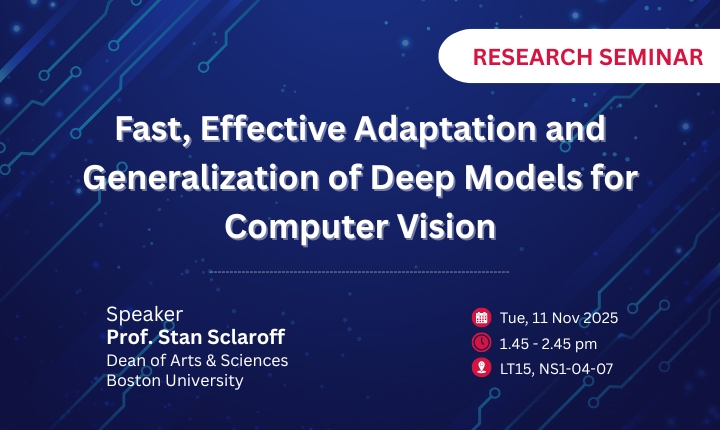
Fast, Effective Adaptation and Generalization of Deep Models for Computer Vision by Prof Stan Sclaroff
Abstract
In this talk, I will give an overview of our group’s work in several areas relating to deep neural networks and their applications in computer vision, with emphasis on applications that consider human faces, body motion and gesture, etc. I will provide survey of this work, including methods for fast and effective domain adaptation and model generalization; domain adaptive pose estimation and action recognition; video segmentation, labeling, and interpolation; modeling what humans and deep neural networks find salient in images and video; and adversarial approaches to testing and disrupting deepfake neural network models. I will also share information about Boston University’s latest activities in computer vision, artificial intelligence, and data science.
Biography
Stan Sclaroff is a Professor in the Department of Computer Science and an affiliated Professor in the Department of Computer & Electrical Engineering at Boston University (BU). With Professor Margrit Betke, he co-founded BU’s Image & Video Computing Research Group. His research interests are in the areas of tracking, video-based analysis of human motion and gesture, shape matching and recognition, visual saliency and attention models, “explainable” deep learning, as well as image/video database indexing, retrieval, and data mining methods. He developed one of the first content-based image retrieval systems for the Internet, the ImageRover, years before Google Image Search appeared. He has served as the Chair of the BU Department of Computer Science (2007–2013), Associate Dean of the Faculty for Mathematical & Computational Sciences (2015–2018), and Interim Dean of Arts & Sciences (2018-2019). He was appointed Dean of Arts & Sciences in 2019. He is a Fellow of the IEEE and IAPR. He received his S.M. and Ph.D. from the MIT Media Lab in 1995.