Centre Director moderates the official ‘Invest in Rwanda’ panel discussion
On the panel was the Minister of Foreign Affairs and International Cooperation of Rwanda
.jpg?sfvrsn=bf833320_1) From left: Rory McDougall, Minister Olivier Jean Patrick Nduhungirehe, Farizan d’Avezac de Moran, Michelle Umurungi, and Amit Jain.
From left: Rory McDougall, Minister Olivier Jean Patrick Nduhungirehe, Farizan d’Avezac de Moran, Michelle Umurungi, and Amit Jain.
The Director of the NTU-SBF Centre for African Studies (CAS), moderated a panel discussion that included the Rwandan Foreign Minister Olivier Jean Patrick Nduhungirehe. The organised by the High Commission of Rwanda and the Rwanda Development Board (RDB) took place on the sidelines of the Africa Singapore Business Forum (ASBF). Billed as ‘Invest in Rwanda’ the panel discussion was centred mostly on the business climate of the landlocked Republic and its positioning as a strategic ‘gateway’ to Africa.
Besides Minister Nduhungirehe the panel featured Michelle Umurungi, the Chief Investment Officer of the RDB, green building expert Farizan d'Avezac de Moran of GreenA Consultants; and Rory McDougall, Chief Financial Officer at DelAgua, a social enterprise financing clean cookstoves through carbon credits.
The Rwandan economy has grown consistently at the rate of 7% a year since 1994 and is widely acclaimed for its safe, corruption free and business friendly policies. It has implemented more than 50 business reforms in the last decade and consistently ranks among the continent’s top performers for ease of doing business. In 2024, Rwanda secured US$3.2bn in investment commitments, a sign of growing investor confidence. Since taking power in 1994, President Paul Kagame has sought to remake Rwanda in Singapore’s image and many of the reforms and institutions that his government have put in place have been inspired from Singapore. Just as Singapore positions itself as ‘gateway’ to Asia, Rwanda has positioned itself as a ‘gateway’ to Africa.
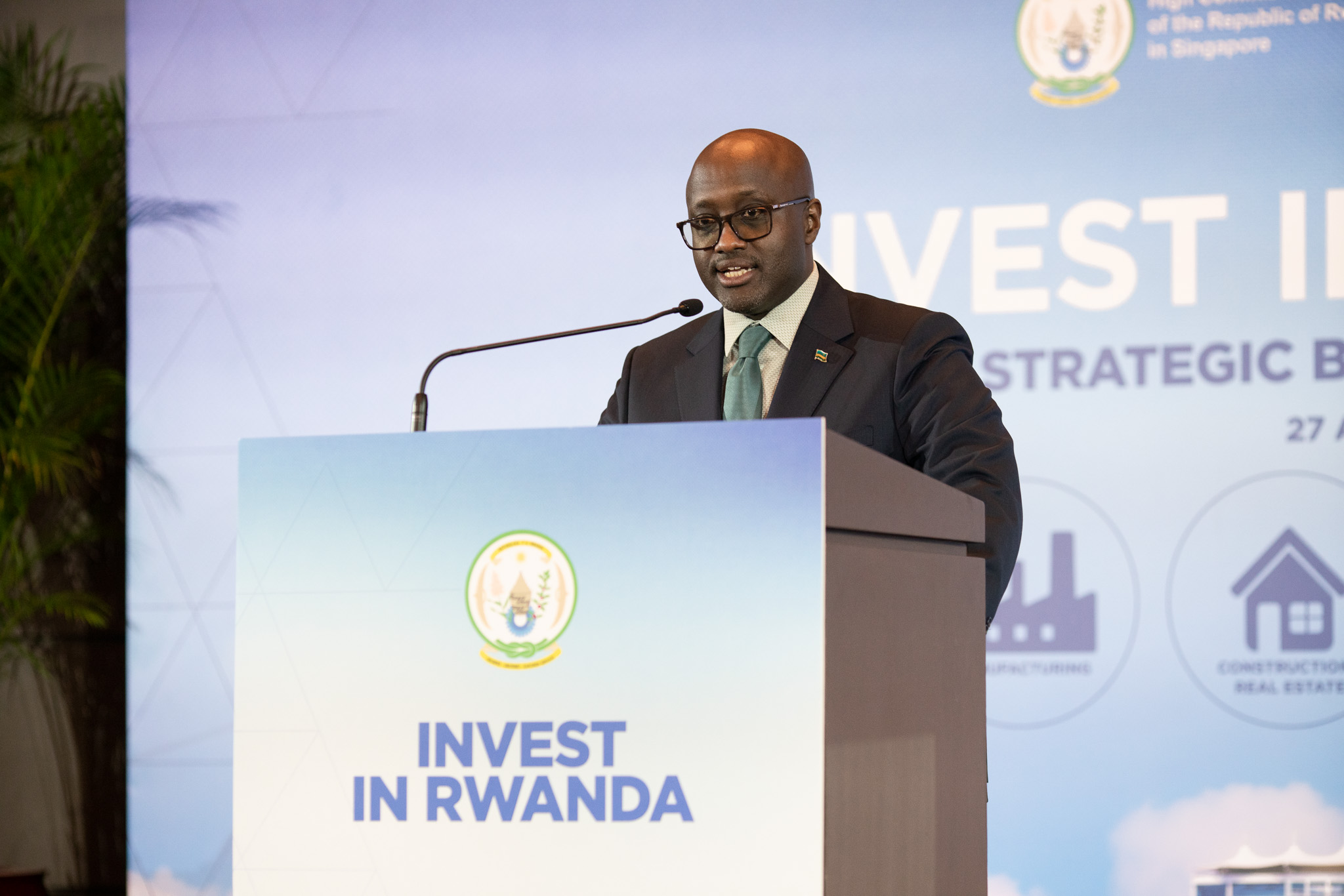 Minister Olivier Jean Patrick Nduhungirehe speaking at the event.
Asked what that ambition means in practice, Minister Olivier said that Rwanda is not only a domestic market of 14 million people but, through the East African Community (EAC) and the Common Market for Eastern and Southern Africa (COMESA), a gateway to more than 300 million consumers. “With AfCFTA, Rwanda could also provide access to 1.3 billion. “We are a small country, but integrated, stable, and business-friendly. That is why we call ourselves a gateway,” he said.
Turning to Michelle, Amit sought to know how easy it is for a foreign investor to do business in Rwanda. She explained RDB’s role as a “one-stop shop” inspired by Singapore’s Economic Development Board (EDB). Investors can register businesses within six hours, profits are fully repatriable. RDB acts as the “first gateway” by consolidating information, facilitating meetings, and accompanying site visits to build investor confidence. “We aim to be as lean and efficient as the private sectoritself,” she said.
At the spur of the moment Amit invited the audience to validate or counter her claim. Ramesh Moochikal, CEO of Africa Improved Foods, recounted his eight years in Rwanda. He described how the Minister of Finance personally called him for breakfast during a period of global uncertainty, asking only: “What can the government do to make your life easier?” He added that settling expatriate talent in Kigali was the easiest in Africa, making Rwanda stand out as a place where both business and people thrive.

On sustainability, Farizan drew comparisons with Singapore. “Rwanda’s first strength is safety, followed by the agility of its design”, she said. Rwanda is ahead in certain areas, such as banning plastics long before Singapore and mobilising citizens for monthly clean-ups, rather than hiring foreign workers. “With its mild climate, Rwanda is naturally suited for green building. Projects like Kigali’s Green City and carbon-neutral industrial parks illustrate its ambition,” she said.
“These are areas where Rwanda is actually ahead of Singapore,” she said. Rwanda is now exploring carbon-neutral industrial parks and applying Singapore’s Green Mark standards to landmark projects in Kigali.
Rory of DelAgua explained how his enterprise distributes clean cookstoves to rural households, funded entirely through the sale of carbon credits. To date, the Rwanda programme has issued over 8 million credits, attracting nearly US$100 million in investment, largely from Europe and North America. Taking a contrarian view Amit challenged Rory and asked, “if those developing carbon projects are foreign entities and those selling carbon credits are foreign entities, then how does Rwanda benefit?” he asked. McDougall pointed to 70 full-time staff, 7000 community workers paid to distribute and monitor stoves, time savings for households, and a revenue-sharing mechanism that channels 5% of carbon credit income into the Green Fund of Rwanda. Amit then turned to Michelle of the RDB and of she was ‘happy’ with that arrangement. Michelle acknowledged that the architecture of the global financial system was skewed against Africa, but to the extent that it helps protect the environment and create jobs in places that otherwise would not see much development she was happy with the carbon market development. Rwanda is one of the only two African countries that Singapore has signed a carbon credit implement agreement.
Amit also raised the fairness of expecting Africa to decarbonise when it contributes less than 4% of global emissions. McDougall’s response was pragmatic: “It is an opportunity to leapfrog. Africa can avoid the mistakes of industrialised countries and build cleaner from the start.”
Asked about the state of Rwanda-Singapore ties, Minister Olivier explained that the two countries established diplomatic ties in 2005 and have since signed 25 agreements across ICT, fintech, education, and trade. He told the audience that the country’s Vision 2050 aspires to emulate Singapore’s transformation from a small, resource-scarce state into a high-income economy.
“Singapore inspires us,” he said. “We do not want endless aid. We want investment and trade that lift our people out of poverty.” He added that direct flights between Kigali and Singapore were inevitable once Rwanda’s new international airport is complete, and discussions on deeper trade cooperation, including a potential FTA, were underway.
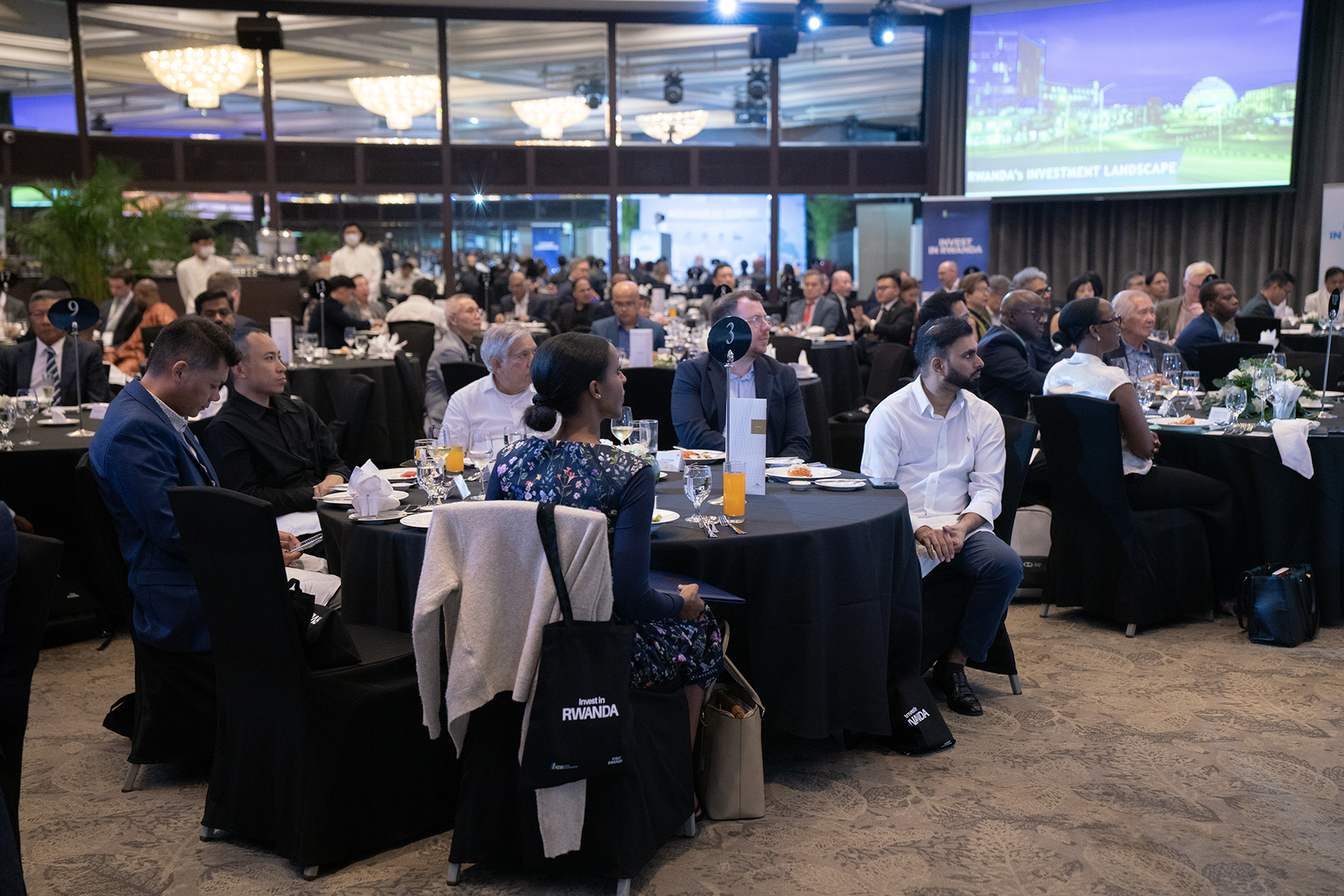
During the Q&A, an audience member asked why more global investors were not pouring into a country growing at 7% annually. Michelle’s answer was candid. “The issue is narrative. Too often, Africa is seen through myths of bad governance and poor returns. Platforms like ASBF are where those myths are de-mystified,” she said. “Capital goes where it feels safe, loved, and understood. Once investors see the data, seek clarity, form relationships, and visit for themselves, the opportunities will present themselves clearly.”
Rwanda is an example of an African market moving beyond dependence on aid by deliberately building the structures and systems that enable global trade and collaboration. It is carefully curating a brand that is trustworthy, predictable, and accessible, while offering abundant opportunities for partnership. Rwanda’s path mirrors Singapore’s improbable rise: two small states that chose reform, integration, and vision to amplify their place in the world. That same ambition drives Rwanda’s determination to position itself not as a recipient of aid, but as a strategic gateway to Africa — a lesson other African countries can draw on as they craft their own path to sustainable growth and global relevance.