Centre Director moderates panel discussion at ASBF 2025
Business leaders take a stab at unlocking the African consumer market with Amit Jain
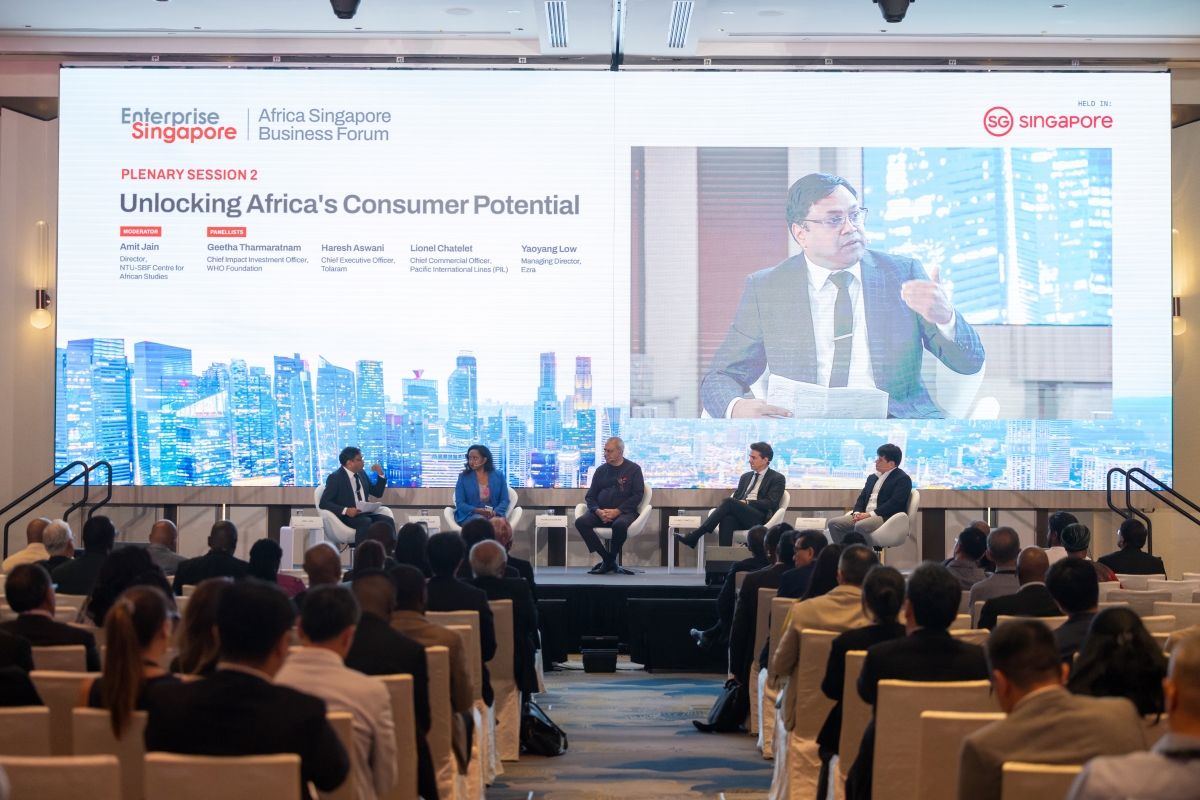 For the second consecutive time Amit Jain, the Director of the NTU-SBF Centre for African Studies moderated the Africa Singapore Business Forum (ASBF) plenary panel discussion. The session, which brought together seasoned business leaders with firsthand experience across African markets discussed what it truly takes to “Unlock” Africa’s consumer potential.
The panel featured Haresh Aswani, Chief Executive Officer of Tolaram Africa - the Nigeria-focused food-to-infrastructure conglomerate; Geetha Tharmaratnam, Chief Impact Investment Officer, WHO Foundation. With 20 years of experience in private equity, impact investment, insurance, and venture capital across multiple geographies; Low Yaoyang, Managing Director of Ezra, a Singapore-based fintech firm that uses non-conventional scoring algorithms (AI) to assess credit-worthiness of small and medium African enterprises; and Lionel Chatelet, the Chief Commercial Officer of the Singapore-based shipping line PIL, which runs one of the biggest fleet of cargo vessels between West Africa and China. Between them, they represented decades of investment, entrepreneurship, and trade experience on the African continent.
Opening the discussion, Amit framed the sheer scale of Africa’s consumer opportunity. He noted that 185 million Africans spend between US$3 and US$5 daily on essential goods, while nearly 300 million already have discretionary spending capacity. Africa’s middle class, he stressed, is now arguably larger than India’s, with half living in cities and most of them young. By 2030, household consumption could exceed US$2.5trn.
“The choices these young people make will determine what the future of the consumer market will look like,” he said. “No matter where you are in the value chain, be it trade, production, or manufacturing, you simply cannot afford to ignore Africa.”
With this foundation, Amit asked Haresh how Tolaram managed to get Nigerians “hooked on a brand like Indomie.” He said the journey was about creating awareness and acceptance. “We were the first to bring noodles into Africa. For six years, we lost money, but we kept going. We had to educate Africans on how to eat noodles.”.
That persistence turned Indomie into a household name and placed Nigeria among the world’s top ten noodle markets. Yet Aswani stressed that demand creation alone was not enough. “We had to build a whole distribution system. Today it is the largest logistics provider in Nigeria, with 4,000 trucks. Only 40% is for our own products; the rest serves other multinationals.”
For him, Nigerian consumers are highly discerning. “You cannot sell second-quality products in Nigeria,” he said, describing the country as a demanding “plus-one market” where global brands often launch ahead of Asia. He added that policy reforms, including fuel subsidy removal and currency harmonisation, were stabilising the business environment. Through ventures such as the Lagos Free Zone and Lekki Deep Sea Port, Tolaram is also providing the infrastructure for others to localise production and reach Africa’s vast consumer base.
If consumer demand is resilient, credit access remains a constraint. The discussion turned to Yaoyang, whose fintech firm Ezra is tackling the problem of financial exclusion. “How does your system really work?” Amit asked, probing Ezra’s business model. Low explained that the firm analyses over 180 data sources — from mobile money transactions and weather data to social media patterns — to score borrowers traditionally excluded from formal finance.
The results have been striking. “Across our African portfolio, default rates are about 3%, almost the same as U.S. credit cards,” Yaoyang said. He noted that 70% of applicants are women, who also show higher repayment rates and create broader economic benefits. For every US$1 received by a female borrower, there is US$2–3 of economic gain in the informal economy,” he said.
Picking up on this point, Geetha emphasised how capital allocation can magnify such outcomes. She cited while only 7% of global investment reaches women-owned businesses, funds with at least 30% female participation on investment teams consistently outperform peers. “This is not only about equality,” she said. “It is about recognising how performance improves through inclusion.” Amit responded by noting that the largest number of enterprises in Africa are run by women, a striking contrast to Southeast Asia.
“What is impact investing, and why does it matter for Africa?” Amit posed to Geetha. She described it as ‘investing intentionally”. Africa, she argued, suffers from a mispriced risk premium: “The cost of capital is extraordinarily high. Impact investing recognises those distortions and designs capital stacks that make scale possible.”
In terms of where impact can go in businesses, she pointed to M-Pesa’s origins — initially seeded by donor funding — as proof that catalytic finance can spark transformative consumer platforms, and cited Zuri Health, a Kenyan health-tech venture operating in nine countries, as evidence of scalable entrepreneurship on the continent.
Turning to trade, Amit asked Lionel how shifting patterns were shaping consumer markets. Chatelet emphasised the importance of logistics: with eight service lines between Asia and Africa, PIL has been a longstanding connector between Asian production hubs and African markets. They remain loyal to Africa, which is their primary market, with 30% of their volumes destined for the continent, supporting its trade through all periods. He pointed to recent improvements in port efficiency, driven by private investment, which have eased congestion and stabilised supply chains. He also added that PIL adapts by partnering with regional operators to serve both coastal and landlocked markets.

The panel converged on a clear message. Africa’s consumer market potential is real, but it requires patience, innovation, and infrastructure. Tolaram showed that creating new consumption habits demands long-term investment and control of distribution. Ezra demonstrated that millions can be profitably included in financial systems, with women at the centre of impact. Intentional, inclusive investment strategies can overcome Africa’s high cost of capital and fuel scale, while logistics and infrastructure investments are indispensable to deliver goods and support local processing.
The message is unmistakable. Africa’s young, urban, and demanding consumers are already reshaping global demand. Success depends on adapting strategies to the realities of the continent, as the panellists’ lived experiences made clear.
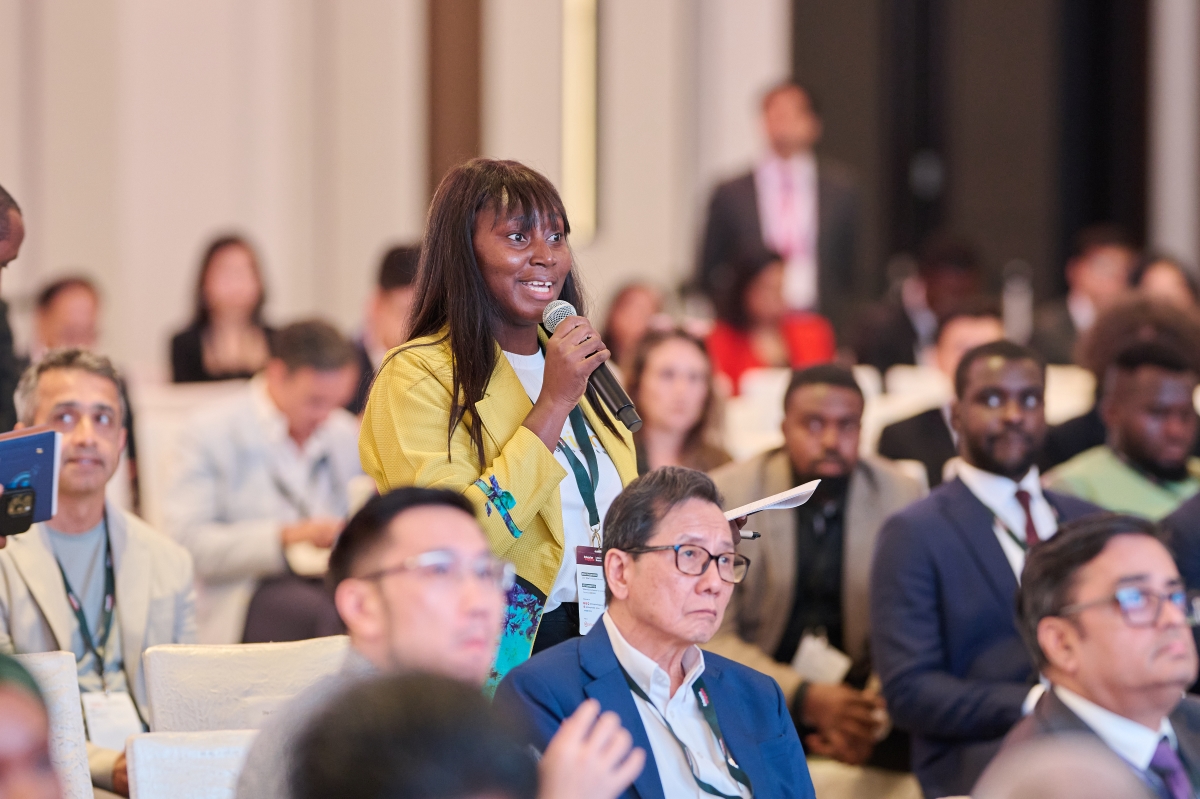 The Africa Singapore Business Forum (ASBF) is organised biennially by Enterprise Singapore. It is the premier platform for business exchange and trade between Africa and Asia. The eighth edition featured other high-level sessions on Building Africa’s Urban Future and Africa’s Green Frontier: Navigating Energy Transition and Carbon Markets.
As the official knowledge partner, the NTU-SBF Centre for African Studies provides research and insights to shape meaningful dialogue that helps businesses navigate Africa’s consumer transformation.