What if AI can help realise your data’s potential? | Assistant Professor Zhimin Chen
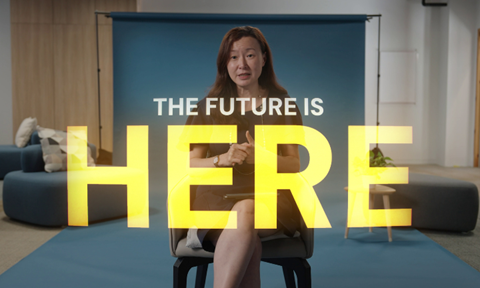
In Episode 4 of Nanyang Business School’s “What If” video series, Assistant Professor Zhimin Chen, from the Division of Finance at NTU’s Nanyang Business School (NBS), explores the limits of machine learning in financial prediction, addressing the challenges of model complexity and how business leaders can avoid the next “AI winter”.
Tuning the Radio: The Frustration of AI Investment
Today, venture capitalists, hedge funds, and entrepreneurs are pouring massive resources into training AI models to predict customer demand, supply chain defaults, and financial market returns. However, the initial results are often underwhelming. When models fail to perform, business leaders face a critical dilemma: should they invest more resources into the project, or abandon it entirely?
Assistant Professor Zhimin Chen compares this challenge to tuning an old radio.
"Think about it like you are tuning a radio, and most likely you hear some static; you cannot hear the broadcast," says Asst Prof Chen. "You might wonder whether it's because the signal is very noisy and you just tuned it for a very short period, or if it's because there is no broadcasting there at all. It's very similar for business leaders in the AI area... they don't know how long they should tune the radio."
Without knowing if a true signal exists in their data, companies risk losing confidence in their AI initiatives, leading to premature project abandonment.
Diagnosing the Signal: A Universal Measure of Potential
To solve this, Asst Prof Chen and his co-authors developed a universal diagnostic tool using random matrix theory. Their research provides a mathematical “lower bound” of predictive power (measured via out-of-sample R-squared). In simple terms, it calculates the minimum potential signal hiding within a company's data.
In the highly competitive world of finance, even a tiny advantage is highly lucrative.
- The Perception: Many hedge fund managers believe there is only a 2% or 3% predictive power available in predicting the US equity market relative to historical benchmarks.
- The Reality: Asst Prof Chen’s research reveals that the actual predictive potential is at least 20%.
Currently, the industry lacks the models to fully realise this 20% potential. However, by running data through this diagnostic package (which Asst Prof Chen's team has made available via GitHub), business leaders can accurately assess if the static is due to a lack of signal, or simply a noisy model. This provides the mathematical confidence needed to justify continued investment.
The Double Descent and the Threat of an AI Winter
A core reason many AI initiatives stall is a misunderstanding of how machine learning models scale. In traditional machine learning, there is a known bias-variance tradeoff: as a model becomes more complex, its performance often decreases initially due to overfitting.
However, in advanced deep learning across fields like computer vision and natural language processing, researchers have observed a phenomenon known as double descent. If you continue to train the model and scale its complexity past that initial degradation, performance eventually rebounds and improves exponentially.
“In my personal view, we are far from the double descent phase in finance,” Asst Prof Chen explains. “Many people just lose confidence in this first phase... The biggest worry now is whether we can prevent the next AI winter, basically when we give up too early. We just stop training too early.”
Human Talent as the Ultimate Accelerator
If significantly more computing power and massive model scaling are required to reach the "double descent", a new problem arises: GPUs are incredibly expensive, and computing power is a fiercely competitive constraint.
This is where the debate of Man-vs-Machine shifts to Man-plus-Machine.
While a massive model might eventually find the signal on its own, it is highly inefficient. Human financial experts play a critical role in accelerating the process by aligning the model directly with the reality of the data.
- Teasing Out Noise: Human expertise is required to filter out the irrelevant data noise before it even reaches the model.
- Accelerating Discovery: By using human intelligence to better align the data and the problem, companies can reach the double descent phase much faster than relying on compute power alone.
“In a competitive world, companies with more human talent will be much faster,” Asst Prof Chen emphasises. “They can make us achieve the potential much quicker, and they can have a huge edge against their competitors.”
Why AI is a Tool, Not a Bubble
With the rapid influx of capital into AI, comparisons to the early 2000s dot-com bubble are inevitable. However, Asst Prof Chen views the current landscape fundamentally differently.
The dot-com boom was driven by the infrastructure of acquiring information: connecting people to the internet. AI, conversely, is not about acquiring information; it is a revolutionary tool used to process information. Because it fundamentally changes how data is synthesised and acted upon, its intrinsic value to financial and economic systems is structural, not speculative.
The mandate for financial institutions is clear: keep investing, do not give up during the initial static, and hire top-tier human talent who can properly align complex models with messy, real-world data.