NBS Knowledge Lab Webinar: AI & the Future of Global Trade
This webinar examined how AI is beginning to reshape global trade by helping firms navigate fragmented data, regulatory complexity, compliance risks and new opportunities for competitive advantage.
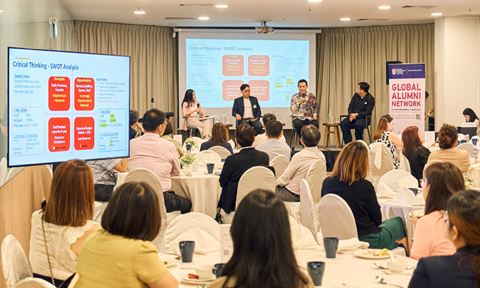
On 29 September 2026, the NBS Knowledge Lab hosted a webinar on “AI & the Future of Global Trade”. Moderated by Associate Professor Tan Joo Seng from the Division of Strategy, International Business and Entrepreneurship at Nanyang Business School, the session featured Eric Tan, CEO and Founder of CWH International, and Penny Chen, CEO of Pax Solutions Inc.
Drawing on perspectives from trade advisory, technology and industry practice, the speakers explored a deceptively simple question: what is really changing in global trade, and where can AI genuinely create value?
Key Takeaways
1. AI will not simplify global trade, but it can help firms manage complexity betterGlobal trade remains shaped by tariffs, customs compliance, documentation, supply chains and different regulatory systems. AI does not remove these structural challenges. Instead, its value lies in helping firms process fragmented information faster, identify patterns and make better decisions in complex trade environments.
2. The biggest opportunity lies in fragmented, high-volume trade data
Trade data is often scattered across countries, entities, systems and departments. This makes it difficult for companies to identify duty savings, compliance issues or operational inefficiencies. AI is especially useful when it can analyse large volumes of import-export data, flag errors, surface opportunities and turn manual review processes into faster, more accessible insights.
3. Regulatory volatility creates risks, but distinct trade mechanisms can also create opportunities
Changing tariffs, duty drawback rules, tariff refund opportunities and preferential tariff treatment under free trade agreements can each affect trade costs in different ways. Eric highlighted that firms need to understand these mechanisms clearly, rather than treating them as interchangeable, and use data and expertise to identify where real value can be captured.
4. AI adoption is not just about technology – it is also about redesigning workflows
The session showed that AI creates value only when it is embedded into how organisations work. This includes redesigning processes, reallocating human effort and deciding where AI should support analysis, execution or review. For example, AI may reduce the time spent producing code or analysing data, while increasing the need for human review, validation and quality control.
5. Human judgement remains essential in high-trust and regulated areas
Both speakers stressed that AI should not fully replace human accountability in trade compliance. In areas involving regulatory exposure, licensing requirements, financial risk or government engagement, human review remains critical. AI can recommend, automate and accelerate, but accountability still rests with individuals, teams and organisations.
6. Competitive advantage comes from how firms use AI, not simply from having access to it
As AI tools become widely available, access alone will not be enough. Advantage will come from how well firms combine AI with proprietary data, domain expertise, talent, agile workflows and regulatory relationships. Organisations that integrate AI effectively into their operations and learn how to use it well will be better positioned than those that simply adopt the tools superficially.
7. Experimentation is now a strategic capability
A recurring message from the session was to “try it”. Businesses do not need to begin with large-scale transformation. They can start by testing AI on practical use cases such as market sizing, demand forecasting, pricing, inventory planning, trade compliance or duty optimisation. The more organisations experiment, the more they build confidence, proficiency and practical understanding of where AI genuinely adds value.
Access the full article here.
-(1).tmb-listing.png?sfvrsn=58da16d6_1)