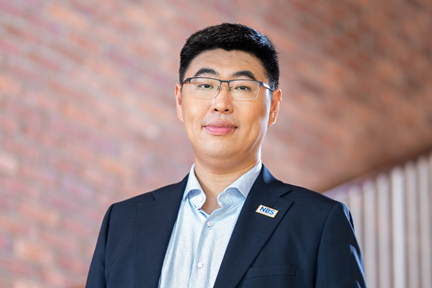
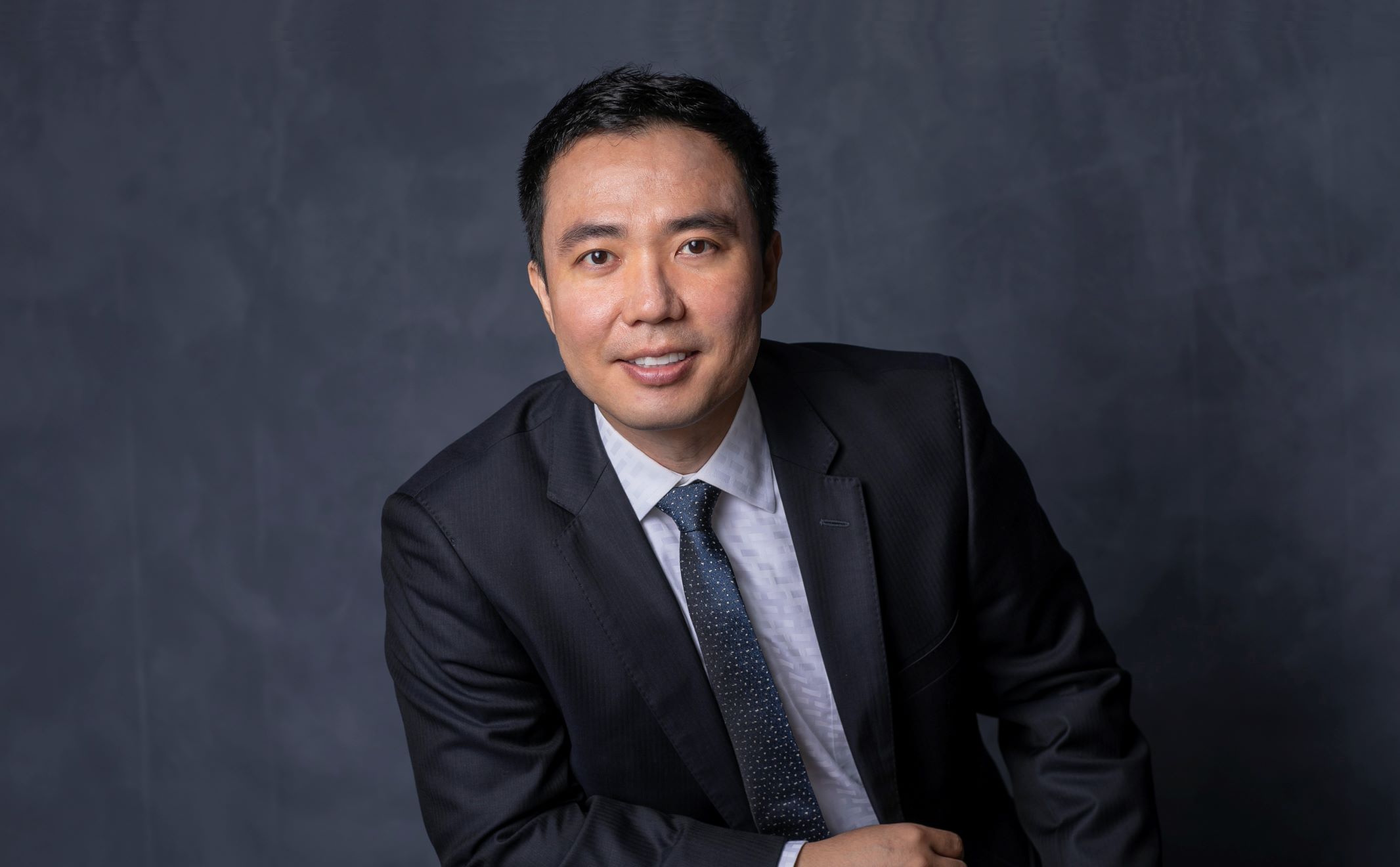
Meet Prof Will Cong
President’s Chair Professor of Finance, Computing and Data Science, and Associate Dean of Nanyang Business School.
One of the world's leading scholars in AI and financial economics has chosen NBS. Here's why.
Prof Will Cong joins Nanyang Business School (NBS) from Cornell University, where he served as the Rudd Family Professor of Management and Finance and led the FinTech Initiative. Having previously lived in Singapore, he is delighted to return and contribute to NTU’s strengths in technology and innovation. He will head GIFTS, the Global Institute of Finance, Technology and Society, a new research institute bringing together scholars, policymakers, and industry to tackle the most consequential challenges at the intersection of finance, technology, and society.
Read on to find out what drew him to NBS, what excites him about AI and digital finance, and why he believes Asia will define the next generation of economic systems.
What drew you to NBS?
What drew me to NBS was first and foremost the people. The leadership and faculty here are among the very best globally, and they are not only outstanding scholars but also generous and collaborative colleagues. Dean Jun Yang has both the vision and the determination to take NBS to the next level, and she works tirelessly to integrate the school within the broader NTU ecosystem. The close collaboration with the university president and other college deans, such as Dean Luke Ong at the College of Computing and Data Science (CCDS), creates a rare level of institutional alignment.
NBS is also uniquely entrepreneurial and interdisciplinary. It is deeply integrated with other colleges, open to industry and policy partnerships, and forward-looking in launching AI initiatives and joint PhD programmes. With my joint appointment at NBS and CCDS, I see firsthand how few places in the world offer this kind of platform for serious interdisciplinary research in business and social science. It is a perfect fit for my research interests and for advancing business research in general.
Importantly, NBS has managed to avoid the inertia that can accompany long-standing institutions. It is pragmatic, solutions-oriented, and focused on impact. At the same time, it remains collegial, respectful, and committed to equity and shared progress. This balance between performance and community is one of its greatest strengths.
Finally, Singapore, and Asia more broadly, are at a historic inflection point. The region has the talent, institutional support, and policy vision to lead in AI for business and social science, digital economy, financial technology, and transdisciplinary innovation, in ways that we have not seen before in academia or the industry. NTU and NBS are positioned not just to participate in that transformation, but to help shape it. I would regret not contributing to this effort.
Your work spans AI for social science, finance, sustainability, economic decision-making, to name a few. What excites you most about where these fields are heading?
I am excited by how AI and digital technologies are transforming both the substance and the methodology of business and economic research. This is a golden era for AI for social science and business research. We are also moving toward what I would call an agentic economy, and perhaps increasingly an on-chain economy, where algorithms and AI systems are not just tools, but economic actors interacting with humans and institutions.
This presents enormous opportunities, but also significant challenges and risks. Technology is reshaping markets, governance, and social coordination in profound ways. As researchers, we have the responsibility not only to analyse these changes but to help design systems that are robust, inclusive, and beneficial to society.
Traditionally, economists have typically taken a back seat. I am particularly excited that economists and business scholars now have a genuine opportunity to contribute at the frontier alongside computer scientists and data scientists. These are interdisciplinary challenges, and they require economic thinking about incentives, institutions, and equilibrium. That intellectual expansion of the profession is deeply energising to me and given my training and interest, I also feel the responsibility to advance and elevate the field.
What excites you most about Asia’s role in the future of finance and technology?
Asia is at a moment of strategic opportunity. Historically, some regions developed through incremental innovation, moving from one step to the next. Today, Asia has the capacity for what we might call “弯道超车,” or leapfrogging on the curve — using new technologies to redefine systems rather than merely catching up within existing ones.
China, for example, combines market scale with increasing commitment to original innovation, not only scaling existing models but pushing from zero to one in areas such as digital platforms, fintech infrastructure, and AI deployment. That scale creates powerful experimentation environments for new economic architectures.
Singapore also occupies a unique position. As a smaller nation with limited land and population, it cannot rely on physical scale — but it can lead in digital scale and intelligent design, leveraging AI, digital infrastructure, and institutional coordination to overcome structural limitations. Singapore can serve as a laboratory for high-quality innovations and governance in an AI-enabled economy.
Across Asia more broadly, there is an extraordinary pool of diligent, mathematically strong, and technologically sophisticated talent. The human capital foundation is remarkable and still proves critical even in this agentic era.
What excites me most is that Asia is not simply participating in global technological change; it is increasingly helping define how finance, markets, and digital systems will function in the decades ahead.
How would you explain your research to a non-expert in one sentence?
I study how information, incentives, and technologies like AI and digital platforms reshape economic systems, financial markets, and the way humans, and increasingly machines, make decisions and innovate.
Outside of research, what helps you recharge?
Research has always been a deep passion for me, so I naturally spend a great deal of time thinking and writing. But I’ve learned that intellectual sustainability requires stepping back. I recharge through listening to music and reading — faith, history of science, and occasionally fiction — which help me reflect more broadly about technology, institutions, culture, and long-run societal change.
I also make a conscious effort to stay physically active. I used to be intensely engaged in sports and crossfit, and I am now gradually rebuilding that routine, spending time training and picking up squash and golf again, my favourites in college and graduate schools. Physical activity helps me reset mentally and maintain perspective.