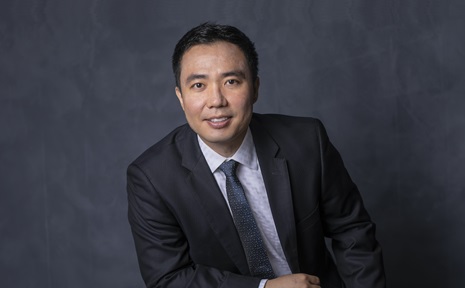
Meet Prof Hao Liang
President’s Chair Professor in Finance
.png?sfvrsn=74a0de3f_1 "MEET Prof Hao Liang (1)")
A leading voice in sustainable finance and business impact has chosen NBS. Here's why.
Professor Hao Liang joins Nanyang Business School (NBS) as President's Chair in Finance, bringing with him a distinguished track record at the intersection of finance, sustainability, and business. At NTU, Prof Liang will lead an upcoming university-wide interdisciplinary research institute focusing on sustainable finance and impact, bringing together expertise across business, finance, accounting, environmental science and engineering to strengthen NTU's leadership in responsible business and sustainability.
From climate change and economic resilience to the rise of AI and the transition economy, Prof Liang believes Asia is uniquely positioned to shape the future and hopes to advance research that not only creates financial value, but also delivers measurable benefits for society and the environment.
Read on to discover what brought him to NBS, why he believes Asia will lead the next chapter of sustainable development, and how business can become a force for meaningful impact.
What drew you to NBS, and what excites you the most about leading the new Institute for Business Impact at NTU?
What drew me to NBS and NTU was the opportunity to build something ambitious and genuinely interdisciplinary. Many of today’s most pressing challenges – from climate change and economic resilience to inequality and technological disruption – cannot be addressed by businesses alone. They require collaboration among business scholars, scientists, engineers, policymakers, and practitioners.
What excites me most about leading the upcoming interdisciplinary research institute focusing on sustainable finance and impact is the opportunity to create an Asia-rooted, globally connected platform that brings these communities together. The Institute will study not only how businesses create financial value, but also how markets, finance and enterprise can generate meaningful and measurable impact for society and the environment, particularly in Asia and the Global South.
Your work bridges finance, sustainability, and business. Which emerging developments do you think will have the greatest impact on these fields in the years ahead?
One important development is the shift from broad sustainability commitments towards credible transition plans and measurable outcomes (i.e., impact). Investors, companies and governments are increasingly asking not only whether an activity is labelled “green”, but whether it contributes to real-world decarbonisation, resilience and societal impact.
At the same time, advances in artificial intelligence, satellite imagery, and alternative data are transforming how we measure corporate activities and their environmental and social consequences. Nature and biodiversity are also becoming increasingly important alongside climate change. Together, these developments will make sustainable and impact finance more rigorous, data-driven and closely connected to real economic transformation.
What opportunities do you see for Asia in the transition economy, and what role can business schools play?
Asia is at the centre of the global transition. It is home to many of the world’s fastest-growing economies, manufacturing and supply-chain networks, and a large share of future energy and infrastructure investment. This creates both significant challenges and enormous opportunities to develop practical solutions in areas such as transition finance, blended finance, carbon markets, resilient supply chains, and nature-positive businesses.
Asia should not simply follow models developed elsewhere. It can create approaches that reflect the region’s own economic structures, development priorities, and institutional contexts.
Business schools can play an important role by producing credible research, developing future leaders, and convening businesses, investors, governments, and researchers. They can help translate new technologies and scientific knowledge into viable business models, investment strategies, and public policy solutions.
If you had to describe your research to someone outside of academia in one sentence, what would you say?
I study how finance, markets, and business decisions can be designed to create measurable benefits for society and the environment while remaining economically viable.
Outside of work, what do you enjoy doing to unwind and recharge?
I enjoy travelling, experiencing different cultures and cuisines, and spending time with family and friends. I also find that a good walk provides valuable space to reflect and occasionally generates new research ideas.