'Money won't last, but education will'
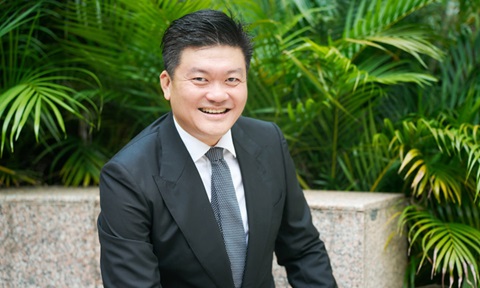
Paeonia Group founder and NTU Board of Trustees member Alice Yin Hung made it in life. Now, she’s helping others make it.
Text: Kenny Chee

A firm believer in education, Ms Alice Yin Hung’s commitment to supporting the education of others came full circle during the COVID-19 pandemic.
When the entrepreneur and founder of Paeonia Group was visiting her father in a hospital in Hong Kong, the nurse attending to him asked if she was Ms Hung before thanking her.
The nurse explained that she had earlier gotten a scholarship from Ms Hung at Hong Kong’s Tsuen Wan Government Secondary School so that she could become a nurse.
“It was a surreal moment when the nurse came forward to thank me. The whole experience warmed my heart and reaffirmed my belief in giving,” says Ms Hung.
“It convinced me to continue helping others reach their potential, so they too can uplift even more people in the future. By providing scholarships to deserving individuals through Paeonia Foundation, I aim to build on the legacy inspired by my parents.”
Paeonia Foundation is the philanthropic arm of Paeonia Group. The group is a family office and an international investment holding company.
Helping others succeed
Now a Singapore permanent resident and a member of the NTU Board of Trustees, Ms Hung’s experiences encourage her to help others make it in life through education.
That is one of her priorities for Paeonia Foundation, which is also focused on advancing science and technology, as well as helping underprivileged families.
One of the foundation’s major goals is to also recognise achievements in science and medicine by setting up a prize in the future that is rooted in Singapore but has global reach.
“Money won’t last, but education will. As long as you are capable, you can go anywhere without fear,” says Ms Hung.
Through Paeonia Foundation, Ms Hung pledged S$5 million to NTU in February last year to support its education and research endeavours.
The University will use this gift to set up a new Professorship in Science and Technology to attract and train research talent, with a portion going towards advancing NTU's strategic initiatives in science, technology and business.
Ms Hung's dedication to education stems from her own life story. Inspired by the innovation she saw in an American mail-order catalogue in the days before the Internet, she wanted to leave Hong Kong to study in the United States.
But her father initially objected. Just 14 then, Ms Hung did not know her family had enough money to pay for only one year of fees at a US high school.
Times were tough and the family of five, including Ms Hung’s maternal grandmother, once lived in a cramped 80-square-foot room in Hong Kong’s Tsuen Wan district.
When she broached the subject of studying in the US, her father argued that she could enrol in a local university. But her mother was adamant on fulfilling Ms Hung’s dream.
“My mother said: ‘She’s going to make it. And when she makes it, we will all make it.’ My mother had faith in me,” recounts Ms Hung.
And she made it.
After she graduated from the University of Pennsylvania with a dual degree in finance and economics, Ms Hung founded, among other companies, a successful Asian business distributing laboratory analytical and testing equipment. She also invested in deep technology startups and real estate globally.
 Ms Hung’s family visiting her (centre) in the US after she graduated from university. (Photo: Alice Hung)
Since Ms Hung’s relocation from Hong Kong to Singapore in 2020, these businesses have come under Paeonia Group, which is headquartered in Singapore.
'It's their life, not mine'
Like her parents, Ms Hung does not want to dictate what her two teenage children pursue in life.
Unlike many business owners, grooming her kids to take over her business is not on the cards, unless they want to and are capable enough.
Passing fortunes to future generations does not sit well with her too. Instead, Ms Hung plans to give most of her wealth away through Paeonia Foundation by the end of her entrepreneurship journey.
She wants her children to be able to make it out on their own and appreciate the process.
“Many Asian parents think they ‘own’ their kids. But I don’t ‘own’ my children. It’s their life, not mine,” she explains.
“As my mother said to my father: If I’m going to make it, we will all make it. Why wouldn’t I want my children to make it, so that I can make it?”
This article first appeared in issue 6 of U, the NTU alumni magazine.