
From Vision to Impact: Economics That Shapes Real-World Decisions
Singapore’s economic success was built on bold decisions, careful planning, and a deep understanding of trade-offs.
Few embodied this more than Albert Winsemius, whose work helped lay the foundation for the nation’s growth. Today, that legacy continues through the Albert Winsemius Professorship in Economics at NTU.
Established in 1997, the Albert Winsemius Professorship honours the Dutch economist who first came to Singapore in 1960 as part of a United Nations Development Programme mission. As a long-term advisor, he played a pivotal role in shaping Singapore’s economic strategy — from fostering a pro-business environment to supporting institutions like the National Wages Council.
His work helped move Singapore up the value chain, balancing growth with stability.
Today, this legacy lives on through Euston Quah, Albert Winsemius Chair Professor in Economics at NTU.
For Prof Quah, economics is fundamentally about navigating trade-offs.
“My work focuses on cost-benefit analysis and environmental economics,” he explains.
(Click here to watch the video)
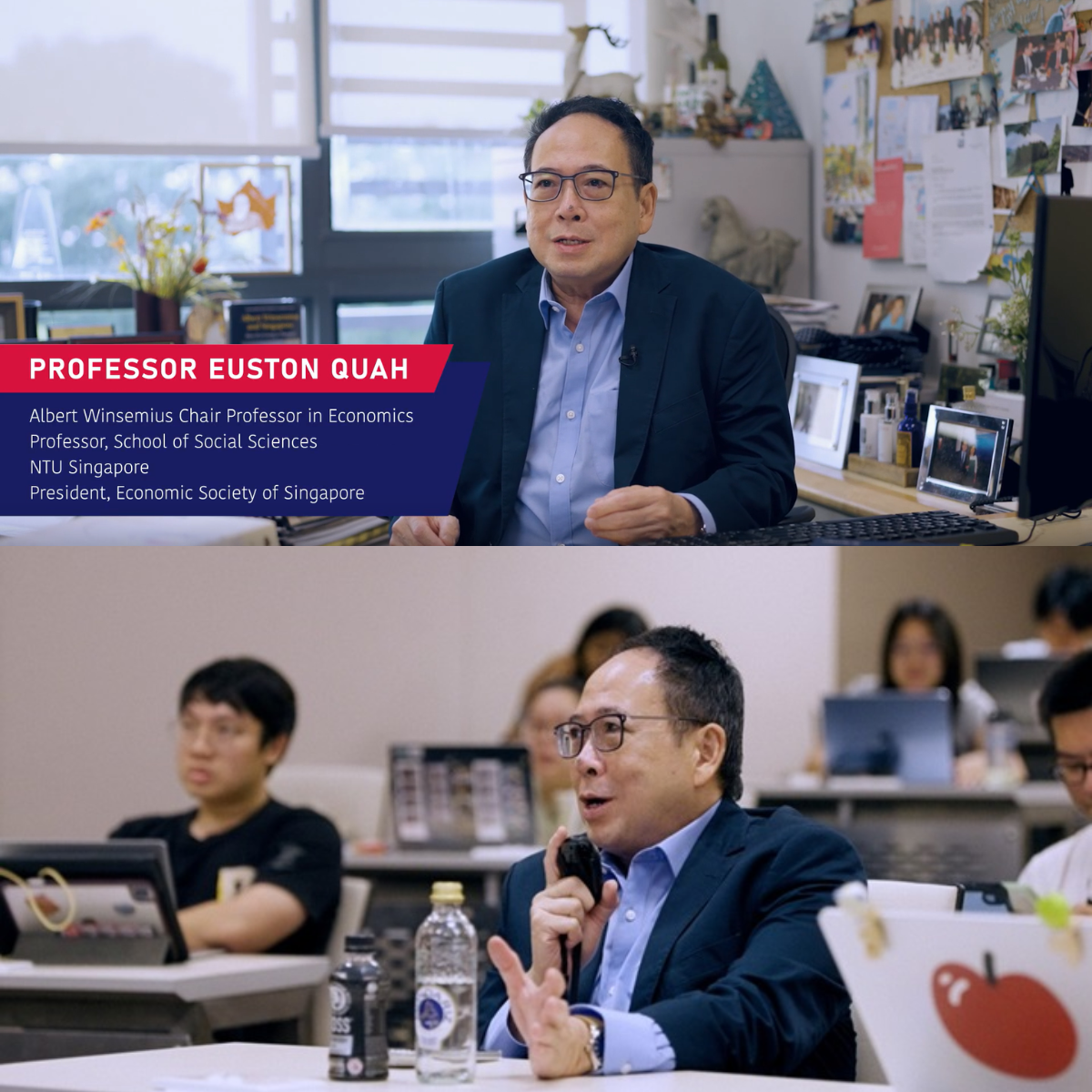
(Prof Quah engaging with students in class)
While cost-benefit analysis may seem straightforward, applying it to national policy is far more complex. Governments must weigh not only financial costs, but broader social outcomes.
Take air quality standards.
Stricter measures can improve public health and productivity, but may also increase costs for businesses and affect competitiveness.
“Assessing these trade-offs is where economic analysis becomes essential,” he says.
Supported by the Professorship, Prof Quah’s work bridges academic research and real-world policymaking, continuing the very principles that guided Winsemius decades ago.
“When advising governments, the foundation must always be sound economics. But in practice, data is rarely perfect. Judgment and careful assumptions are crucial.”
Beyond research, the Professorship enables him to mentor future economists and engage policymakers and industry leaders.
For Prof Quah, the goal is clear. “At its core, the professorship reflects a simple idea: that economics should remain relevant to society, grounded in real decisions and real outcomes.”
8f8cb357-9ccd-496c-99ba-c83a124b10c4.tmb-listing.jpg?sfvrsn=23d5c662_1)
04dbe276-d22d-46c9-8f62-18118dd599e1.tmb-listing.jpg?sfvrsn=d0140a33_1)
3c38eb5d-7939-449a-9383-35bae1b7eb79.tmb-listing.jpg?sfvrsn=91e6058_1)
5d7470bd-299b-41db-a96d-4fe0889e6ba4.tmb-listing.jpg?sfvrsn=da50695d_1)
ff1824ab-e4be-441b-af30-8ed4e4613a88.tmb-listing.jpg?sfvrsn=fbaa8d08_1)
6091cd9e-769e-471d-b16a-1e76879787a7.tmb-listing.jpg?sfvrsn=aeac9683_1)