
Eye contact may act as a learning “switch” for babies’ brains
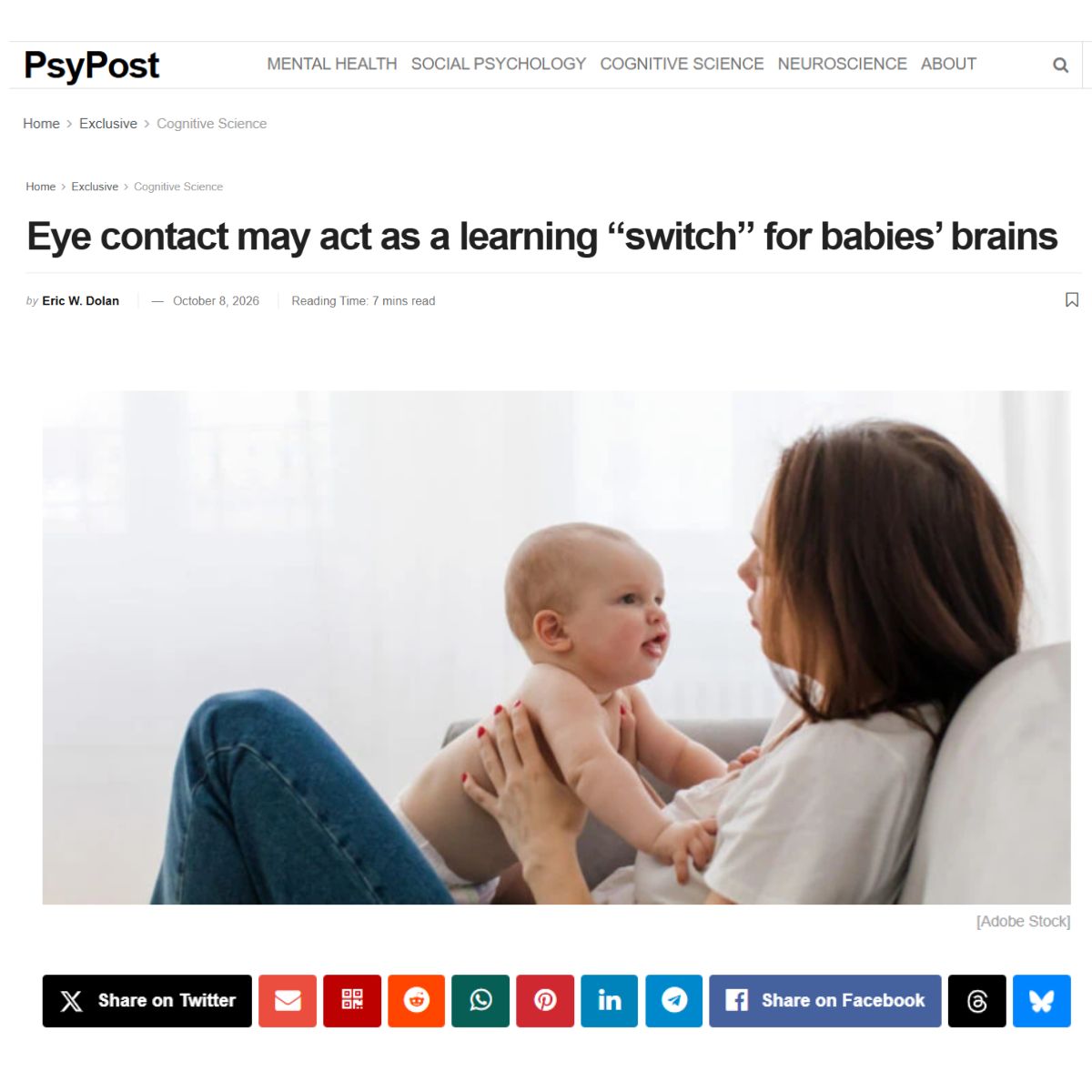
A new study suggests that direct eye contact from an adult speaker guides how infants choose which words to learn by aligning the baby’s brain activity with the adult’s. The research team, which included first author Wei Zhang of NTU and Victoria Leong, a professor in SSS at NTU and the Department of Paediatrics at the University of Cambridge, set out to address the role of shared brain activity in learning. “We had previously published a seminal demonstration that eye contact modulates adult-infant neural synchrony,” Leong told PsyPost. “The current study replicates (across two countries) and extends these findings to show that neural synchrony underpins infants’ selective learning in social contexts.” The researchers tested 47 infants, roughly nine months old, with an average age of 286 days. The infants watched videos of an adult speaking three artificial languages. The speaker’s eyes were either fully visible, partially obscured or completely hidden behind different types of glasses. The researchers found that infants only learned a language when the speaker maintained full eye contact. The researchers also found that when a baby was learning the language, its brainwaves were more likely to align with the speaker's.
Click here to read.


8f8cb357-9ccd-496c-99ba-c83a124b10c4.tmb-listing.jpg?sfvrsn=23d5c662_1)
04dbe276-d22d-46c9-8f62-18118dd599e1.tmb-listing.jpg?sfvrsn=d0140a33_1)
3c38eb5d-7939-449a-9383-35bae1b7eb79.tmb-listing.jpg?sfvrsn=91e6058_1)
5d7470bd-299b-41db-a96d-4fe0889e6ba4.tmb-listing.jpg?sfvrsn=da50695d_1)