From Seeking Recognition to Knowing Ourselves: Professor Xiang Biao on What It Means to “Be Ourselves”
On 22 August 2026, the Nanyang Centre for Public Administration at Nanyang Technological University, Singapore and Lianhe Zaobao jointly organised a public lecture by Professor Xiang Biao, titled Must We “Prove Ourselves” to “Be Ourselves”? Held at the Stephen Riady Auditorium at NTUC Centre, the event brought together about 150 students and participants from NCPA’s six Master’s programmes and executive and professional development programmes, alongside more than 300 Lianhe Zaobao readers.
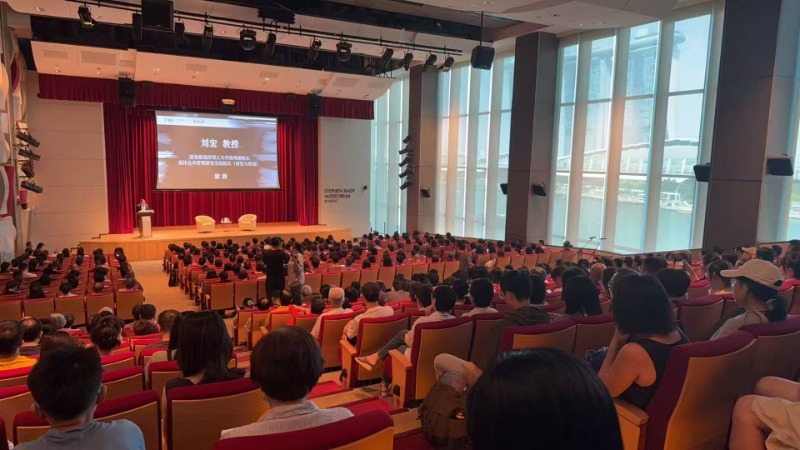
Ms Woo Mun Ngan, Deputy Editor and Head of Features at Lianhe Zaobao, delivered the welcome remarks on behalf of the organisers. Professor Liu Hong, Associate Vice President of NTU and Director (Research and Executive Education) of NCPA, then welcomed Professor Xiang and introduced him to the audience.
Professor Liu highlighted Professor Xiang’s ability to connect academic inquiry with the lived experiences and concerns of contemporary society. Ideas such as “involution” (内卷), “the disappearance of the nearby”(附近的消失) and “suspension”(悬浮) have brought complex social issues into public discussion and offered new ways of understanding the pressures and uncertainties of everyday life.
“Professor Xiang’s work speaks to many of the anxieties of our time. Its impact extends far beyond academia, prompting people to reflect more deeply on their own experiences and on the society in which they live,” Professor Liu said.
87ff0a56482b4b79ab18906ef5700b1e.jpeg?sfvrsn=5fd44131_4 "640 (4)")
Professor Xiang was in Singapore as an NCPA Distinguished Visiting Scholar for a series of academic engagements. During his visit, he also delivered a keynote speech at the “Migration and Governance in Global Asia” International Conference, jointly organised by NCPA, the Centre for Chinese Language and Culture, and the Global Asia Research Centre. The conference brought together more than 30 scholars from different disciplines for discussions on migration, governance and transnational connections.
Professor Xiang, Director at the Max Planck Institute for Social Anthropology in Germany, examined what it means to “be ourselves” in a society where success is often measured against external expectations. He observed that for many young people, the desire to define life on their own terms can become intertwined with a constant need to demonstrate their abilities, achievements and worth to others.
At the heart of the lecture was Professor Xiang’s distinction between two forms of social recognition: “acknowledgement”(认可) and “knowing” (认得). “Acknowledgement” refers to the recognition of an individual’s achievements, often according to established standards or by those in positions of authority. “Knowing”, by contrast, begins with knowing oneself and, in turn, making it possible for others to know you. Compared with waiting to be acknowledged by others, Professor Xiang suggested that “knowing” allows individuals to take a more active role in the process of social recognition.
Professor Xiang also noted that while securing recognition, rights and dignity remains important for women, ethnic minorities, sexual minorities and other groups, people seek more than recognition and respect. They also want to experience a sense of progress and development. He suggested that the same perspective could be extended to how we think about countries and political systems.
Turning to the rise of AI, Professor Xiang asked what role the social sciences could play at a time when AI can generate vast amounts of writing that readily meets established standards of recognition. He suggested that the idea of “knowing” could have relevance beyond academia, including in programme design, corporate management and politics.
The session was moderated by Dr Miao Chunzi, Research Assocate at NCPA. Following the lecture, Ms Hong Yulin, an NTU School of Social Sciences PhD student and NCPA scholarship recipient, joined Professor Xiang for a conversation that explored some of the lecture’s key themes in greater depth.
The floor was then opened to the audience, leading to a lively exchange with Professor Xiang. Questions ranged from the distinction between “acknowledgement” and “knowing” to some of his widely discussed ideas, including “involution” and “the nearby”, as well as the dilemmas and uncertainties people encounter in everyday life. Professor Xiang responded to questions from the audience and offered further reflections on how these ideas might help us understand contemporary social experiences.
The event concluded with a book-signing session, where a long queue quickly formed as audience members waited for the opportunity to meet Professor Xiang. The enthusiastic response brought an engaging afternoon of discussion and exchange to a fitting close.
The link to the Zaobao article is below: https://www.zaobao.com.sg/news/singapore/story20260822-9559308