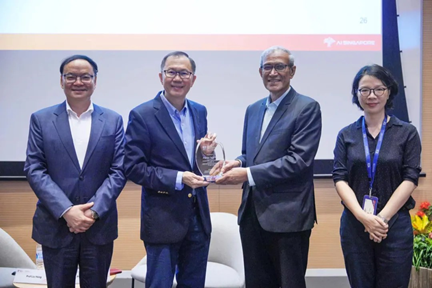
Professor Liu Hong Recognised Among World’s Top 2% Scientists for Seventh Consecutive Year
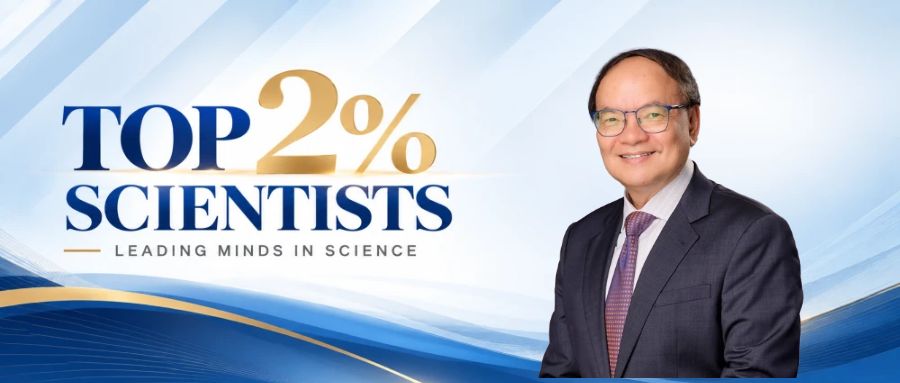
The Stanford–Elsevier World’s Top 2% Scientists List, one of the most widely used benchmarks of research influence, published its 2026 edition on 7 October 2026, identifying the most-cited researchers across every field of science and scholarship. Professor Liu Hong, Associate Vice President (International Engagement) of Nanyang Technological University, Tan Lark Sye Chair Professor in Public Policy and Global Affairs at the School of Social Sciences and Director (Research and Executive Education) at the Nanyang Centre for Public Administration, who also holds a courtesy appointment at the School of Humanities, is once again listed for both “Career-long Citation Impact” and “Single-Year Citation Impact.” He has now been included in the single-year rankings for seven consecutive years and in the career-long rankings for five, a record that speaks to the lasting influence of his work on governance, transnational networks and Global Asia.
Professor Liu’s research brings together cultural analysis, political economy and historical inquiry, and the 2026 results show that reach in full. His single-year composite score places him in the top 0.6% of the 11,619,713 researchers assessed worldwide and, for the first time, within the global top 100,000 across all disciplines — a tier in which scholars from the Social Sciences hold only around 4% of places.
Among the 265,152 social scientists assessed globally, Professor Liu stands in roughly the top 1%. In Cultural Studies — an interdisciplinary subfield spanning globalisation, migration, area studies and questions of power and identity, and the core of his intellectual contribution — he is ranked the 20th among 8,723 scholars worldwide for single-year citation impact (top 0.23%), up from 30th a year earlier, and 61st for career-long impact (top 0.7%).
Set against the thresholds published for each subfield, Professor Liu’s single-year score would also place him within the top 2% in Economics, International Relations, Geography, Anthropology, Development Studies, Political Science & Public Administration and Sociology. He is ranked 11th among 20,299 scholars worldwide in History (top 0.05%), a measure of the historically grounded approach that runs through his work on international governance and Global Asia. Taken together, these results describe a body of scholarship that crosses disciplinary lines and informs international debate on governance and institutional change, and they add to NTU’s growing standing in interdisciplinary social science research centred on Global Asia.
The Stanford–Elsevier list is built from Scopus data and ranks authors by a composite indicator that combines the h-index, the co-authorship-adjusted hm-index and citations to single-, first- and last-authored papers, calculated with and without self-citations. It spans 20 broad fields and 174 subfields and reports both recent and career-long impact. The 2026 edition is based on a Scopus snapshot taken on 1 August 2026; the single-year figures reflect citations received during calendar year 2025 across 11,619,713 authors, and the career-long figures run to the end of 2025.
More information on the selection criteria and methodology of the Top 2% Scientists List can be found: https://elsevier.digitalcommonsdata.com/datasets/btchxktzyw/9 (7 Oct 2026).
Selected recent publications by Professor Liu Hong since 2024:
Journal Articles
Liu, H, Lyu, M., and Wardhana, D., “Asian New Regionalism Revisited: ASEAN–China Interactions in the 21st Century,” The Pacific Review, forthcoming.
Jianan Huang, Cong Cao, and Hong Liu, “Indigenization and Inclusion in Chinese Academia,” Nature Human Behaviour, vol. 10, no. 3 (2026), pp. 492-504.
Hong Liu, Chen Li, and Guanie Lim, “Asia in Flux: Network Power, New Regionalism, and Global Development,” Asia Europe Journal, vol. 23, no. 2-3 (2025), pp. 229-237.
Hong Liu and Yao Chao, “From Infrastructure Space to Network Power: Chinese Cross-border Collaborative Special Economic Zones in Southeast Asia,” Asia Europe Journal, vol. 23, no. 2-3 (2025), pp. 263-284.
Celia Lee, Hong Liu, and Thi Van Cao, “Applying the Singapore Model in Cambodia and Thailand? Implications for Transnational Policy Transfer,” Public Administration and Development, vol. 45, no. 2 (2025), pp. 112-129.
Hong Liu and Miao Chunzi, “Digital Geopolitics in a VUCA World: China Encounters a New Global Order,” Global Policy, vol. 15, no. S6 (2024), pp. 67-83.
Hong Liu, Celia Lee, and Jeremy Goh, “Introduction: Agile Governance for a Volatile, Uncertain, Complex and Ambiguous World,” Global Policy, vol. 15, no. S6 (2024), pp. 5-11.
Hong Liu, Xu Chengwei, and Lim Guanie, “The China Effect on Regional Economic Integration: A Longitudinal Study of Central, South, and Southeast Asia,” Journal of the Asia Pacific Economy, vol. 29, no. 4 (2024), pp. 2110-2132.
Hong Liu and Jeremy Goh, “Emerging Business Transnationalism in Singapore and Greater China: Governance, Networks, and Strategies,” Asia Pacific Business Review, vol. 30, no. 4 (2024), pp. 640-666.
Liu Hong and Zhang Huimei, “Tan Kah Kee and Chinese Business Networks in Southeast Asia,” China Economic Studies, no. 3 (2024), pp. 1-7. [In Chinese].
Liu Hong and Zhang Huimei, “Research on Tan Kah Kee from an Interdisciplinary Perspective,” Journal of Chinese Social and Economic History, no. 2 (2024), pp. 1-6. [In Chinese].
Books
Lim, Guanie and Hong Liu, The Political Economy of Chinese Investment in Southeast Asia (Oxford: Oxford University Press, forthcoming).
Hong Liu, Cheun Hoe Yow, and Huimei Zhang, eds., The Making of Singapore as an Asian Regional Corridor: Historicity, Trade, and Diaspora (London and New York: Routledge, 2026).
Hong Liu, Celia Lee, and Jeremy Goh, eds., ASEAN Centrality and the Revitalisation of Regional Connectivity (Singapore: World Scientific Publishing, 2025).
Liu Hong, The Mobile Borders: Studies in Migration, Culture, and Politics of Identity (Hangzhou: Zhejiang University Press, 2024). [In Chinese].
Hong Liu, Celia Lee, and Jeremy Goh, eds., Governing a Volatile, Uncertain, Complex and Ambiguous World (London: University of Durham and John Wiley, 2024).
Hong Liu, Celia Lee, and Jeremy Goh, eds., Good Governance in the Post COVID-19 World – Global Health and Economic Recovery (Brussels: International Institute of Administrative Sciences, IIAS Public Governance Series, 2023).
Book Chapters
Hong Liu, Cheun Hoe Yow, and Huimei Zhang, “Historicity, Trade and Diaspora in the Making of Singapore as an Asian Regional Corridor: An Introduction,” in idem, eds., The Making of Singapore as an Asian Regional Corridor: Historicity, Trade, and Diaspora (London and New York: Routledge, 2026).
Hong Liu, “The Belt and Road Initiative from the Perspectives of Political Economy and Business Transnationalism,” in Yos Santasombat, Kian Cheng Lee, and Decha Tangseefa, eds., China’s BRI in Southeast Asia: Concepts and Methodologies (Kyoto: Kyoto University Press; Boston: Trans Pacific Press, 2025), pp. 233-266.
Hong Liu, “The Chinese Diaspora in Southeast Asia and the Belt and Road Initiative: With Special Reference to Singapore,” in Yos Santasombat and Kian Cheng Lee, eds., The Impact of China’s Belt and Road Initiative in Southeast Asia (Singapore: Springer, 2025), pp. 47-67.