
Knowledge Hub
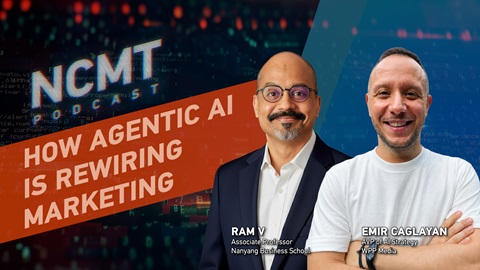
The NCMT Podcast
Technology is rewriting the rules of marketing, rapidly reshaping how we connect, create, and compete. In this new NCMT podcast series, we sit with industry leaders to explore topics at the intersection of marketing and technology. We skip the theory and draw on real-world examples to uncover exactly what these shifts mean for businesses and marketers.
At the heart of every conversation is a simple question: what has changed, what has not, and how can marketers create greater impact with human ingenuity and technology?
Explore our latest articles:
The forgotten experience: What kiosks are teaching consumers to forget
Summary: This article explores the cognitive and neurological consequences of self-service kiosks in retail and service environments. It examines why hyper-streamlined, frictionless user experiences often diminish long-term brand recall and emotional connection, highlighting how the strategic introduction of "meaningful pauses" within automated interactions can help brands remain memorable without compromising convenience.
Read the article here.
This article was originally published by WARC. Shared here for visibility.
How neuroscience explains the power of destination storytelling
Summary: Drawing on consumer neuroscience, this piece examines the emotional and psychological mechanisms that underpin compelling destination marketing. It demonstrates how narrative-driven campaigns activate specific cognitive pathways in prospective travelers, translating emotional engagement into measurable travel intentions and sustained brand equity for destination marketing organizations.
Read the article here.
This article was originally published by WARC. Shared here for visibility.
Can Robots Make a Premium Brand Feel Less Premium?
Summary: Investigating the adoption of frontline service robots across luxury hospitality and retail, this empirical study across seven experiments identifies a key brand vulnerability: robotic automation often erodes perceived exclusivity. Because consumers instinctively associate robotic labor with standardization rather than bespoke, attentive service, premium brands risk degrading their core value proposition unless human-led personalization is preserved.
Read the article here.
When AI Makes Shopping More Efficient, Could It Also Make Us Less Generous?
Summary: Across nine online and field experiments in autonomous retail and hospitality settings, this research analyzes the broader social footprint of friction-free, AI-managed commerce. The authors find that eliminating human service touchpoints consistently dampens consumers' downstream prosocial inclinations, suggesting that hyper-efficient automated stores inadvertently reduce willingness to assist others in everyday social environments.
Read the article here.
The Big Story: Singapore wants less screen time for teens. Can a daily time limit work?
Summary: In response to Singapore's legislative proposals introducing mandatory daily usage caps, stricter age gates, and algorithmic curbs on youth social media consumption, Professor Gemma Calvert unpacks the behavioral realities of digital regulation. The discussion assesses the practical challenges of platform enforcement, user privacy safeguards, and whether top-down restrictions can fundamentally alter digital consumption habits among teenagers.
Listen to the podcast here.
This podcast was originally published by SPH Media (The Big Story). Shared here for visibility.
How brands can escape the social trap
Summary: Associate Professor Ramanathan Vythilingam critiques the pervasive industry myth of social networks as organic community hubs, cautioning brands against over-investing in vanity metrics and ephemeral viral trends. Instead, the analysis outlines a commercial framework tailored for low-attention audiences, focusing on structured paid distribution, persistent brand visual assets, and rigorous commercial performance attribution.
Read the article here.
This article was originally published by WARC. Shared here for visibility.
CNA938 Rewind – One click to sign up – why is cancelling so difficult?
Summary: NBS Adjunct Professor Lynda Wee breaks down the deceptive architecture of digital "cancellation traps" and subscription churn management. The discussion uncovers the cognitive friction and deliberate behavioral nudges that modern digital service providers deploy to impede consumer exits, alongside practical consumer strategies to counteract these retention tactics.
Listen to the podcast here.
This interview was originally broadcast on CNA938 (Singapore Today). Shared here for visibility.
CNA Deep Dive Podcast: Flash sales and countdown timers keep you buying – can we outsmart these tactics?
Summary: NCMT Director Sharon Ng examines the pervasive deployment of digital "dark patterns" in e-commerce, such as artificial scarcity countdowns and algorithmic flash sales. The conversation dissects how this engineered urgency cues exploit cognitive vulnerabilities to trigger impulse purchasing, offering frameworks for shoppers to identify manipulative interface designs.
Watch the podcast here.
This episode was originally published on CNA Deep Dive Podcast. Shared here for visibility.
The Illusion of Influence: What’s broken in Influencer Marketing and How to Fix It
This paper explores the disconnect between influencer marketing hype and actual business ROI through the lens of AI-driven consumer research and media performance data. It argues that campaign failures—seen in low brand recall and high skip rates—are driven by a three-second attention threshold, growing consumer skepticism toward scripted endorsements, and the algorithmic shift toward "Interest Media." Ultimately, the authors contend that for marketers to successfully drive long-term impact, they must stop chasing vanity metrics and instead prioritize early brand visibility, educational "testaments," and strategic paid amplification.
PDF: here.
This article was originally published by ESOMAR. Shared here for visibility.
From punk to platforms: The neuroscience of rebellious branding
This article explores the enduring appeal of the punk aesthetic among Gen Z through the lens of neuroscience and behavioural psychology. It argues that punk’s resurgence—seen in the popularity of brands like Vivienne Westwood and Dr. Martens—is driven by dopamine-fueled anticipation, “psychological reactance” against conformity, and the activation of mirror neurons that make rebellion contagious. Ultimately, the authors contend that for marketers to successfully tap into this anti-authoritarian ethos, they must recognise that punk cannot simply be scaled as a fashion trend; it must remain a deeply personal symbol of identity and choice.
Read the article here.
This article was originally published by WARC. Shared here for visibility.
Enhancing Content Marketing with Generative AI: Overcoming Challenges for SMEs
Generative AI offers Singapore’s SMEs a powerful way to scale content production, yet recent public backlashes against global brands serve as a cautionary tale against losing authenticity. Drawing on insights from Meta’s CMO Alex Schultz during his visit to Nanyang Business School, this article explores practical strategies for SMEs—from navigating copyright risks to enhancing sensory marketing—ensuring that AI functions as a capability amplifier rather than a replacement for human creativity.
Read the article here.
Spotify: From streaming service to cultural soundscape
In this article, the evolution of Spotify from a simple streaming service into a powerful cultural and strategic engine is examined. It highlights how the platform leverages deep insights into listening behavior to create mood-driven targeting and ritualized experiences. The piece explores audio as one of the last uncluttered mediums for emotional connection and discusses how brands can shift from mere visibility to using "sound as strategy."
Read the article here.
This article was originally published by WARC. Shared here for visibility.
Viral today, forgotten tomorrow: The Moment Economy shows limits to trend-jacking marketing
In this article, Professor Gemma Calvert and Gita De Beer examine the rise of the "Moment Economy," where brands increasingly prioritize short-lived viral trends over long-term equity. They explore how the digital landscape rewards speed and novelty, often at the expense of trust and reliability—factors that behavioral economics suggests are crucial for sustained consumer commitment.
Read the article here.
This article was originally published on The Straits Times. Shared here for visibility.
Why creative quality needs a rethink in the age of GenAI
In this article, Associate Professor Ramanathan Vythilingam shares his view on the explosion of GenAI-driven content and the challenges brands face when traditional ad testing methods can no longer keep pace. He explores the necessary shift from conventional pretesting to continuous, post-launch evaluation at scale, and discusses how organizations can leverage predictive AI to maintain creative quality and adhere to best practices.
Read the article here.
This article was originally published by WARC. Shared here for visibility.
Being Talked about Is Not Always Good for Brands
Is all PR good PR? In today’s hyper-sensitive digital world, being "talked about" can actually be a brand's worst nightmare. In this article, Associate Professor Ramanathan Vythilingam explores the thin line between earned media success and brand backlash. He provides a framework for marketers to understand brand legitimacy, navigate social sentiment, and ensure campaigns drive business results rather than just buzz.
Read the article here.
PDF: here
This article was originally published by Greenbook. Shared here for visibility.
Australia’s Teen Social Media Ban - Could Singapore be next?
Australia recently drew a bold line in the digital sand, becoming the first country to enforce a ban on social media for children under 16. The move has ignited a global conversation, forcing societies to confront the complex relationship between youth wellbeing, online safety, and the powerful role technology plays in shaping modern childhood. As the world watches, this policy serves as a critical case study for other nations, including Singapore, as they navigate their own digital safety landscapes. In a recent interview, NCMT’s Deputy Director, Professor Gemma Calvert, joined Money FM 89.3’s Breakfast Show to unpack the implications of Australia’s approach.
Listen to the podcast on Awedio here.
This podcast was originally published by SPH Media Limited. Shared here for visibility.
CNA Commentary: To stop ‘dark patterns’, consumers need more than just warnings
NCMT Director Sharon Ng writes a commentary for Channel News Asia on Jan 14, 2026. In this commentary, she shares her view on the rise of misleading online selling practices and the need for stronger consumer protection.
Read the commentary here.
This commentary was originally published by Channel News Asia. Shared here for visibility.
AI Won’t Replace Marketers—But It Will Replace Marketing-as-Usual
If you work in marketing, the ground under your feet is moving—fast. In a live panel at NTU, three industry leaders cut through the hype: Krishnan Menon (Managing Director, R/GA), James Breeze (CEO, Research Network), and Melvyn Tan (Entrepreneur & Co-founder, Befinity AI). Their verdict? Generative AI is rewriting the playbook—from research and production to capability building and legal risk. The marketers who thrive will be those who go upstream: inventing the brief, shaping the strategy, and designing the future—while machines accelerate the rest.
Read the article here.
Holding AI to its promise – Outcomes that balance Efficiency and Effectiveness
The last 5-10 years have seen significant change, with the evolution of Artificial Intelligence and its increasing applications in every field. While there is optimism for an overall net positive business impact and betterment of society, it is counter-balanced by pessimism linked to the impact on the role of Humans and the depreciating value being placed on Human effort. This has been the narrative for a while – at least the last 5+ years, when Machine Learning, Neural networks, and other advancements were gaining ground. With the introduction of ChatGPT in November 2022, the reality is even more accelerated. In this short period of time, the world does seem a very different place – it is as if we could demarcate a BC (Before ChatGPT) and AC (After ChatGPT) eras. While GPTs were not necessarily new and have been around since June 2018, the democratization of access truly happened with the chat interface. Now anyone can enter a few lines of conversational text, to generate outcomes. This chat functionality has then transcended mere text outputs, and we have text-to-image and text-to-video generating tools – whose quality of outputs is improving by leaps and bounds. They might not be there yet, but they are fast getting there.
Read the article here.
This article was originally published by ESOMAR. Shared here for visibility.
Beyond social media – How to win in the age of interest media
NCMT Associate Professor Ramanathan Vythilingam writes an article for WARC. In this article, he shares his view on the shift from social media to “interest media” and what this change means for brands’ advertising and content strategies.
Read the article here.
This article was originally published by WARC. Shared here for visibility.
The Perils of Influence
NCMT Associate Professor Ramanathan Vythilingam writes an article for WARC. In this article, he shares his view on the rapid evolution of the influencer landscape and the challenges brands face in a space lacking a clear playbook. He explores the history of “influence”—from 20th-century celebrity endorsements to the digital age—and discusses how brands can navigate vested interests to align their strategies with tangible business goals.
Read the article here.
This article was originally published by WARC. Shared here for visibility.
Scroll. Like. Repeat.
The Hidden Cost of Social Media on Young Minds
As policymakers worldwide debate the future of platforms like TikTok, this study delivers urgent, first-person insight into how social media is shaping the brains, behaviours and emotional lives of the next generation. In a joint project by Nanyang Technological University (NTU Singapore), Research Network, and ListenLabs.ai, 583 young people aged 13–25 and their parents from Singapore and Australia were interviewed using an innovative AI-based interviewing platform. Instead of surveys or Likert scales, participants spoke freely and candidly in voice-recorded interviews, revealing how social media affects their attention, emotions, mental health, relationships and sense of self.
Read the article here.
Physiological Self-Tracking Makes People More Likely to Donate Organs
Previous studies have shown that factors such as social marketing as well as people’s place of residence, religious beliefs and body integrity concerns influence their willingness to donate organs. Yet many questions remain. Our recently published research into body perception and self-identity indicates that self-tracking of the body’s physical status (e.g. through wearable monitoring devices) can help individuals dissociate their identity from their body and by so doing, increases their willingness to donate their organs in the event of death.
Read the article here.
Redefining Insights: How AI is Shaping the Future of Social and Consumer Research
This AI-driven platform not only accelerates data collection but also unlocks perspectives that are rarely voiced in conventional research, making it a pivotal tool for fields as diverse as healthcare, public policy and consumer behaviour.
Read the article here.
Leading the Charge: How to Implement Generative AI in SMEs in Singapore
In our first article of this series, "Unlocking the Power of Generative AI: Transforming Marketing for SMEs in Singapore," we explored the immense potential of Generative AI (GenAI) to transform marketing for small and medium enterprises (SMEs). But knowing the benefits is just the beginning. Incorporating GenAI into your business is not a strategy in itself-it is simply a tool to achieve your broader business goals. The true value of GenAI lies in how effectively you use it to drive meaningful outcomes, whether that’s improving customer engagement, streamlining your operations, or boosting efficiency. One of the key challenges lies in effectively implementing these GenAI tools within your business. In this guide, we will walk you through the steps to successfully lead your GenAI transformation. From setting clear goals to overcoming common challenges, you’ll learn how to implement GenAI to drive growth and efficiency of your processes.
Read the article here.
Unlocking the Power of Generative AI: Transforming Marketing for SMEs in Singapore
Are you running a small-medium enterprise (SME) in Singapore and feeling the pressure from competitors using advanced technologies to personalize marketing and engage customers? You have probably heard the buzz around Generative AI (GenAI) and its potential to transform marketing. This article will guide you through how GenAI can boost your marketing efforts and keep you competitive. First, let’s break down what GenAI really means.
Read the article here.
Digital Humans
The live e-commerce market is booming, set to reach USD 3.9 trillion by 2031. Traditional human hosts are facing competition from virtual digital humans, powered by AI. While digital hosts offer cost efficiency, challenges like the "uncanny valley" effect and legal complexities remain. Collaboration aims to optimize their integration into live commerce, reshaping broadcasting and content production.
Read the article here.
Farmers as YouTubers
In rural India, unnoticed influencers like Yash Jatt and Pramod Prajapati, Indian farmers doubling as YouTubers with millions of followers, are reshaping agricultural knowledge-sharing. Coupled with tech startups like Carnot and Niqo, leveraging IoT and AI, rural India's transformation into a hub of innovation presents significant economic opportunities, demanding attention from global managers and businesses.
Read the article here.