
Learning Uncertainties for Safe Control: Theory and Applications
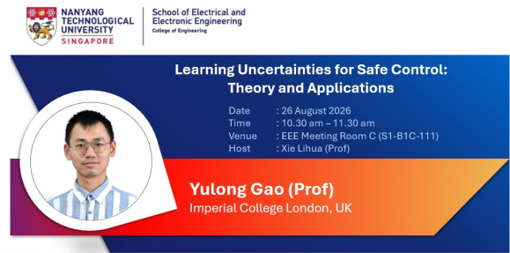
26 Sep 2026
10.30 AM - 11.30 PM
EEE Executive Seminar Room (S2.2-B2-53)
Public
Professor Yulong Gao
Imperial College London, UK
Host: Xie Lihua (Prof)
Abstract:
Uncertainties are inevitable for control of dynamical systems of practical relevance. The safety boundary of the systems is sensitive to the uncertainty size. A fixed and over-approximation of the uncertainty set may lead to conservative solutions. In the first part of this talk, we will present new data-driven methods to learn uncertainty sets in real time, with provable guarantees. We will first show how to embed the learned sets in the tube model predictive control. These learned uncertainty sets can be adaptively used to update the tube, without increasing the online computation complexity. In the second part of the talk, we exploit these methods for safe motion planning in dynamic environments. We develop efficient, robust, and safe motion-planning algorithms that integrate real-time learning of the obstacle uncertainties. These algorithms can naturally capture the control intention in the multi-agent systems. We demonstrate our results in both simulations and hard-ware experiments.
Biography:
Yulong Gao is an Assistant Professor at the Department of Electrical and Electronic Engineering, Imperial College London. He received the B.E. degree in Automation in 2013, the M.E. degree in Control Science and Engineering in 2016, both from Beijing Institute of Technology, and the joint Ph.D. degree in Electrical Engineering in 2021 from KTH Royal Institute of Technology and Nanyang Technological University. He was a Postdoctoral Researcher at KTH from 2021 to 2022 and a postdoctoral researcher at Oxford before joining Imperial College London. His research interests include formal verification and control, machine learning, and applications to safety-critical systems.
Source note: The supplied biography screenshot is partially obscured near the bottom; the text above follows the legible content and preserves its stated research focus.