Start-ups funding dynamics continue to shift
Q1 2026 start-up funding in Africa rose YoY, but only because debt surged while equity and deal volume kept sliding
By Max Cuvellier Giacomelli

Start-ups in Africa raised just under US$600m in the first quarter of 2026 through US$100k+ deals (equity, debt and grants; excluding exits), a +27% YoY increase compared to Q1 2025 (US$469m). But the shape of the quarter has shifted enough that the topline number alone is no longer a reliable signal. The total funding raised is up, but it is increasingly a story about fewer deals, larger tickets, and a funding stack that is becoming structurally more debt-driven.
Indeed, the growth was exclusively debt-driven. Debt funding rose from US$52m in Q1 2025 to over US$300m in Q1 2026 (roughly 6x YoY). Over the same period, equity declined from almost US$400m to under US$300m (-27% YoY). In percentage terms, the funding raised in Q1 2026 was almost evenly split between debt (51%) and equity (49%), with grants rounding to ~1%. A year earlier, Q1 2025 presented a completely different picture, with equity at 85%, debt at 11%, and grants at 4%. Quarter-on-quarter, the picture is also telling. Q1 2026 came in -36% QoQ versus Q4 2025 (US$598m vs US$930m), with that contraction sitting almost entirely in equity. Equity fell from US$743m in Q4 2025 to US$291m in Q1 2026 (-62% QoQ), while debt nearly doubled from US$175m to US$304m.
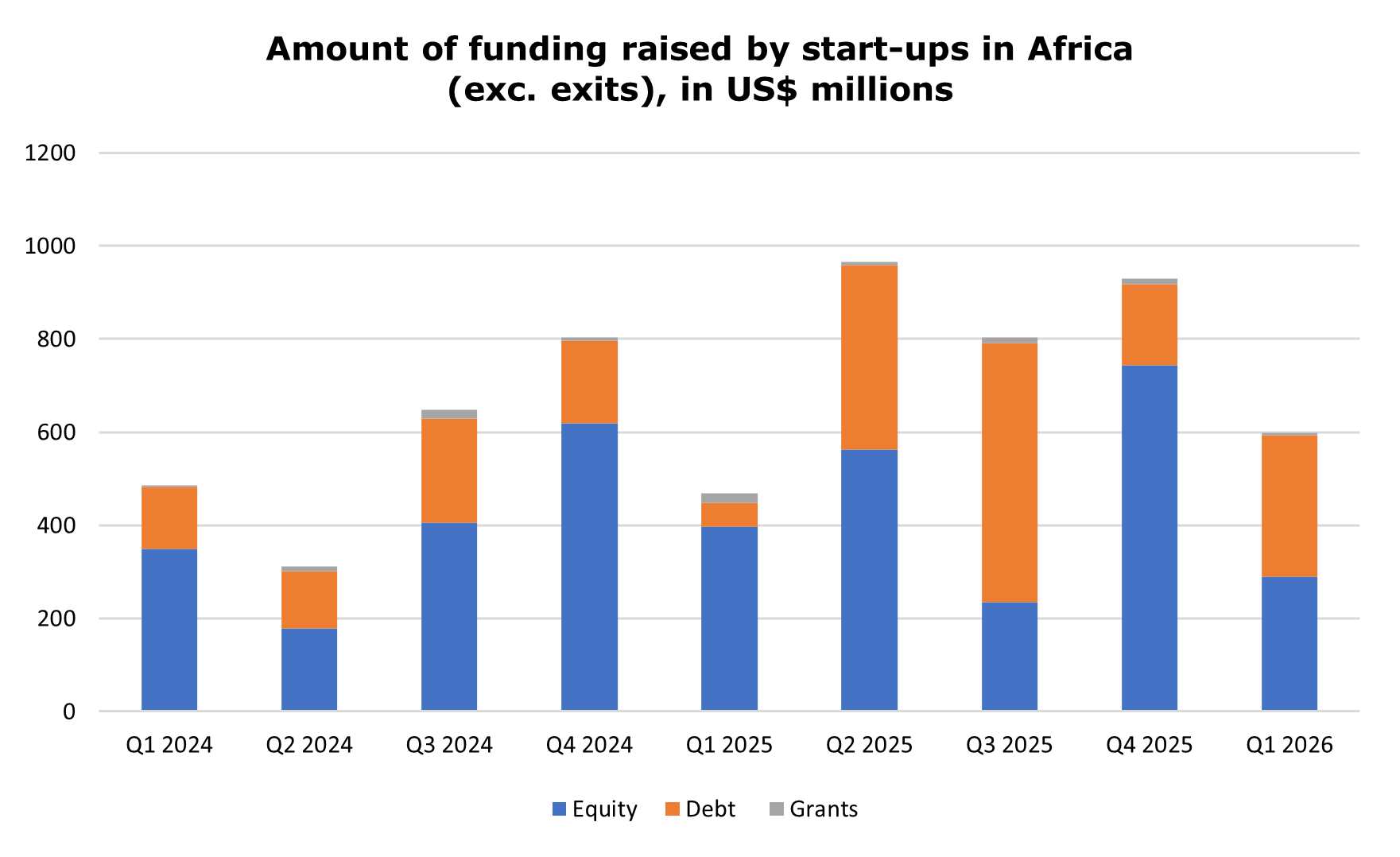 In other words, funding did not “slow down” in a uniform way: it rotated further toward debt as equity came off a very strong Q4 (in fact the ‘best’ quarter in terms of equity funding raised since the height of the funding heatwave in Q2 2022). Also worth noting is the fact that much of this debt is not “tag-along” capital attached to equity rounds like it tended to be in earlier periods; it is increasingly standalone financing with its own logic and its own repeat borrowers.
Notably, in North Africa, ValU extended the “institutional debt” story in fintech with a roughly US$64m facility from the National Bank of Egypt [1], reinforcing how mature consumer-credit platforms are increasingly able to tap local balance sheets at scale. A few weeks later, the same pattern reappeared via MNT-Halan, with another bond issuance of roughly US$41m [2], again pointing to a market where repeat borrowers and repeat instruments are becoming a core part of the funding stack, not a niche exception. Sistema.bio’s roughly US$53m debt facility [3] shows that climate-related debt capital is not only flowing to solar and energy distributors; it is also backing circular-economy and farmer-focused models with structured credit, helping explain how climate tech’s share can rise even when energy funding numbers are down. And large-ticket debt stories are not only a Big Four feature: Benin-born electric mobility player Spiro stacked multiple debt announcements, including a roughly US$50m facility involving Afreximbank and other backers [4], highlighting the rise of e-mobility financing (see below).
The second headline is a significant drop in deal volume. Q1 2026 saw 83 ventures announce at least one US$100k+ deal with a disclosed (or estimated) amount, down from 130 in Q1 2025 (-36% YoY) and 160 in Q4 2025 (-48% QoQ). That decline in breadth is the immediate cause for concern, because it is concentrated where the ecosystem builds its future pipeline: smaller cheques. One way to see how this shift expresses itself is concentration by deal size. Q1 2026 recorded 18 deals of US$10m+, up from 14 in Q1 2025, and those US$10m+ deals represented 82% of the total amount raised, versus 63% a year earlier. This is why the median disclosed deal size more than doubled over the past year, from US$0.5m in Q1 2025 to US$1.3m in Q1 2026.
It also explains why the ‘thinning’ of the funding pyramid’s base can hide in plain sight: small rounds barely move the totals. In fact, the mirror image of large deal prevalence is what happened to small deals. The number of US$100k–US$500k deals was halved year-on-year (73 to 32), and it fell from 44 to 18 (-59% YoY) if we focus exclusively on equity deals. In parallel, grant funding fell significantly from US$20m in Q1 2025 and US$12m in Q4 2025 to US$3m in Q1 2026 (-85% YoY, -70% QoQ), suggesting that patient philanthropic capital is not compensating for the failure of the traditional capital market to fund early-stage ventures with non-dilutive instruments.
On a more positive front, exit performance was good. Q1 2026 recorded 12 exits, double the 6 recorded in Q1 2025, and higher than Q4 2025 (11), though below Q2 and Q3 levels (15 & 17 respectively). March alone recorded five exits, including Orda’s acquisition by Moniepoint [5]. The deal is noteworthy less for its (undisclosed) price tag than for what it signals about the direction of African fintech: so-called unicorn Moniepoint is effectively buying merchant “workflow”, not just a product. Folding Orda - a restaurant operating system - into its offering helps Moniepoint push embedded payments deeper into daily merchant operations by linking what gets sold to how it gets paid for, improving reconciliation, increasing retention, and strengthening the data layer that supports adjacent products such as credit. More broadly, this is exactly why exits matter: they are the clearest liquidity signal an ecosystem can offer, and a steadier exit flow is what encourages investors to stay engaged, recycle capital, and ultimately underwrite new rounds with more confidence.
Climate tech funding is also increasing. It grew from US$124m in Q1 2025 to US$184m in Q1 2026, lifting its share from 26% to 31%, despite a sharp decline in funding going to the energy sector specifically (from US$84m to US$34m), which has historically been the main driver of climate tech investments on the continent. Interestingly, it is green mobility that has been carrying the numbers in Q1. We already mentioned Spiro, but we could add GoCab in Côte d’Ivoire who combined a seed round with a larger debt component [6], illustrating how operationally grounded mobility and platform plays are increasingly mixing instruments as they scale, and how francophone markets can still generate meaningful tickets. Over to the East, Kenya produced one of the quarter’s clearest equity outliers via Zeno’s US$25m Series A [7].
On the geography front, things were broadly business as usual in terms of coverage, with 19 countries in total recording at least one US$100k+ deal in both Q1 2026 and Q1 2025. However, the “Big Four”’s grip seems to be easing as their share of total amount raised fell from 82% to 72% over the past year – driven in particular by the GoCab and Spiro deals in Francophone West Africa -, and their share of deals from 61% to 54%. Finally, women continued to miss out on funding disproportionately. In Q1 2026, 20 deals involved a start-up with a woman CEO and/or at least a woman co-founder, down from 46 in Q1 2025. The amount raised fell from US$111m to US$49m, collapsing their share of total funding from 24% to 8%. In comparison, start-ups with a man CEO and/or at least a man co-founder raised 98.4% and 99.3% of the funding in Q1 2025 and Q1 2026 respectively.
So where does that leave us? Q1 2026 was not a weak quarter by amount raised. It is up YoY, and it actually sits neatly within a stable 12-month rolling plateau [8]. But it is a quarter that makes the ecosystem’s trade-off clearer. Stability is back, but it is more debt-driven. The top end remains active, but the base is thinning. Exits are improving, but small cheques are rarer. If this pattern persists, Africa can still print large rounds in 2026 and post encouraging topline numbers, while quietly underfunding the pipeline that produces the next generation of breakout companies, therefore creating problems for outer years.
References
[1] https://weetracker.com/2026/01/20/valu-financing-national-bank-egypt/
[3] https://techbuild.africa/sistema-bio-53m-african-smallholder-farmers/
[5] https://techcabal.com/2026/03/23/moniepoint-acquires-orda/
[6] https://techpoint.africa/feature/gocab-raises-45m-for-expansion/
[7] https://launchbaseafrica.com/2026/03/05/zeno-raises-25m-series-a/