Equity is strong, but African start-up funding rests on fewer shoulders
African start-ups raised close to US$800m in Q3 2026, led by Moove’s US$250m Series C. While year-to-date funding is flat, topline numbers hide shifts in funding structure
By Max Cuvellier Giacomelli

Start-ups in Africa raised approximately US$797m in the third quarter of 2026 through transactions of at least US$100k (equity, debt and grants; excluding exits). That is almost exactly what they raised in Q3 2025 (US$804m, -1% YoY), and it makes Q3 the strongest quarter of the year so far. Look at the type of capital raised, however, and Q3 2026 could hardly be more different from the same quarter last year.
Equity accounted for US$580m, or 73% of the total. That is 2.5 times more than in Q3 2025 (US$236m), and the best third quarter for equity since 2021. Debt moved in the opposite direction, falling to US$215m from US$556m a year earlier (-61% YoY), when two large off-grid solar securitisations by d.light and Sun King[1] had dominated the quarter. Grants were marginal, at around US$3m. The money was also shared among fewer companies: 124 ventures raised at least US$100k in Q3, compared with 151 a year earlier (-18% YoY). Most of that decline happened among smaller rounds, with 69 ventures raising between US$100k and US$1m (vs. 90 in Q3 2025), while the number raising US$1m or more held up better (55 vs. 61).
The deals that tell a bigger story
The quarter’s headline transaction was Moove’s US$250m Series C in August, led by Abu Dhabi’s Mubadala Investment Company and co-led by Woven Capital (Toyota’s growth fund) and Ion Pacific.[2] The round values the company at US$2.1bn, up from US$750m in 2024, making Moove one of the fastest African-born start-ups to reach unicorn status.[3] Launched in Lagos in 2020 with 76 vehicles, Moove now finances and manages around 42,000 vehicles across 29 cities in 13 countries. On its own, the round represents almost a third of all the funding raised on the continent in Q3. What makes it particularly interesting, though, is where the money is going: much of it will fund Moove’s autonomous-vehicle business, built around its partnership with Waymo in Phoenix and Miami (with London next). In other words, Africa’s newest unicorn is increasingly a global mobility company with African roots, now headquartered in the UAE. Tellingly, in October, Moove announced it was ending its operations in Nigeria, the market where it was born, handing full ownership of the vehicles to its local drivers.[4]
The theme of African-born companies scaling beyond the continent runs through several of the quarter’s other large rounds. Nigerian-founded stablecoin infrastructure provider Yellow Card raised US$40m from SC Ventures (Standard Chartered), Sony Innovation Fund, Polychain Capital and Blockchain Capital, partly to deepen its presence in Latin America and Asia-Pacific.[5] In Egypt, payments company Paymob raised a US$35m pre-Series C led by Mubadala and the EBRD, with the Gulf, where it has onboarded some 20,000 merchants since early 2025, central to its plans.[6] Two of the quarter’s five largest equity rounds were led by the same Emirati sovereign investor (Mubadala), a reminder of how prominent Gulf capital has become at the top end of the African market.
Jumia’s round was slightly different. The e-commerce group, listed on the New York Stock Exchange since 2019, raised US$50min new equity, with the IFC contributing around half and Axian Telecom, its largest shareholder, also participating.[7] The company expects to turn a profit in the fourth quarter, for the first time since its launch in 2012. Whether or not that milestone materialises, the round is a useful reminder that Africa’s tech champions can still need patient, development-oriented capital long after their IPO.
Finally, Odyssey Energy Solutions raised US$74m, combining US$27m in equity with US$47m in debt, largely from development finance institutions.[8] Odyssey does not install solar systems itself; it runs a platform connecting more than 6,000 solar installers and engineering firms with financiers and equipment suppliers, across more than 50 countries. Its round is a nice counterpoint to a weak year for energy funding overall (see below): capital is still flowing to the sector, but increasingly to the financial and procurement “plumbing” behind distributed energy rather than to the operators themselves. Led by Emily McAteer, Odyssey also completed the largest raise by a start-up with a woman CEO since Gro Intelligence (which has since shut down[9]) raised US$85m in early 2021.
Together, the quarter’s five largest fundraisers (Moove, Odyssey, Jumia, Yellow Card and Paymob) raised close to US$450m, or 56% of all Q3 funding.
Zooming out: a flat year, but not a static one
Taking the first three quarters together, start-ups in Africa have raised US$2.16bn in 2026 as of the end of September, -4% compared with the same period in 2025 (US$2.24bn), but +46% compared with Q1-Q3 2024 (US$1.47bn). Equity reached US$1.48bn (+23% YoY), its best Q1-Q3 since 2022, while debt fell to US$669m (-33% YoY). As a result, equity represents 68% of the funding raised this year, compared with 53% over the same period in 2025, and debt 31%, down from 45%. It is too early to call the end of the debt cycle described in this column over the past two years, but (large) equity investors are clearly returning.
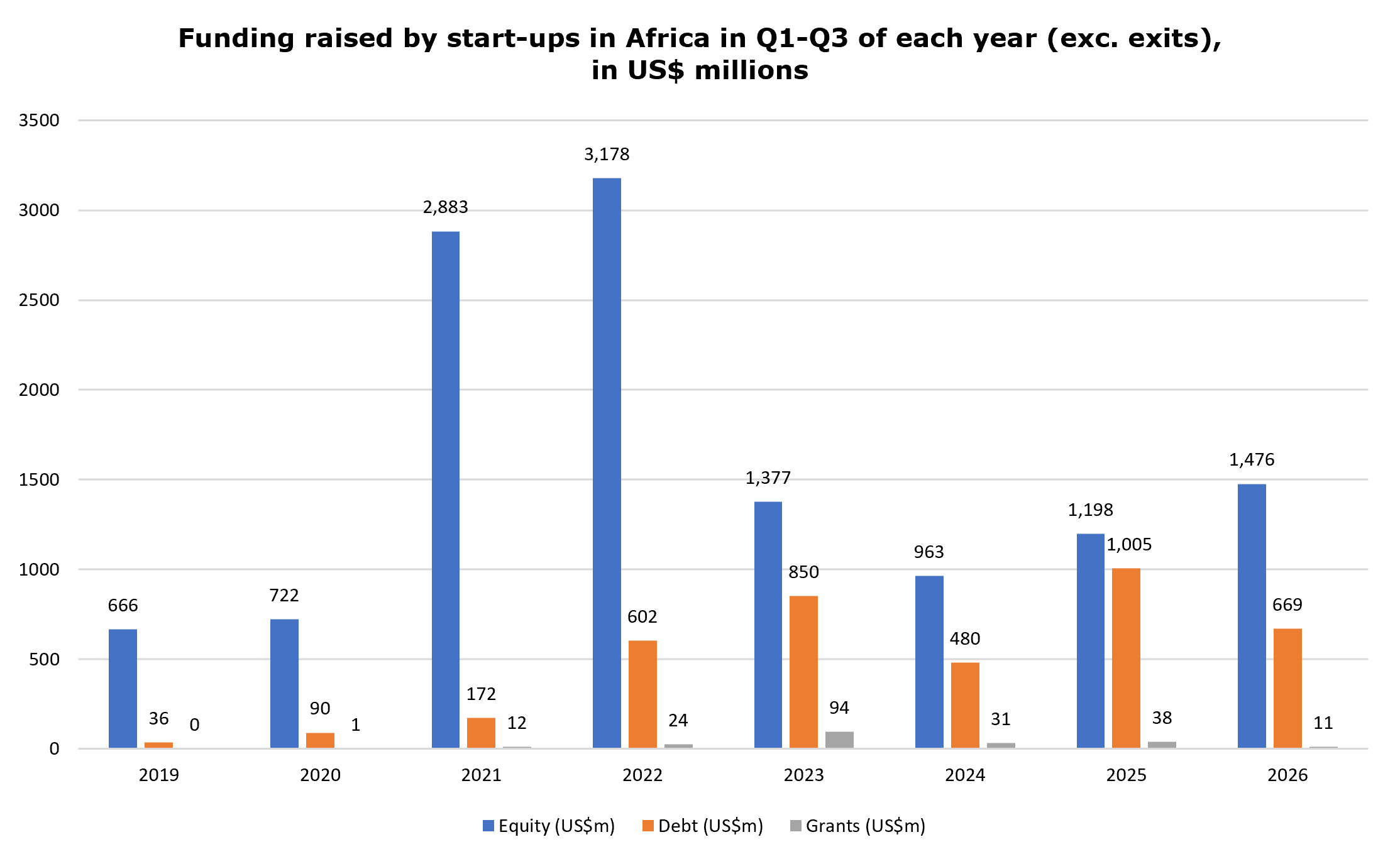
The less encouraging news is that this capital is reaching fewer companies. Only 311 ventures raised US$100k or more in Q1-Q3 2026, -18% YoY and the lowest tally since we started tracking in 2021. At the other end of the spectrum, deals of US$10m or more represented 83% of all funding. As we noted in our H1 analysis, aggregate numbers can look reassuring while the base of the pyramid quietly narrows.
Two companies, Spiro (US$345m) and Moove (US$250m), which together account for 28% of the year-to-date total, also explain the year’s most striking sectoral shift. Logistics and Transport ventures have raised US$780m so far (36% of the total), narrowly ahead of Fintech (US$760m, 35%), something we have not seen in any comparable period since we started tracking in 2019. Funding to Energy start-ups, on the other hand, has fallen from US$721m in Q1-Q3 2025 to US$187m this year (-74% YoY), largely because of the drop in debt. Geographically, Nigeria is back at the top of the table for the first time since 2022, with US$635m raised (2.6 times its total over the same period last year). Note that we still count Moove in Nigeria’s numbers, while Spiro is classified as pan-African; but even without Moove, Nigeria (US$385m, +56% YoY) would be the only Big Four market recording strong YoY growth. Egypt has been steady (US$445m, +10% YoY), while Kenya (US$201m, -73% YoY) and South Africa (US$182m, -58% YoY) have had a much quieter year. The number of ventures raising funding, a metric less skewed by very large deals, tells a similar story: Nigeria is the only Big Four market with more start-ups raising US$100k+ than a year earlier (77, +10% YoY), while Kenya (45, -32%), Egypt (40, -29%) and South Africa (34, -36%) all recorded sharp declines.
Investors, too, are fewer. At least 334 named investors took part in a US$100k+ deal in Q1-Q3 2026, -18% YoY and also the lowest tally since 2021. The decline is steeper among equity investors (271, -26% YoY) and among ‘repeat’ investors involved in two or more deals (91, -31% YoY). In other words, more equity is coming from fewer hands, and going into fewer, larger rounds.
On the exit front, activity remains healthy, with 34 exits recorded in Q1-Q3 (vs. 38 a year earlier), nine of them in Q3 alone. Not all of them are happy endings (some are distressed sales or acqui-hires), but they still return capital and experience to the ecosystem. More significantly, October (not included in the tally) has seen two IPOs get under way. OPay filed for a New York listing reportedly targeting a valuation of around US$4bn[10]; if completed, it would be the first US IPO by an African-born tech company since Jumia in 2019 (Swvl’s 2022 Nasdaq listing was done through a SPAC merger rather than an IPO). In Cairo, MNT-Halan launched an offering of its Egyptian business on the Egyptian Exchange, valuing that arm at roughly US$750m.[11] Following Optasia and CashPlus, which listed in Johannesburg and Casablanca in late 2025, these listings suggest public markets are slowly reopening as an exit route for the continent’s most mature start-ups.
What Q4 might bring
To match 2025’s full-year total (US$3.2bn), start-ups would need to raise around US$1bn in Q4, slightly more than in Q4 2025 (US$930m), and more than any quarter in 2026 so far. It is possible, but far from guaranteed. On the equity side, however, ‘only’ around US$466m is needed to beat 2025 (US$1.9bnn), less than was raised in Q2 2026 (US$602m), Q3 2026 (US$580m) or Q4 2025 (US$743m). Barring a very quiet end of year, 2026 could therefore end up as the best year for equity on the continent since 2022.
That is genuinely good news. But the more important question for the months ahead may be a simpler one: how many companies will get funded? This year has shown that the ecosystem can still produce unicorns and US$100m+ rounds. What it has not yet shown is that the seed and pre-seed rounds, the ones that will produce the next Moove, are coming back.
References
[1] Techpoint Africa, “d.light secures US$300 million consumer financing facility”, https://techpoint.africa/news/d-light-842m-consumer-financing/; Citigroup, “Citi and Sun King securitization to deliver solar to 2 million Kenyans”, https://www.citigroup.com/global/news/press-release/2025/citi-sun-king-securitization-deliver-solar-million-kenyans
[2] Moove (via StreetInsider), press release announcing its US$250 million Series C, https://www.streetinsider.com/dr/news.php?id=26868858&gfv=1
[3] Africa: The Big Deal, “Moove over: Africa has a new unicorn”, https://thebigdeal.substack.com/p/unimoove
[4] tech-ish, “Moove ends Nigerian operations one month after Uber exit”, https://tech-ish.com/2026/10/08/moove-ends-nigerian-operations-one-month-after-uber-exit/
[5] Yellow Card, “Yellow Card secures US$40 million in strategic funding to further global expansion”, https://yellowcard.io/blog/yellow-card-secures-40-million-in-strategic-funding-to-further-global-expansion
[6] Wamda, “Paymob raises US$35 million pre-Series C led by Mubadala, EBRD”, https://www.wamda.com/2026/09/paymob-raises-35-million-pre-series-c-led-mubadala-ebrd
[7] Bloomberg (via Jumia), “Jumia wins IFC, Axian backing in US$50 million equity fundraising”, https://group.jumia.com/news/jumia-wins-ifc-axian-backing-in-50-million-equity-fundraising-bloomberg
[8] Odyssey Energy Solutions, “Odyssey Energy Solutions raises US$74 million to accelerate distributed renewable energy financing in emerging markets”, https://odysseyenergysolutions.com/news-insights/odyssey-energy-solutions-raises-74-million-to-accelerate-distributed-renewable-energy-financing-in-emerging-markets
[9] TechCabal, “Kenya data analytics startup Gro Intelligence shuts down”, https://techcabal.com/2024/06/02/kenya-data-analytics-gro-intelligence-shuts-down/
[10] Launch Base Africa, “Inside OPay’s New York IPO: Who Wins Big in Africa’s Landmark Fintech Exit?”, https://launchbaseafrica.com/2026/10/12/inside-opays-new-york-ipo-who-wins-big-in-africas-landmark-fintech-exit/
[11] Enterprise, “MNT-Halan kicks off blockbuster IPO, with 20% up for grabs”, https://enterpriseam.com/egypt/2026/10/01/mnt-halan-kicks-off-blockbuster-ipo-with-20-up-for-grabs/