
SCALE@NTU Research Webinar Nov 2021
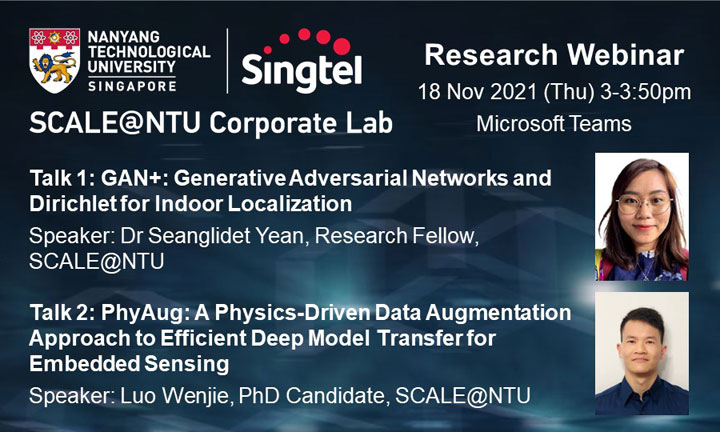
This research webinar on Teams is organized by Singtel Cognitive and Artificial Intelligence Lab for Enterprises (SCALE@NTU) to share the research work in the Corp Lab. For registration, please visit:
https://wis.ntu.edu.sg/webexe88/owa/REGISTER_NTU.REGISTER?EVENT_ID=OA21102515561938
Talk 1: GAN+: Generative Adversarial Networks and Dirichlet for Indoor Localization
Indoor Localization is indispensable to many service applications ranging from hospitals, malls, to parking lots. Machine Learning techniques have been explored with limited success. This is partly due to insufficient training data. This talk presents a data augmentation workflow, GAN+, which uses Dirichlet distribution coupled with Generative Adversaries Network. It aims to improve the performance of the model by synthetically producing additional training samples. The proposed technique was tested using the multi-floors and buildings dataset. Experimental results show that the dataset generated by GAN+ can achieve an average location error that is more than ten times lower than that of the original dataset. Therefore, the proposed data augmentation scheme validates the feasibility of using GAN’s in the domain of indoor localization.
Speaker: Dr Seanglidet Yean, Research Fellow, SCALE@NTU
Seanglidet Yean received her B.Eng. and Ph.D. degree in Computer Science from Nanyang Technological University (NTU), Singapore, in 2015 and 2020 respectively. From 2020, she has been a Research Fellow (Cognitive and AI) at Singtel Cognitive and Artificial Intelligence Lab for Enterprises (SCALE@NTU). Her research interest includes signal processing, navigation system fusing with the intelligence systems, and multidisciplinary projects under the umbrella of well-being (future healthcare).
Talk 2: PhyAug: A Physics-Driven Data Augmentation Approach to Efficient Deep Model Transfer for Embedded Sensing
Run-time domain shifts from training-phase domains are common in sensing systems designed with deep learning. The shifts can be caused by sensor characteristic variations and/or discrepancies between the design-phase model and the actual model of the sensed physical process. To address these issues, existing transfer learning techniques require substantial target-domain data and thus incur high post-deployment overhead. This paper proposes to exploit the first principle governing the domain shift to reduce the demand on target-domain data. Specifically, our proposed approach called PhyAug uses the first principle fitted with few labeled or unlabeled source/target-domain data pairs to transform the existing source-domain training data into augmented data for updating the deep neural networks. In keyword spotting and automatic speech recognition case studies, PhyAug recovers the recognition accuracy losses due to microphone characteristic variations by 37% to 72%. In seismic source localization case study, PhyAug only requires 3% to 8% of labeled TDoA measurements required by the vanilla fingerprinting approach in achieving the same localization accuracy.
Speaker: Luo Wenjie, PhD Candidate, SCALE@NTU
Luo Wenjie received his B.Eng. in School of Electrical and Electronic Engineering from Nanyang Technological University (NTU), 2015. He has been a full-time research graduate at Singtel Cognitive and Artificial Intelligence Lab for Enterprises (SCALE@NTU) since 2019. His research focuses on exploiting physical knowledge to improve the performance of AIoT.