
AI Capability Development Pathways for the Future Workforce

How can organisations build a sustainable AI learning culture that continuously adapts to new tools, technologies, and business applications?
How can leaders ensure their employees are equipped with the latest AI capabilities required for future business challenges?
How can businesses effectively bridge the gap between rapidly evolving AI innovations and daily workplace implementation?
Programme Overview
AI is no longer optional. It is becoming part of everyday work, decision-making, productivity, and innovation. NTUpreneur Academy’s AI Capability Development Pathways are designed to help individuals, professionals, and leaders progress from awareness to action. Learners do not just learn what AI is. They learn what is AI, apply it, and lead with it in real organisational settings. This directly supports Singapore’s current push to develop practical AI capability across the workforce through structured learning and hands-on experimentation.
The pathway is designed at three levels, so learners and organisations can enter at the right point.
NTUpreneur AI Capability Pathways:
- Level 1: Learn AI
- Level 2: Apply AI
- Level 3: Lead with AI
*For advanced learners, the Level 3 pathway can be positioned as part of a stackable postgraduate learning journey, consistent with NTU’s broader FlexiMasters and MSc progression model.
Course Outline
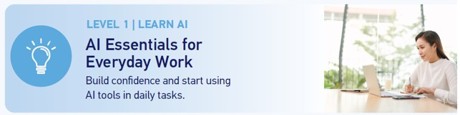
This pathway is designed for general employees who want to move beyond curiosity and learn how to use AI confidently in everyday work. Participants explore a range of popular AI tools for writing, summarizing, searching, ideation, meeting support, presentation preparation, and productivity. The program is practical, accessible, and application-focused so learners can quickly translate AI into smarter, faster, and more effective work.
Duration: 2 days
Fees: S$2,000
Target Audience: General employees, administrators, executives, support staff, frontline corporate staff, and public-sector officers new to AI
Entry Requirement: Comfortable with digital tools
Value Proposition:
Learners gain confidence using popular AI tools to improve daily work, communication, and productivity.
Learning Objectives
By the end of the programme, participants should be able to:
1. Understand how AI tools can support everyday work, productivity, and communication.
2. Apply popular AI tools to drafting, summarizing, searching, ideation, presentation preparation, and meeting support.
3. Analyze routine work tasks to identify where AI can save time or improve quality.
4. Evaluate AI outputs for accuracy, relevance, tone, and safe workplace use.
5. Create simple AI-assisted workflows that can be used immediately in daily work.
Detailed Programme
| Module / Session | Focus | Desired Learning Outcome |
| Session 1 | AI at work: what it can do for me | Explain how AI can support common workplace tasks and improve productivity for non-technical users. |
| Session 2 | Using popular AI tools with confidence | Use a range of popular AI tools for drafting, summarizing, searching, and idea generation. |
| Session 3 | Prompting for better results | Construct clear prompts that improve output quality, speed, and relevance. |
| Session 4 | Everyday applications across work tasks | Apply AI to emails, meeting notes, document summaries, slide outlines, and action planning. |
| Session 5 | Checking quality and responsible use | Review AI outputs critically and identify when verification or human judgement is required. |
| Session 6 | Personal productivity workflow lab | Build a simple AI-assisted workflow that improves an everyday work process. |
| Capstone Lab | My AI-at-work application plan | Produce a practical personal use case showing how AI can improve efficiency, quality, or responsiveness at work. |
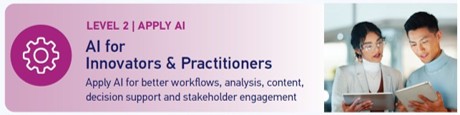
Move beyond basic use. Learn how to apply AI to improve processes, analyse information, create content, enhance service delivery, and develop smart solutions for your community and workplace.
Recommended Duration: 2 days
Target Audience: PMETs, analysts, consultants, marketers, HR practitioners, finance staff, operations executives, educators, public-sector professionals
Entry Requirement: Comfortable with digital tools; prior exposure to AI helpful but not required
Learning Objectives
By the end of the programme, participants should be able to:
• Understand how AI is reshaping professional work, problem-solving, and innovation.
• Apply AI tools to research, writing, analysis, ideation, and workflow redesign.
• Analyze task suitability, process bottlenecks, and opportunities for improvement.
• Evaluate trade-offs across speed, quality, risk, and business value.
• Create an AI-enabled innovation use case or workflow improvement plan for the workplace.
Detailed Programme
| Module / Session | Focus | Desired Learning Outcome |
| Session 1 | AI for professional work and innovation | Explain how AI can support both execution efficiency and innovation in professional roles. |
| Session 2 | Prompting for stronger outputs | Construct prompts for research, drafting, comparison, and structured problem-solving. |
| Session 3 | Workflow redesign with AI | Map work tasks into automate, augment, and human-led categories. |
| Session 4 | AI for idea generation and innovation | Generate, refine, and compare solution ideas for a real workplace challenge. |
| Session 5 | Functional applications | Apply AI in at least one domain context such as operations, HR, marketing, finance, or policy. |
| Session 6 | Responsible AI and output quality | Review AI outputs critically and justify safe, responsible use in the workplace. |
| Capstone Lab | Applied AI and innovation mini-project | Produce a practical use case showing how AI can improve work or enable innovation. |
• Use AI with greater confidence in daily professional work.
• Identify at least one meaningful innovation opportunity in their function or team.
• Design a workflow or use case that improves speed, quality, service, or insight generation.
• Exercise stronger judgement in reviewing AI outputs and applying responsible-use principles.
Programme Overview
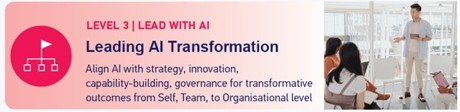
For managers and leaders who must guide teams, redesign work, and lead responsible AI adoption. Learn how to align AI with strategy, innovation, capability-building, governance, and transformation outcomes. This pathway provides a holistic approach from Self, Team to organisational level. An integrated learning approach from psychological to entrepreneurial theories and frameworks will be used to connect the dots for leaders and managers to level-up their self-awareness and create new insights for leading transformational innovations.
Duration: 2 days
Target Audience: C-suites, directors, business owners, transformation leaders, public-sector leaders, SME and MNC decision-makers
Value Proposition: Learners build the leadership capability to use AI for innovation, transformation, and organization-wide value creation.
Learning Objectives
By the end of the programme, participants should be able to:
1. Understand how AI is reshaping industries, business models, organizational design, and innovation.
2. Understand AI Transformation and Leadership.
3. Understand mindsets and psychology of change in Team and Organization.
4. Understand Technopreneur mindset.
5. Understand Change Management and Leadership.
6. Apply AI thinking to identify strategic opportunities for productivity, growth, service improvement, and new value creation.
7. Apply Team and Collective Leadership to Leading AI Transformation.
8. Analyze organizational readiness, barriers to adoption, and transformation priorities.
9. Evaluate AI opportunities, risks, governance choices, and change implications for the organization.
10. Evaluate self in leadership change: Psychology of Self and Change.
11. Create an AI transformation and innovation roadmap for a business, function, or team.
Detailed Programme
Day 1 : AI and Organizational Innovation
| Module / Session | Focus | Desired Learning Outcome |
| Session 1 | AI as a strategic and innovation imperative | Explain why AI is a leadership issue and how it can drive competitiveness, innovation, and transformation. |
| Session 2 | Identifying high-value AI opportunities | Prioritize AI use cases that improve productivity, customer value, operations, or growth. |
| Session 3 | Redesigning work, processes, and business models | Analyze where AI can reshape workflows, services, decision-making, or business models. |
Day 2: AI and Transformation
| Module / Session | Focus | Desired Learning Outcome |
| Session 1 | Leading organisational adoption and change | Develop an approach for capability-building, stakeholder buy-in, and AI-enabled change. |
| Session 2 | Governance, risk, and responsible AI | Evaluate governance principles, risk controls, and human oversight for organisational AI use. |
| Session 3 | Innovation and transformation studio | Integrate AI, innovation, and leadership thinking into a coherent transformation agenda. |
| Session 4 | AI transformation and innovation roadmap | Produce a practical roadmap showing how AI can enable innovation and organizational transformation. |
Limited-Time Discounts: 10% off for sign-up from 23 September – 2 October 2026.
Group Discounts: Additional 5% for two or more sign-ups

- Fees listed above are exclusive of 9% GST
Registration is open.
- Click here to register for the physical class.
For group registrations, please register your interest with us to discuss your requirements and explore a customised learning solution tailored to your organisation's needs.
Benefits of Group Registration
1. Shared Learning and Organisational Alignment
Team members learn together, fostering a common understanding, and aligned goals to enhance organisational effectiveness and execution.
2. Practical Application to Business Challenges
Participants can apply learning directly to current business priorities, projects, and organisational challenges, ensuring immediate workplace relevance.
3. Industry-Relevant Case Studies
Learning can be enriched with industry-specific cases and real-world business scenarios, making the programme more relevant and impactful.
4. Enhanced Cross-Functional Collaboration
Bringing together participants from different departments encourages knowledge sharing and strengthens collaboration.
5. Delivery & Continuous Support
Classes can be conducted in NTU, your premises, or virtually plus an option of post-programme coaching (with additional fees), if desired. Training dates and times are flexible and can be arranged to suit your organisation's availability.
6. Greater Return on Learning Investment
When teams learn and implement together, organisations are more likely to achieve sustainable improvements and maximise training outcomes.
7. Stronger Innovation and Transformation Capability
Collective learning helps cultivate an innovation mindset, strengthen change leadership, and accelerate organisational growth and transformation.
-01c9b0def5-09cd-49fe-94bb-6bee4aaf0cf3.svg?sfvrsn=beb8cc8a_5&Status=Master)
