Metal 3D Printing, Reinvented
NTU researchers create a method to make metal additive manufacturing faster, more reliable, and globally accessible.
When the TCT Awards announced their 2026 shortlist, a research project from Nanyang Technological University found itself among six global finalists in the Hardware category, alongside entries from General Motors, NASA, and other major industrial organisations.
The project was LAPIS, short for Laser Pulse Integration of Sheets, a hybrid metal additive manufacturing platform developed at NTU's School of Mechanical and Aerospace Engineering. For Nanyang Assistant Professor Lai Chang Quan, the researcher who started it, the recognition was significant. It was also a long way from where the idea began.
The origin of LAPIS can be traced to a bolt of inspiration Prof Lai had during a vaccination appointment in 2021. He had been mulling over the problem of fabricating closed-cell designs for several weeks at that point in time, when the answer came to him suddenly, as clear as day.
"I was so excited I called up my collaborator immediately," he recalls, "I must have looked absolutely ridiculous, with one hand holding the cotton swab on the injection site and the other hand holding the phone to my ear."
The idea he shared in that call was straightforward in concept but significant in implication: replace the metal powder used in conventional 3D printing with metal sheets instead. That single shift in material would, over the following years, address some of the most persistent limitations in metal additive manufacturing.
The Problem that Existing Technology could not Solve
Metal additive manufacturing, more commonly known as metal 3D printing, has long promised to reshape the production of complex components.
In practice, however, the technology has remained constrained by the very material at its core: metal powder. It is toxic, can be highly flammable and gives brittle parts if not processed properly.
These limitations become even more apparent when engineers attempt to fabricate closed-cell lattice structures, components with fully sealed internal cavities.
Consider a solid metal part with cube-shaped voids completely enclosed within it. Structures of this kind combine reduced weight with high structural integrity, and are particularly valuable in aerospace, biomedical implants, and high-performance sports equipment.
No powder-based system can reliably produce them. The powder used to build the surrounding structure inevitably becomes trapped inside the cavity, where it cannot be extracted.
Engineers have historically resorted to machining parts in two halves and bonding them together, a process that introduces inconsistency and limits design freedom.
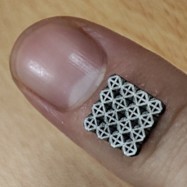 Successful trial of lattice printing with uniformity even at small sizes
Prof Lai had been working on exactly this class of problem when the solution presented itself. Rather than attempting to improve how powder behaves, the question became whether powder was necessary at all.
"The initial development of LAPIS was motivated by the desire to fabricate closed-cell lattices," he says.
"But we very quickly realised that using sheets as a precursor material solves a host of other problems in current additive manufacturing technologies, including reliability, cost, and safety."
What Sheets make Possible
LAPIS works by using patterned metal sheets as its feedstock material rather than loose powder. Sheets can be positioned precisely, behave consistently from one build to the next, and do not present the handling risks associated with fine metallic particles.

Production method using LAPIS’s sheet-based approach
Early experimentation produced results the team had not fully anticipated. Stainless steel parts fabricated using the sheet-based method came out one and a half times stronger than parts produced through conventional means.
More significantly, the team found that LAPIS could process titanium alloy in ambient air, without the sealed argon gas environments that powder-based systems require.
In powder-based metal 3D printing, titanium alloy must be processed inside an inert gas enclosure because fine titanium particles are combustible in open air. That infrastructure requirement adds cost, complexity, and operational overhead.
Because LAPIS uses solid sheets rather than fine reactive particles, that risk does not materialise. The team found they could achieve titanium prints in a standard lab environment, removing both the safety concern and the associated cost barrier.
"We just took for granted that LAPIS could 3D print titanium alloy in air and went about doing so," says Jonathan Singham, a PhD student in Prof. Lai’s lab, "not realizing that this wasn’t supposed to be possible and others had to suit up in protective gear, construct an argon chamber, evacuate it and fill it with gas, just because they were using powder and we were using sheets."
The result is a system capable of producing geometries that powder-based printing cannot, while doing so more safely, with a lower infrastructure requirement and at meaningfully reduced cost.
Addressing the consistency challenge
Beyond geometry and safety, LAPIS addresses a challenge that has quietly limited wider adoption of metal additive manufacturing: part-to-part consistency.
In powder-based systems, particle size distribution, packing density, and surface chemistry all influence how the material responds during printing, introducing variability between builds. For industries where component performance must be predictable, this presents a massive challenge

A titanium alloy lattice fabricated from powder, fracturing randomly at different locations
Sheet-based feedstock does not carry the same uncertainty. The material properties are stable, builds are highly reproducible, and parts produced across separate runs are consistent with one another.
Prof Lai captures the cumulative effect of these advantages with an analogy that is deliberately familiar.
"Around 40 years ago, we had to send documents to a printing shop and wait for delivery," he says.
"With the advent of office printers, everyone can generate their own documents instantly, reliably and in the comfort of their workplace, with a click of a button."
"LAPIS does exactly that for engineering parts. Design today, get your part tomorrow, in your own shopfloor."
Just as the desktop printer redistributed the means of document production without requiring a printing background, LAPIS is designed to bring metal fabrication within reach of engineers, researchers, clinicians, and product owners who do not have access to large-scale manufacturing facilities.
Building the team
Translating the concept into a working technology required more than a single insight. Prof Lai describes assembling the LAPIS team as a discipline in itself.
"I feel like Nick Fury sometimes," he says, referencing the Marvel character known for recruiting specialists for missions no single person could complete. "I think engineering the team was just as important as the actual technical engineering."
Work began in 2021 with interns and research engineers running early feasibility tests. Doctoral student Dominic Lim Kang Jueh joined the group in 2022 and supercharged the metal prototyping effort with sharp engineering acumen and workmanship, pioneering key features of the workflow that would eventually become LAPIS.
These innovations were captured and built upon during the equipment development, led by a talented research associate, Cai Chenhui, who joined later that year.
Prof. Lai credits this early group, as well as a whole host of researchers that followed after, for expanding the LAPIS technology far beyond a simple research project.
The personnel who developed the technology are, notably, the same people now building the company around it.
"We are a pretty well-oiled team," Dominic explains. "We have been working together for so long that everyone knows how to fit in with each other and cover for each other to advance LAPIS quickly."
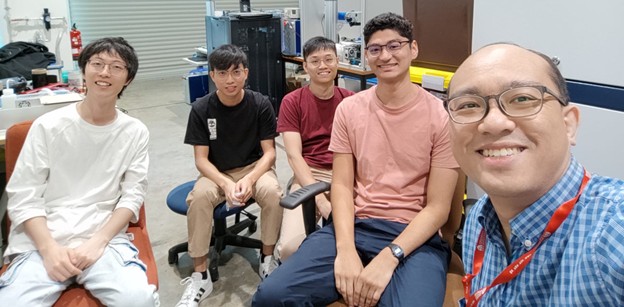
Prof Lai (right) and his Gen 1 team (left to right): Cai Chenhui, Lim Guo Yao, Dominic Lim Kang Jueh, Jonathan Singham
Critical support came through NTUitive, NTU's innovation and enterprise arm, whose proof-of-concept and proof-of-value grants helped the project cross what Prof Lai calls the death valley of innovation.
That is the stretch between early-stage research and industry-ready deployment where most deep-tech projects lose momentum.
"We went from 'let us just make this work well enough to produce a few samples for the next publication'," he says, "to 'let us make this repeatable for hundreds of thousands of cycles to meet the actual market needs.' "
A Singapore Technology, recognised on the World Stage
Prof Lai's message to colleagues on receiving the TCT news was measured: "It truly takes a village to grow a child, and I hope our LAPIS baby will continue to make big strides in the journey ahead."
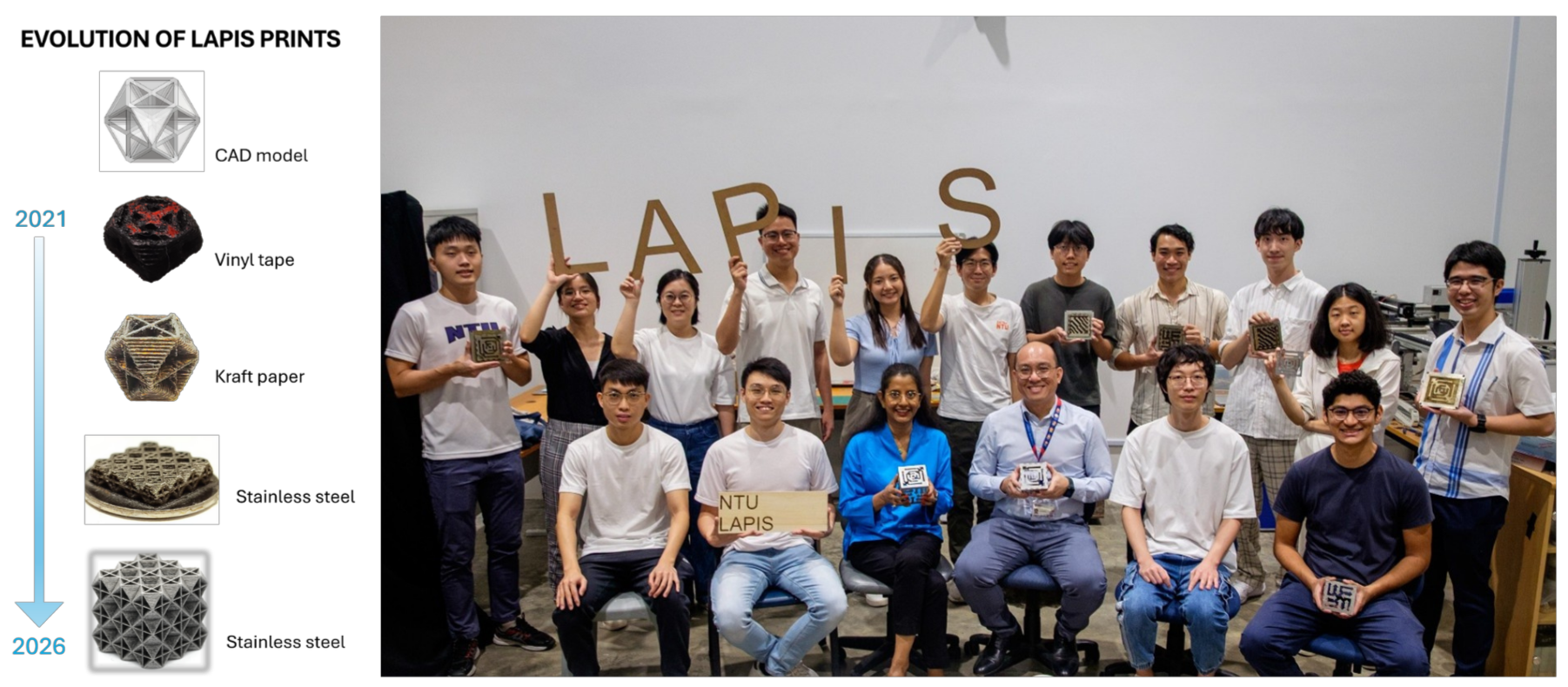 Evolution of material used in LAPIS printing and the team who joined Deep Sea Cube event
There is a particular resonance to a technology developed in Singapore competing at that level.
With no indigenous metal manufacturing tradition and no large domestic aerospace sector to anchor commercial demand, what Singapore brings is an engineering research base willing to attempt problems that larger industries have not prioritised. LAPIS sits squarely in that tradition.
The collaborators it has attracted reflect the breadth of the technology's potential: Tan Tock Seng Hospital and the National Dental Centre Singapore for biomedical applications; TU Munich and TU Dublin for international academic partnerships; Infineon and Foxconn for manufacturing solutions; Zeda Inc. and GCTG in the United States; as well as Autodesk, among others.
Going deeper and reaching further
Prof Lai frames the next phase of LAPIS across two directions: deepening the scientific understanding of why the technology works and expanding the contexts in which it is applied.
Questions remain about the fundamental material science behind some of LAPIS's more unexpected results.
Why are sheet-fabricated stainless-steel parts stronger than conventionally produced equivalents? What mechanisms allow titanium alloy to be processed in ambient air?
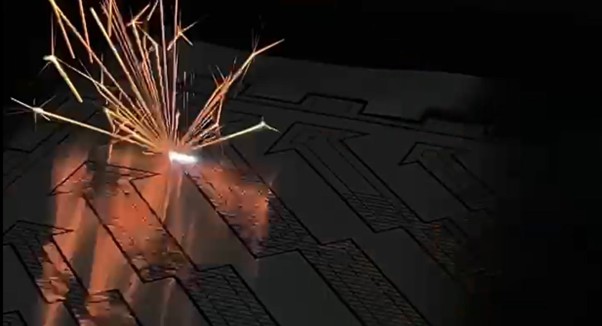
Fabrication of stainless steel with LAPIS
Understanding these phenomena will inform the next generation of applications and process improvements.
"As an academic, I cannot help but wonder why some things work and some things do not," Prof Lai says. "And I intend to find out."
On the application side, the team is actively developing LAPIS for heat exchangers, patient-specific biomedical implants, semiconductor parts, consumer products and aerospace components.
Commercial machines are expected to be available globally before the end of 2026 through an incorporated spin-off company, LAPIS Innovations Pte Ltd. A pipeline of early adopters is already forming.
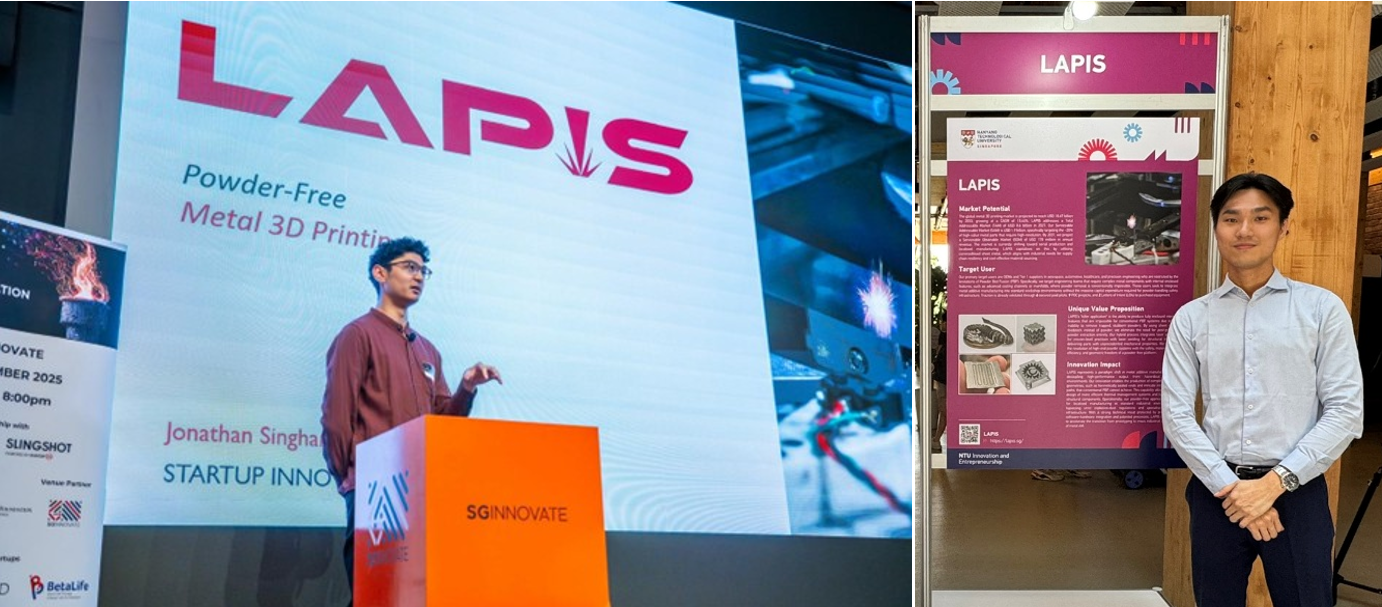
(left) LAPIS at showcasing their technology at NAMIC Start Up Innovation Forum by Jonathan Singham, Co-Founder of LAPIS. (right) LAPIS exhibit at NTU x UOB Innovation Hub Launch event by Simon Goh, Co-Founder of LAPIS.
"I will know LAPIS is successful," Prof Lai says, "once it becomes a verb. As in: 'The hook is broken? Why don't you LAPIS a new one?' "
The printing press democratised information. The desktop printer put that power on every desk. LAPIS is built on the premise that the same progress is now possible in metal, one sheet at a time.
Accolades and Recognition
Beyond the awards circuit, LAPIS has enabled interdisciplinary projects that demonstrate the technology's versatility, including the fabrication of a metal structure installed 7,000 metres beneath the ocean surface near the Mariana Trench, as part of a deep-sea art and environmental sensing project carried out in partnership with NuStar Technologies and the Japan Agency for Marine-Earth Science and Technology (JAMSTEC).
About Professor Lai and the Advanced Materials Design & Synthesis LabDr Lai Chang Quan is an Assistant Professor at NTU, jointly appointed in the School of Mechanical and Aerospace Engineering and the School of Materials Science and Engineering. He leads the Advanced Materials Design & Synthesis Lab, focusing on designing materials and structures across scales and translating these insights into new manufacturing approaches. Dr Lai received his BEng from the National University of Singapore, an MEng from MIT, and a PhD through the Singapore MIT Alliance programme. His work combines fundamental materials science with applied manufacturing innovation, including the development of the LAPIS metal additive manufacturing platform. Learn more about Prof Lai's work : https://personal.ntu.edu.sg/cqlai/. |  |
References:
By Karen Chai, NTU MAE Communications