
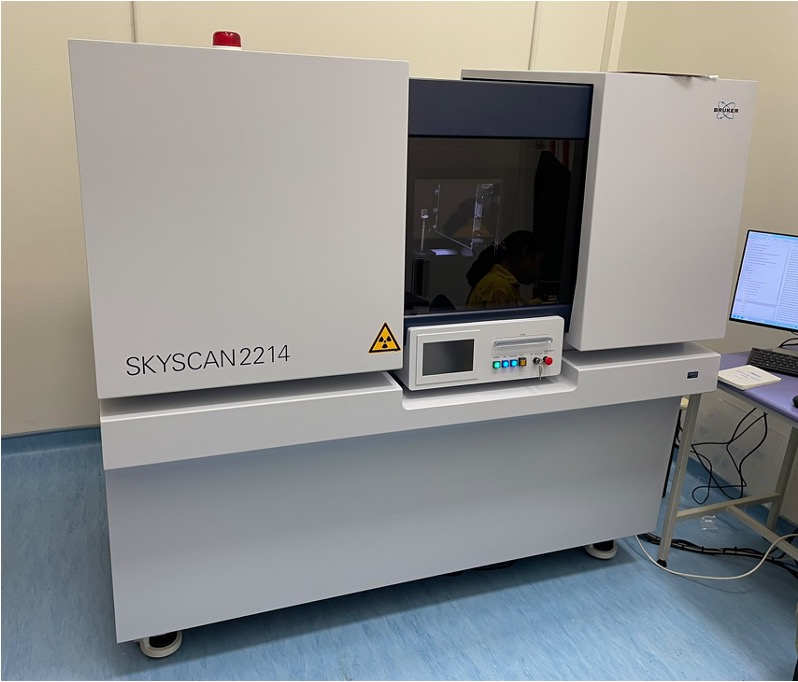
XRM Skyscan 2214
FACTS XRD room at N4.1 B4-10
The Bruker SKYSCAN 2214 X-ray Microscope (XRM) is a high-resolution, non-destructive 3D imaging system for characterising the internal structure of a wide range of materials. It enables visualisation and quantitative analysis of internal features such as pores, cracks, particles, interfaces and defects, without physically sectioning the sample.
XRM Skyscan 2214
The sample is placed between a nanofocus X-ray source and detector and rotated while 2D X-ray projections are collected from many angles. Differences in X-ray attenuation provide contrast within the sample, and the projections are computationally reconstructed to generate a high-resolution 3D representation of its internal structure.
Detectors
(1) 16 Mp standard sCMOS → High resolution scanning
(2) 6 Mp flat-panel detector → Large FoV, fast screening
Emitter
(1) W → 0.8μm resolution, 20 – 160kV
(2) LaB6 → 0.5μm resolution, 20 – 100kV
Maximum Sample Size
300mm in diameter (140mm scanning size)
400mm in height
20kg in weightExample applications of the Bruker SKYSCAN 2214 XRM include:
- Batteries and energy-storage materials — internal electrode structure, coating uniformity and defects
- Additive manufacturing / 3D-printed components — porosity, trapped powder, incomplete infill and dimensional verification
- Fibres and composites — fibre orientation, distribution, layer thickness and internal structure
- Geological materials — pore networks, mineral/density variations and internal rock structures
- Electronic devices — internal inspection of electronic components, circuit boards and assemblies
- Metals and engineering components — internal defects, wear, dimensional analysis and quality assurance
- Pharmaceuticals and medical devices — formulation structure, coating thickness and internal device components
- Building materials — concrete, wood, coatings and other heterogeneous materials
- Ex-vivo biological samples — for example, lung structures and tumour vascularisation
- In-situ studies — observing structural changes during mechanical loading or changes in temperature.