
Team Sirius wins first place at Pathways in Python “Tech for Good” Hackathon
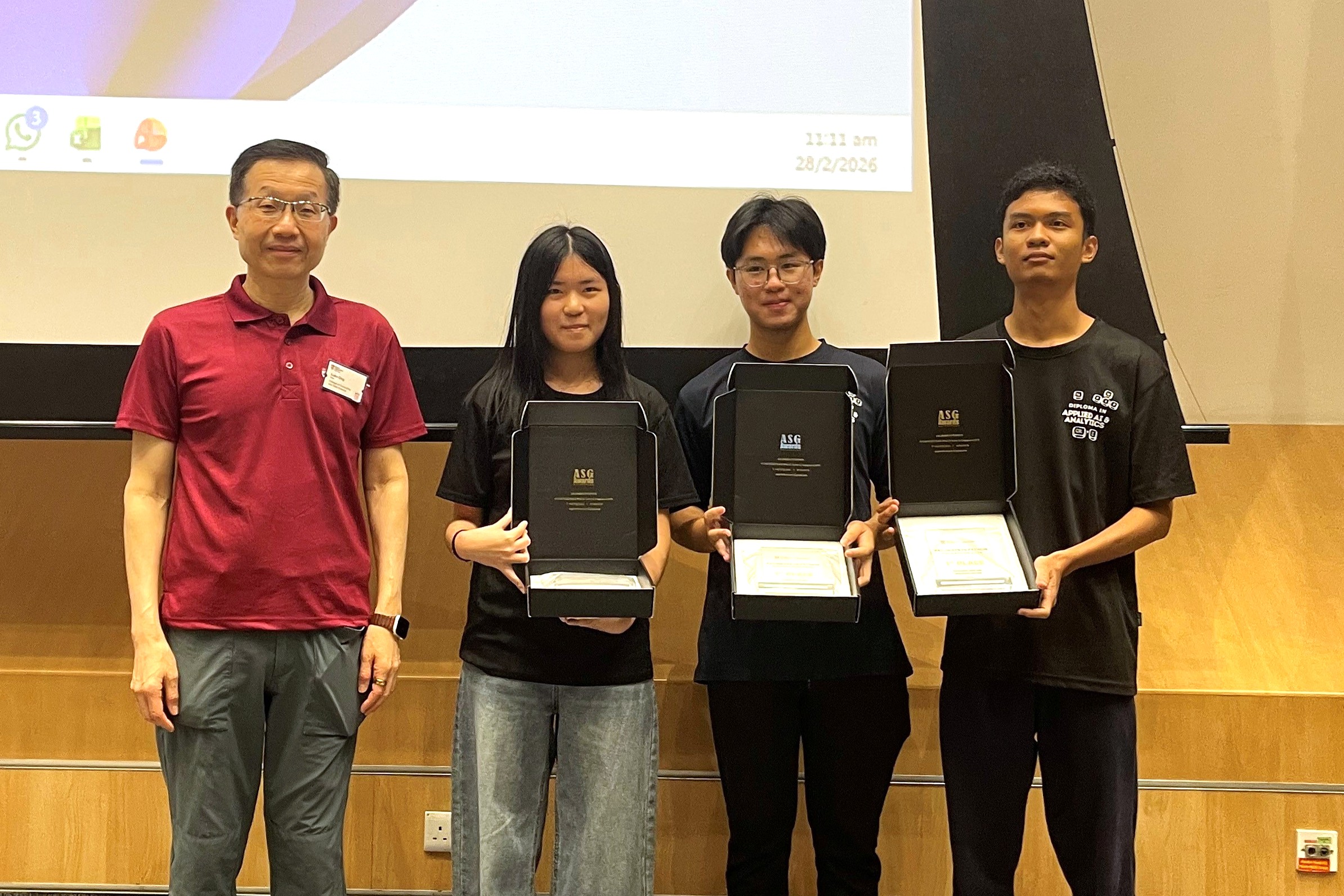
Team Sirius with Dean of CCDS, Prof Luke Ong
Pathways in Python (PiP) 2026 came to a successful conclusion at the NTU Open House on 28 February, marked by an award ceremony and project showcase from standout teams of the PiP Hackthon.
More than an introduction to computing, this flagship CCDS initiative served as a transformative roadmap for pre-university students, elevating them from novice coders to collaborative innovators equipped with the technical fortitude to address real-world challenges.
One team that felt the profound impact of PiP was Team Sirius. Comprising Singapore Polytechnic students Kendrick Slamat, Chen Shitian and Mohamad Aniq Bin Mohamad Hisyam. The team shared that their greatest takeaway was the synergistic mindset they cultivated, “This journey has taught us many things, like how to collaborate better with our teammates, understand their strengths and weaknesses, and how to build a project that's not just meaningful to everyone but also translates into actual results.”
The team clinched the top spot at the PiP Hackathon with Exit 0, a horror-themed game that impressed judges with its visually engaging approach to teaching programming and code application. They utilised LangChain (an open-source framework that simplifies building applications with large language models) to guide players through logical frameworks. To progress, players must navigate checkpoints such as a Haunted Library and Chemistry Lab, proving their coding logic at every turn.
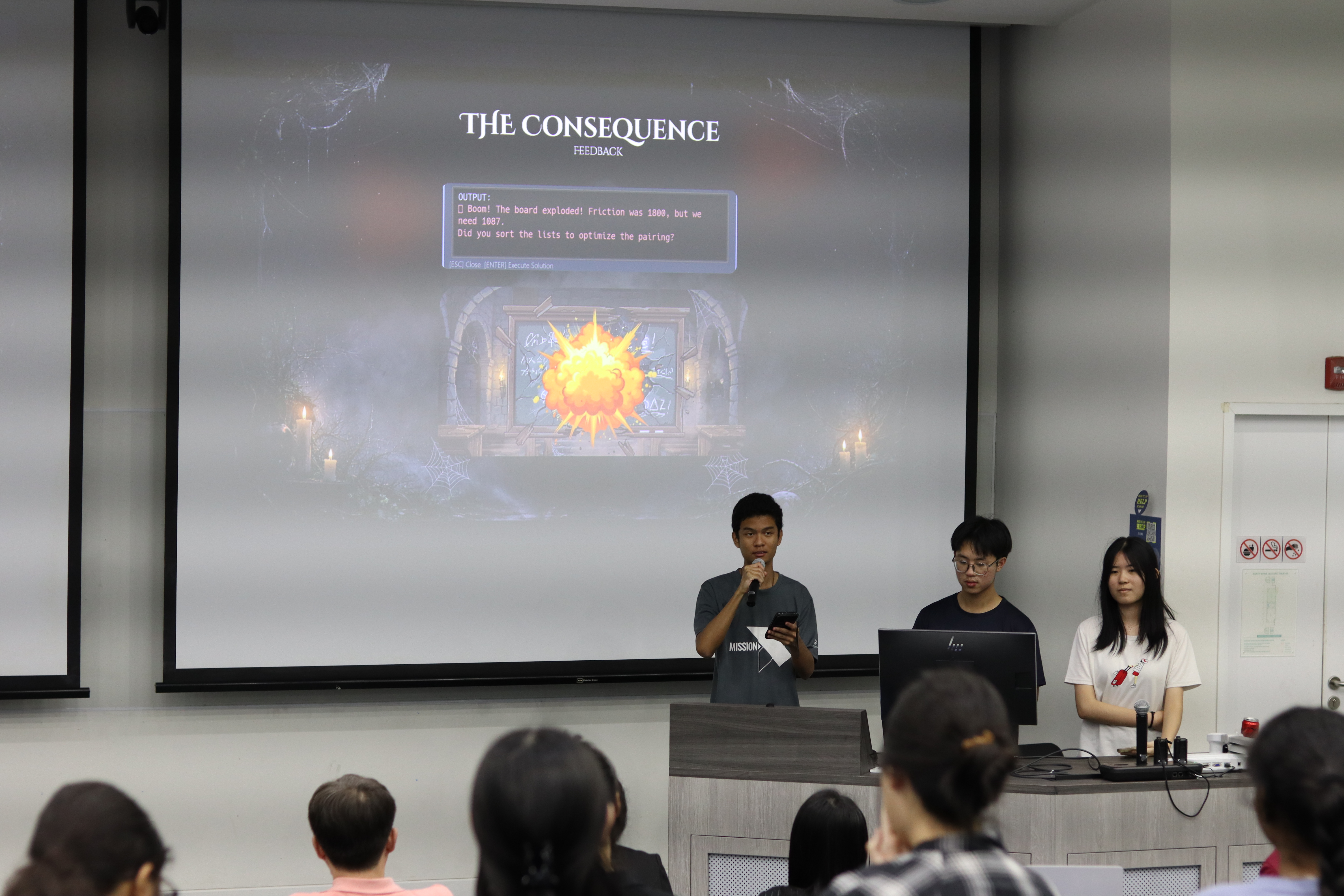
Team Sirius presenting their project Exit 0
Intensive learning and innovation
Team Sirius’ journey at PiP was shared by fellow participants. Together, they dived into a dynamic learning environment centred on intensive learning, problem-solving and innovation.
The immersive experience began in early January with the PiP Intensives, a three-week guided learning phase that introduced the fundamentals of computational thinking and programming under NTU faculty and student mentors.
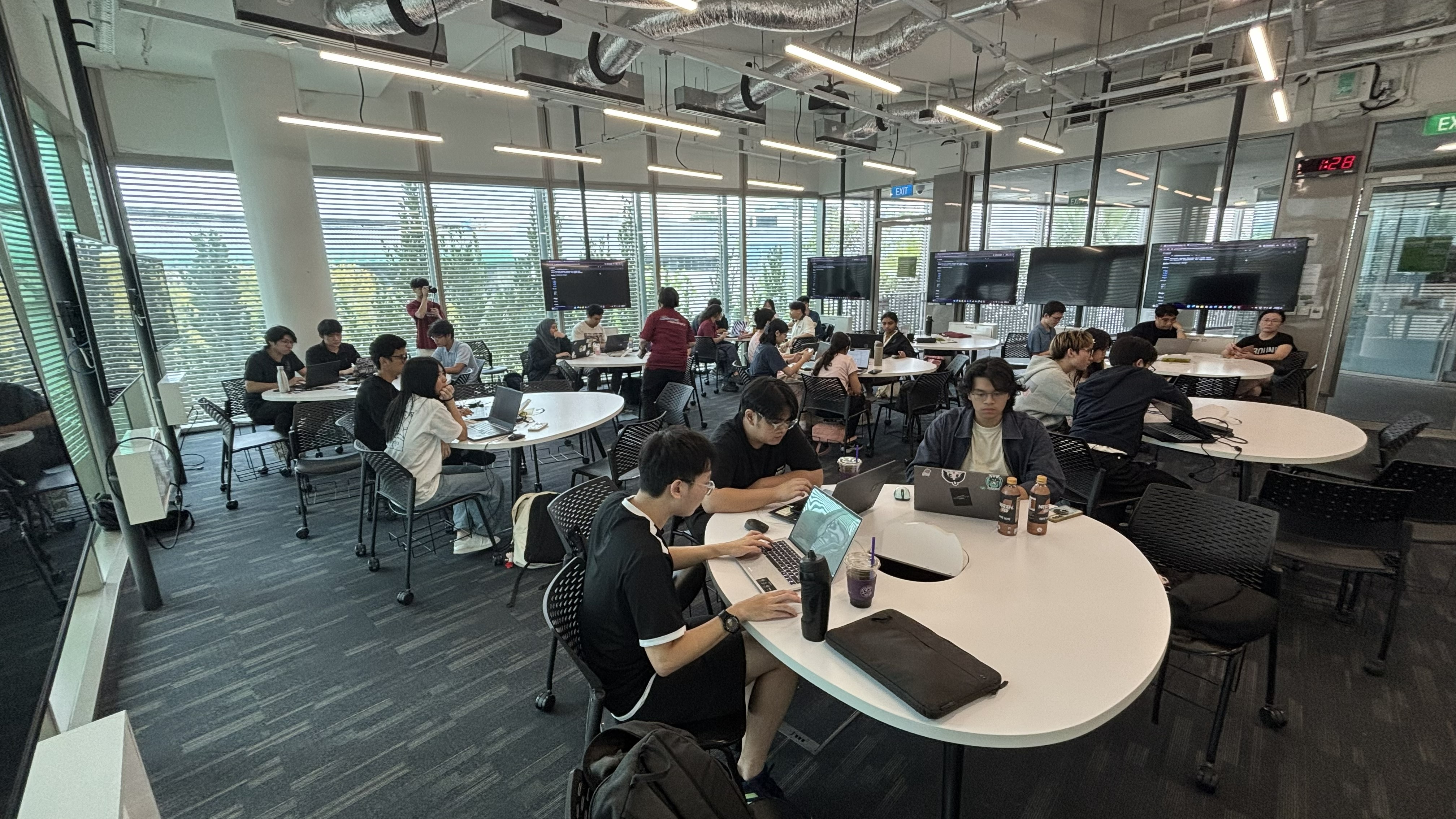
10 teams were shortlisted for the PiP Hackathon finals
This was followed by the PiP Hackathon, open to both PiP Intensives participants and those with basic programming knowledge. Teams of three were tasked to design real-world solutions based on the theme “Tech for Good”, after which 10 teams were selected to present their projects on 14 February. The initiative concluded with the Tech for Good Showcase @ CCDS Open House, where selected projects were spotlighted to visitors.
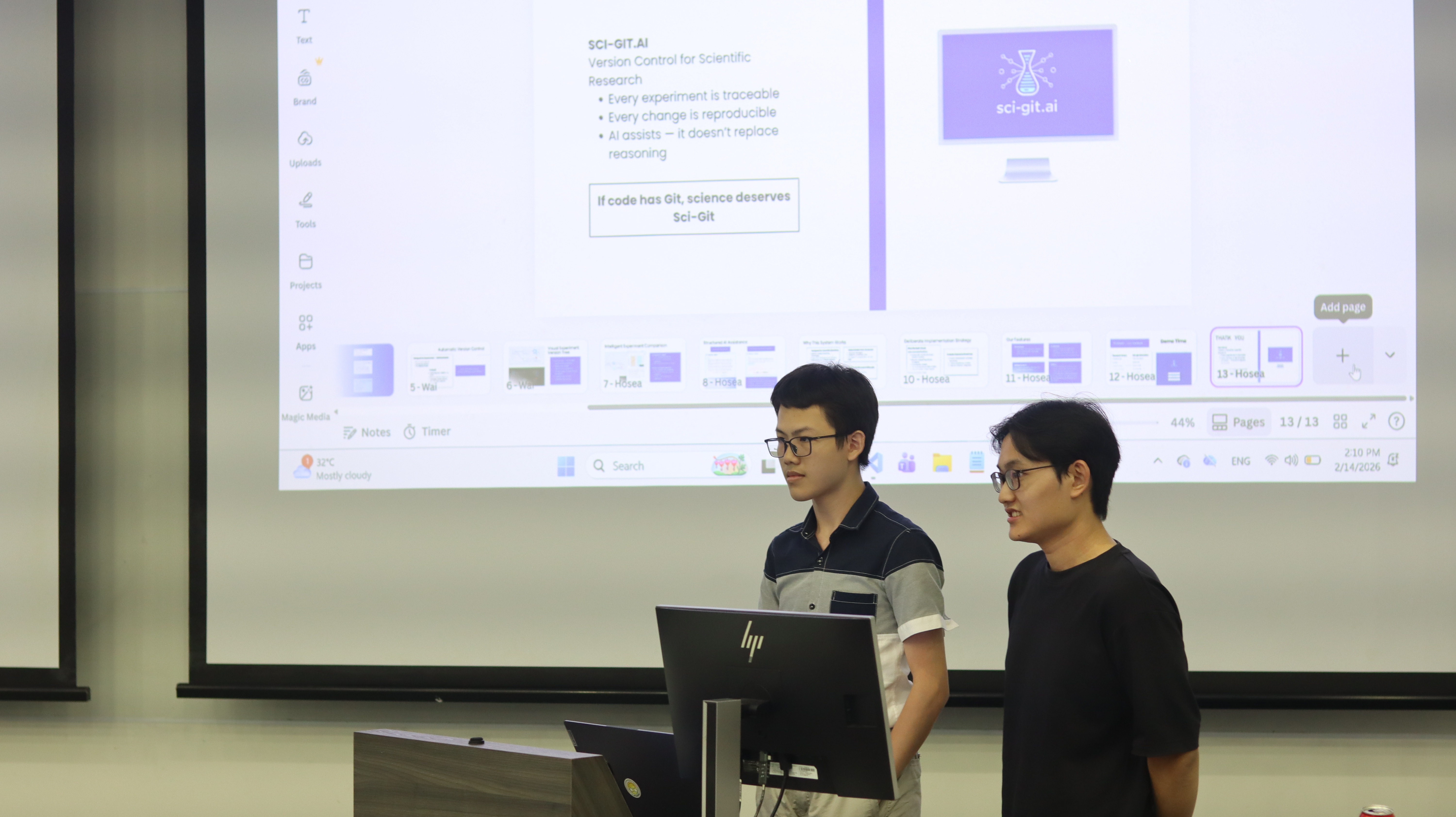
Team 2 JC 1 Poly presenting their project SCI-GIT.AI
The PiP Hackathon pushed participants to expand their horizons, both socially and technically. For first runner-up 2 JC 1 Poly, the hackathon brought three strangers from different schools and backgrounds together – Wai Phyo Aung from Singapore Polytechnic, and Hosea Kok Si Yuan and Tan Pei Xi from Dunman High School.
Despite their differences, Hosea noted that the shared pressure of the hackathon fostered an immediate bond. “We just helped and listened to each other, and somehow ended up in second place!” he said.
The result of their collaboration was SCI-GIT.AI, a version-control system for scientific research. It uses AI-powered snapshot tracking to help scientists monitor their experiments, preserve data from previous sessions, and compare results.
On a personal note, Hosea said PiP strengthened his grasp of Python fundamentals and sharpened his approach to problem-solving. “It helped strengthen my basics, especially on how to break down a problem into smaller parts, and to look at a project through a different lens,” he said.
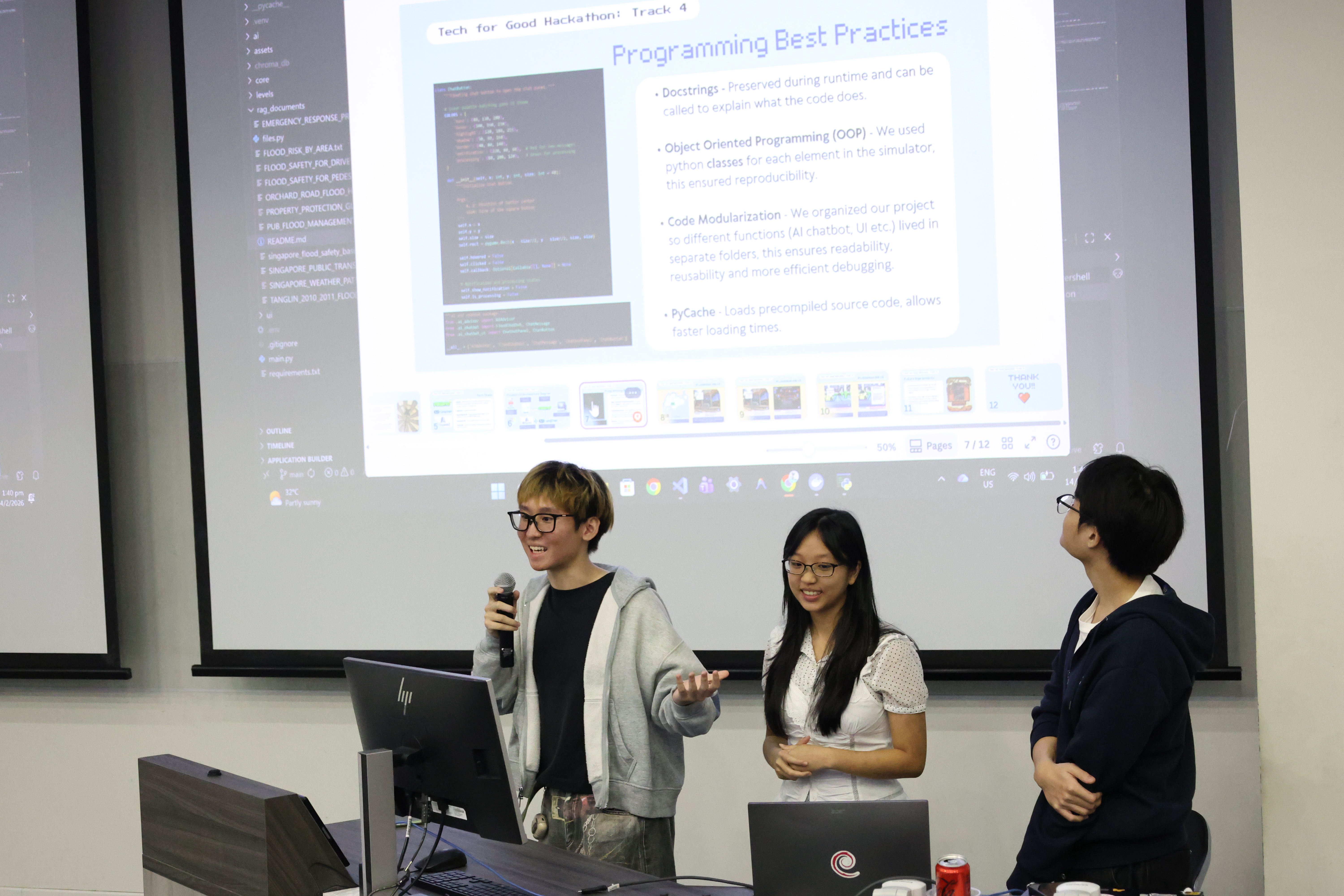
Team JAB presenting their project FloodSim.SG
Meanwhile, third place winner Team JAB had to overcome conflicting schedules and school exams to create their AI-powered flood simulation system, FloodSim.SG. It harnesses live rainfall data to predict evolving flood risks, and provides practical safety tips and travel updates for users.
The project was well worth the effort, according to team members Boo Jianhao from Nanyang Polytechnic, and Ben Angelo and Alysa Yong from Temasek Polytechnic. “It taught us how to collaborate as a team and how to use tools that are available in the real world,” said Ben.
Learning to lead
The PiP journey may have been challenging, but participants had help from NTU CCDS faculty and student mentors. With their mentorship, they gained an authentic glimpse into the life of a computing student, receiving hands-on guidance that bridged the gap between theory and practical application.
One student mentor, Ronav Pattanaik, was impressed with their drive to learn. “The students are very passionate and energetic. They take your feedback and criticism, and build upon it,” said the Year 3 Computer Engineering student.
He himself came away inspired: “They are also teaching us, showing that it’s important to put effort into the things you do. You never know what doors they might open later.”
Another student mentor, Denzyl Chua De Han, gained deep respect for the participants. The Y2 Computer Science student shared that while some came into PiP without any coding knowledge, they asked questions, worked hard on their projects and managed to prototype their solutions. “I have to remind myself to be more courageous after following their journey!” he said.
Congratulations to the top three teams on their well-deserved win, and a salute to every participant who stepped up to the challenge. The spirit of innovation and technical grit shown by students made this year’s PiP Hackathon a resounding success, showcasing the potential of the next generation of tech talent.
-singapore-team-selection-test-6c639870-7d55-4d34-8fdc-3e49bcbdd219.tmb-listing.jpg?sfvrsn=43e2bfc5_2)