
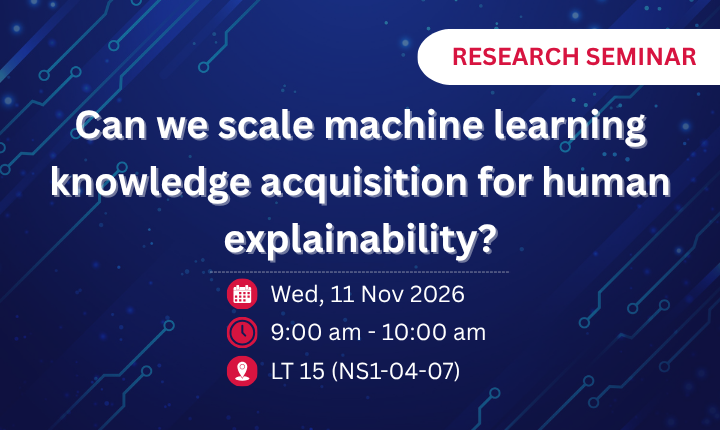
Can we scale machine learning knowledge acquisition for human explainability?
Abstract
While much of the applied AI activities have been preoccupied with how to extract value from large language models (LLMs) and methods by which LLMs are adapted to application verticals, much less attention has been devoted to the challenge of building AI applications that can work in partnership with humans. As an alternative to the pursuit of things like "artificial super intelligence" (ASI), we distinguish the path of developing AI systems that work as companions with humans, to achieve more than could be done with either.
This pursuit leads naturally to technical problems that are technically challenging, including the use of existing AI tools to capture and deploy not only domain knowledge but also the meta knowledge that can support explainability (for humans).
We don't yet have a principled framework for scaling machine learning to curate and use this broader scope of knowledge, but we can summarize some of the challenges that must first be addressed before we do.
About the Speaker
Randy Goebel is a Professor of Computing Science in the Faculty of Science and adjunct Professor in the Faculty of Medicine at the University of Alberta, and Fellow and Co-founder of the Alberta Machine Intelligence Institute (AMII), one of three Canadian federally-funded AI research organizations.
He has had faculty appointments and visiting faculty appointments at the University of Waterloo, University of Regina, University of Tokyo, Hokkaido University (Sapporo, Japan), Multimedia University (Kuala Lumpur, Malaysia), Instituto Tecnológico de Monterrey (Monterrey, Mexico), and has been a visiting researcher at the German Center for AI Research (DFKI), the National Institute for Informatics (NII, Tokyo), and the Volkswagen Data Lab (Munich).
His research interests include formal knowledge representation and reasoning (induction, belief revision, explainable AI (XAI)), knowledge visualization, algorithmic complexity, natural language processing (NLP), and systems biology, with applications in clinical medicine, legal reasoning, and automated driving.