
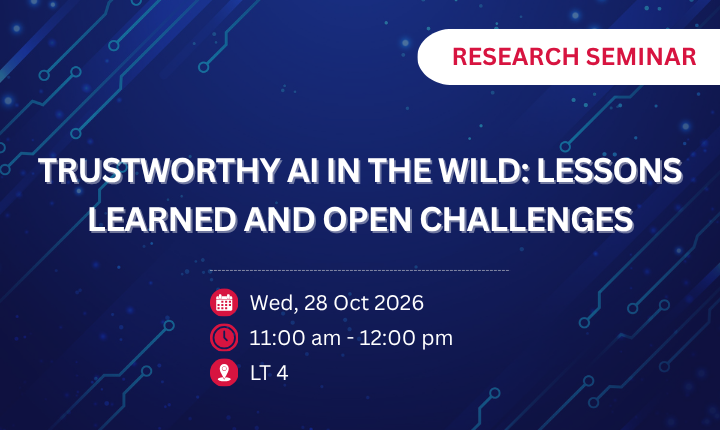
Trustworthy AI in the Wild: Lessons Learned and Open Challenges
Abstract
As Generative AI and agentic systems rapidly transform our world, we face an evolving threat landscape. How to ensure AI safety and reliability in real-world applications has become a frontier imperative.
This talk reviews the realities of securing AI systems in the wild through the lens of Adversarial ML. We discuss the fundamental security vulnerabilities when models are deployed in dynamic, unpredictable environments where assumptions about data distributions, threat models, and system boundaries are constantly challenged.
Grounded in real-world experiences across applied AI privacy, safety, and security, we explore the essential shift from reactive patches to sustainable protection in red teaming, data integrity, and agentic guardrails. The talk concludes with open research directions for academic-industry collaboration.
About the Speaker
Catherine Huang is a senior staff researcher at Google Privacy, Safety & Security (PSS) Research, where she leads trustworthy AI and frontier research for emerging threats. Her work focuses on advancing technologies to ensure the safety of generative AI and agentic systems. A recipient of Google Tech Impact Award (2025) and Core Tech Impact Awards (2024 and 2025), Catherine’s research spans on adversarial machine learning, AI safety, and neuroAI, resulting in 15+ patents and 40+ publications. She’s vice-chair of IEEE neural networks technical committee (2025–2026), chair of IEEE cognitive and developmental systems technical committee (2019–2020), and associate editor for IEEE Transactions on (AI, NNLS and CDS). Previously, she was principal scientist at McAfee and senior research scientist at Intel Labs, and holds a Ph.D. in biomedical engineering at Oregon Health & Science University and an M.S. in electrical and computer engineering at University of New Brunswick.