
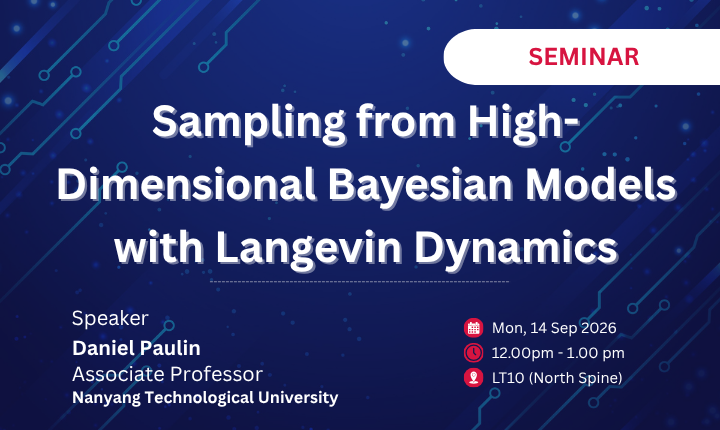
Sampling from High-Dimensional Bayesian Models with Langevin Dynamics by Prof Daniel Paulin
Abstract:
Bayesian inference treats the unknown parameters of a statistical model as random variables: starting from a prior distribution that encodes what we believe before seeing the data, and a likelihood that describes how the data depend on the parameters, Bayes' rule combines the two into the posterior distribution, the conditional distribution of the parameters given the observed data, which is proportional to prior times likelihood. Since the posterior is rarely available in closed form, in practice we approximate expectations under it by Monte Carlo, drawing samples using stochastic processes whose long-run distribution is the posterior. Langevin dynamics is one such process, in which the parameters move along the gradient of the log-posterior while being continuously perturbed by Brownian motion; its kinetic (underdamped) version adds a momentum variable, much like a particle moving through a landscape with friction and random kicks, which helps it explore high-dimensional spaces faster. Because these dynamics must be simulated in discrete time steps, the central questions are how quickly the resulting Markov chain converges, how much systematic error (bias) the discretization introduces, and how to cope with the fact that for large datasets the exact gradient of the log-posterior is too expensive to compute at every step. In this talk I will present a framework for proving explicit convergence rates for discretized kinetic Langevin dynamics under standard convexity assumptions [1], and show how coupling chains at different discretization levels in a multilevel Monte Carlo construction removes the bias entirely, yielding unbiased posterior estimators whose cost scales independently of the dataset size even when only approximate or stochastic gradients are available [2]. I will then introduce a symmetric minibatch splitting integrator that keeps the bias small while using only one minibatch of data per iteration [3]. Throughout, I will illustrate the methods on examples ranging from simple Gaussian and regression models to Bayesian neural networks for image classification, where the samplers deliver substantially better-calibrated predictive probabilities than standard training approaches.
Biography:
Daniel Paulin is an Associate Professor at the College of Computing & Data Science (CCDS) and the School of Physical and Mathematical Sciences, Nanyang Technological University (NTU), Singapore. He received his PhD degree from the National University of Singapore in 2014, his MSc degree from Ecole Centrale Paris in 2009, and a BSc degree from the Budapest University of Technology and Economics in 2009. After his PhD, he was a post-doctoral research fellow at NUS and the University of Oxford. From 2019 to 2024, he was a lecturer at the University of Edinburgh, UK. He is interested in Monte Carlo methods and uncertainty quantification in data science and machine learning. Specifically, he works on creating efficient sampling methods for high-dimensional models involving large datasets.