
Is Complementary-Label Learning Realistic? by Professor Hsuan-Tien Lin
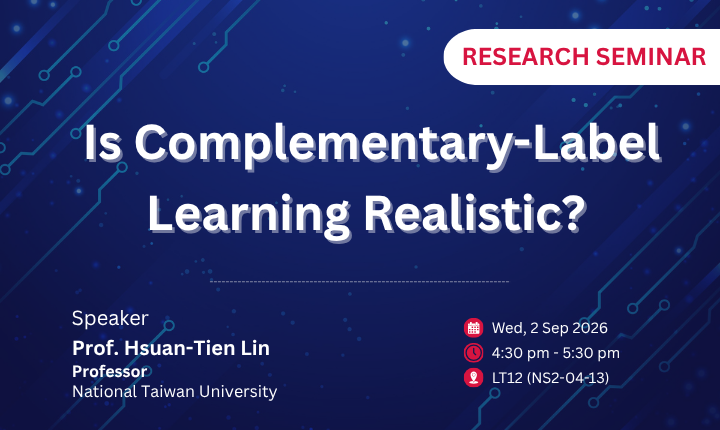
Abstract: Complementary-Label Learning (CLL) is a weakly supervised learning paradigm that is claimed to be useful in situations where collecting true labels is expensive. This talk begins by walking the audience through two advances in CLL. The first work discovered that the CLL loss design from Unbiased Risk Estimator (URE) suffers from high variance in gradient estimation. To address this, a novel surrogate complementary loss (SCL) framework is proposed, which reduces variance and improves gradient alignment, mitigating the overfitting issue. The second work introduces a new approach to CLL by reducing the problem to estimating the probability of complementary classes. This framework sidesteps the limitations of traditional methods and improves robustness in noisy environments, offering a broader perspective for both deep and non-deep models. Empirical results demonstrate the efficacy of both approaches in improving CLL performance. Finally, the speaker will share some of the ongoing attempts in making CLL more realistic, including some first-hand experience in collecting real-world datasets and releasing an open-source library..
Bio: Prof. Hsuan-Tien Lin received his B.S. in Computer Science and Information Engineering from National Taiwan University in 2001, and his M.S. and Ph.D. in Computer Science from California Institute of Technology in 2005 and 2008, respectively. He joined the Department of Computer Science and Information Engineering at National Taiwan University as an Assistant Professor in 2008, and was promoted to Associate Professor in 2012, and has been a Professor since August 2017. In 2022, he was named the Cyberlink/Perfect Endowed Chair Professor. From 2016 to 2019, he served as Chief Data Scientist at Appier, a startup company that specializes in making AI easier across domains such as digital marketing and business intelligence, and he continued as Chief Data Science Consultant until 2025.
From the university, Prof. Lin received the Distinguished Teaching Awards in 2011 and 2021, the Outstanding Mentoring Award in 2013, and five Outstanding Teaching Awards between 2016 and 2020. He co-authored the introductory machine learning textbook Learning from Data and offered two popular Mandarin-teaching MOOCs Machine Learning Foundations and Machine Learning Techniques based on the textbook.
Prof. Lin served in the machine learning community as Progam Co-Chair of NeurIPS 2020, Expo Co-Chair of ICML 2021, Workshop Co-Chair of NeurIPS 2022, Workshop Chair of NeurIPS 2023, Program Co-Chair of ACML 2024, General Co-Chair of ACML 2025, Senior Program Chair of NeurIPS 2025, and General Co-Chair of NeurIPS 2026. His research interests include mathematical foundations of machine learning, studies on new learning problems, and improvements on learning algorithms. He received the 2012 K.-T. Li Young Researcher Award from the ACM Taipei Chapter, the 2013 D.-Y. Wu Memorial Award from National Science Council of Taiwan, the 2017 Creative Young Scholar Award from Foundation for the Advancement of Outstanding Scholarship in Taiwan, the 2025 Breakthrough Chair Professorship from Foundation for the Advancement of Outstanding Scholarship in Taiwan, and the 2025 Outstanding Research Award from National Science and Technology Council of Taiwan. He co-led the teams that won the third place of KDDCup 2009 slow track, the champion of KDDCup 2010, the double-champion of the two tracks in KDDCup 2011, the champion of track 2 in KDDCup 2012, and the double-champion of the two tracks in KDDCup 2013.