
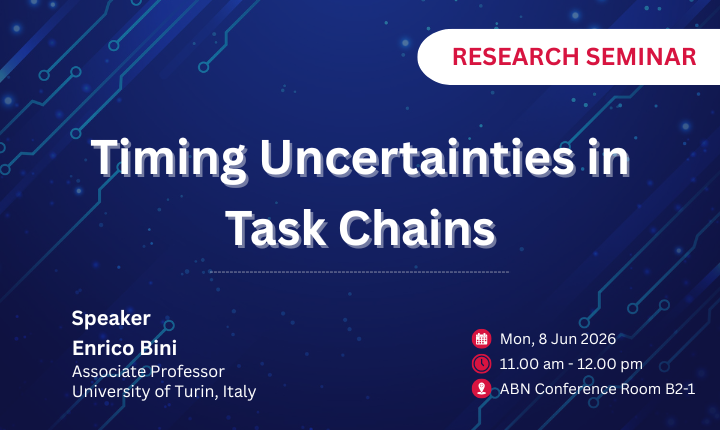
Timing Uncertainties in Task Chains by Enrico Bini
Abstract
Chains of tasks are ubiquitous and used in a broad spectrum of applications: robotics, automotive, and more. In these contexts asynchronous communication is often preferred to avoid blocking and potential deadlocks. Hence, tasks execute according to their timing: they communicate with the others by writing to and reading from shared memory. The schedule of tasks and the read/write instants are naturally subject to uncertainties (variability in the execution time, interference due to shared resources of higher priority tasks, etc.).
In this presentation, we propose a novel event model that explicitly captures the uncertainties in read and write operations. We develop a (linear-time complexity) compositional analysis framework that tracks how the uncertainty propagates across chains and impacts metrics such as reaction time, data age, and end-to-end latency. Our model supports arbitrary communication paradigms (e.g., implicit, LET) and is applicable to the analysis of real-world frameworks such as ROS2 without requiring intrusive changes.
About the Speaker
Enrico Bini is Associate Professor at Department of Computer Science, University of Turin. He also held positions at Scuola Superiore Sant'Anna (Assistant Professor, until 2016) and Lund University (Marie-Curie fellow, 2012–14). In 2004, he completed the PhD on Real-Time Systems at Scuola Superiore Sant'Anna (recipient of the "Spitali Award" for best PhD thesis of the whole university). In January 2010, he also completed a Master degree in Mathematics with a thesis on optimal sampling for linear control systems.
He has published more than 100 papers (1 Test-of-Time award by the IEEE TCRTS, 4 best-paper and 1 outstanding-paper awards @RTNS @RTCSA @ICC) on real-time scheduling, operating systems, optimization methods for real-time and control systems, optimal management of distributed and parallel resources. Until 2026, he served the community as Associate Editor of IEEE Transactions on Computers, ACM Computing Surveys, and Springer's Real-Time Systems journal. Since 2026, he is Editor-in-Chief of Springer's Real-Time Systems journal. His service also includes chairing 12 events (including Program Chair of RTSS21, Program co-Chair of RTCSA2020, chair of the Embedded Software track of DAC2020) and the participation in about 100 Technical Program Committees.