
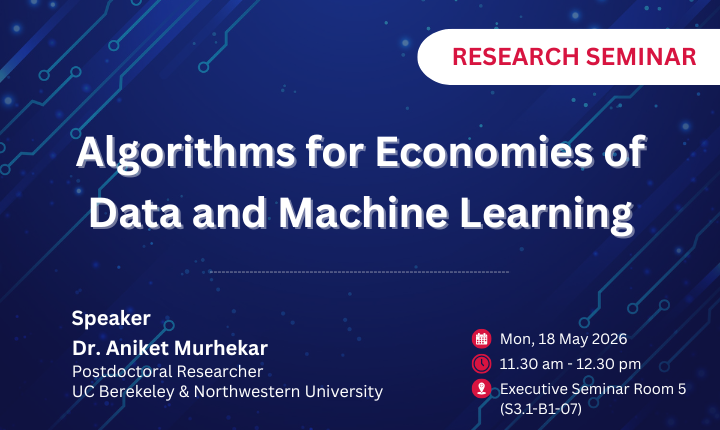
Algorithms for Economies of Data and Machine Learning by Dr Aniket Murhekar
Abstract
Data has emerged as a central economic asset in modern AI and machine learning systems. Yet it fundamentally differs from traditional goods: it is non-rival, allowing multiple agents to use it simultaneously, easily replicable, and often coupled with privacy concerns. These differences challenge standard economic frameworks and call for a rethinking — and often a rebuilding from first principles — of the foundations of data and machine learning economies.
In this talk, algorithmic and economic perspectives are presented on three data-economic frameworks: federated learning, data exchange, and data markets. The discussion begins with federated learning, where agents with local datasets collaboratively train a model, alongside mechanisms that ensure contribution-based fairness and robustness to strategic behavior. It then covers data exchange economies, where organizations share data for mutual benefit without monetary exchange, achieving reciprocal fairness and stability. Finally, data markets are discussed, revisiting equilibrium pricing in settings where data is non-rival and derives value from improving predictive performance.
The talk concludes with current and future research directions on the economics of data and machine learning, showing how algorithmic and game-theoretic ideas can be used to design trustworthy AI systems.
About the Speaker
Aniket Murhekar is a postdoctoral researcher affiliated with the Simons Institute for the Theory of Computing at UC Berkeley and Northwestern University. He obtained a PhD in Computer Science from the University of Illinois, Urbana-Champaign, where he also interned at Google Research and Adobe Research.
He is a recipient of the Simons-Berkeley Research Fellowship, the Mavis Future Faculty Fellowship, and the Siebel Scholarship. His research focuses on the intersection of algorithms, economics, and machine learning, with current work on designing fair, stable, and incentive-aware algorithms for data and machine learning economies and allocation problems