
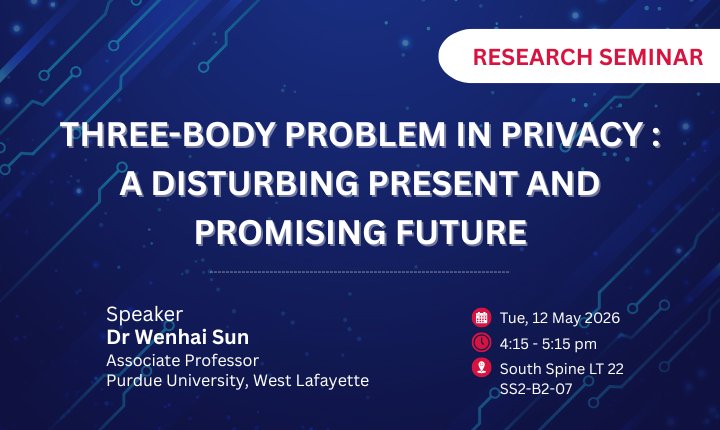
Three-Body Problem in Privacy: A Disturbing Present and Promising Future by Dr Wenhai Sun
Abstract
Privacy is a fundamental requirement for Internet users, and local differential privacy (LDP) has become a widely studied and deployed approach for protecting user data from service providers. Yet recent work has revealed a disturbing new reality: LDP systems themselves can be vulnerable to data poisoning attacks, blurring the traditional boundary between trusted and untrusted parties. In this setting, both users and service providers may become attackers or victims at the same time. This shift has major implications, not only for the practical deployment of privacy-preserving technologies, but also for the safety and freedom of people who rely on them most.
In this talk, Dr. Wenhai Sun will describe this emerging threat landscape and argue that it creates a new three-body problem for privacy research: balancing privacy, security, and utility in increasingly complex systems. He will present recent work on attacks and defenses in LDP-based data collection, and discuss how these challenges extend beyond classical data analytics to modern machine learning and AI systems. Finally, he will share opportunities for using machine intelligence itself to strengthen privacy protections, pointing toward a promising future of AI for privacy.
About the Speaker
Dr. Wenhai Sun is an Associate Professor in the School of Applied and Creative Computing (SACC). He holds two Ph.D. degrees in computer science and cryptography. His research focuses on security and privacy issues across broad systems and applications, with a special interest in the emerging threat of abusing privacy-enhancing technology and AI for privacy.
He has published in top venues such as USENIX Security, NDSS, ACM CCS, NeurIPS, and IEEE INFOCOM, and has served on program committees for IEEE S&P, ACM CCS, and IEEE INFOCOM. Dr. Sun is a University Faculty Scholar, Chair of the Cybersecurity Program in SACC, and an affiliated faculty member with Purdue CERIAS and AARC.
His honors include the NSF CAREER Award (2023), Outstanding Faculty Award in Discovery (2024), Employee Recognition Award (2024), and a Distinguished Paper Award at ASIACCS (2013). He is also an Associate Editor of IEEE TDSC and IEEE TIFS.