
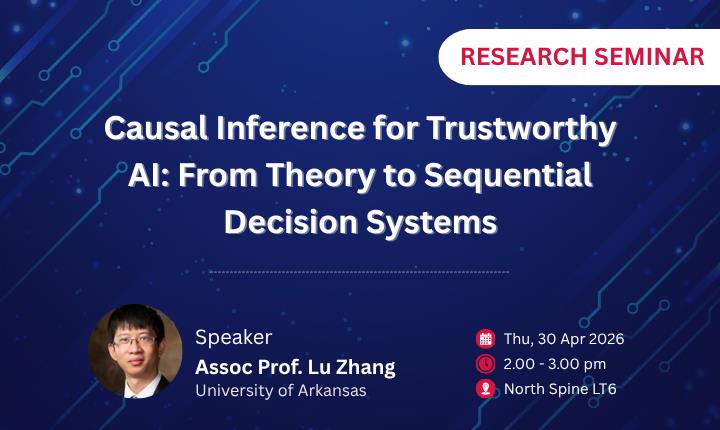
Causal Inference for Trustworthy AI: From Theory to Sequential Decision Systems by Assoc Prof Lu Zhang
Abstract:
Causal inference provides a principled framework for reasoning about interventional and counterfactual effects—capabilities that are essential for building trustworthy AI systems. However, most modern machine learning approaches remain largely correlational, limiting their ability to support reliable decision-making in dynamic and high-stakes environments.
In this talk, I will first introduce the core concepts of causal inference, including structural causal models (SCMs) and intervention-based causal reasoning. I will then turn to sequential decision systems, where actions affect not only immediate outcomes but also the long-term evolution of the population through feedback loops. These dynamics introduce fundamental challenges for trustworthiness, particularly in ensuring fairness over extended time horizons.
To address these challenges, I will present two lines of research on long-term fairness in sequential decision making. In the first line, we model system dynamics using time-lagged causal graphs and address feedback loops through a performative optimization framework. In the second line, we adopt a reinforcement learning perspective to model and optimize decision policies over time. Across both settings, we show that causal reasoning enables principled formulations of fairness as path-specific causal effects, providing a unified perspective on bias in dynamic systems.
The talk concludes with open directions at the intersection of causal inference and modern machine learning, with an emphasis on building fair, robust, and explainable AI systems.
Biography:
Dr. Lu Zhang is an Associate Professor in the Department of Electrical Engineering and Computer Science at the University of Arkansas. He received his Ph.D. in Computer Engineering from Nanyang Technological University, Singapore, and his B.E. in Computer Science and Engineering from the University of Science and Technology of China. He has extensive research experience in machine learning and artificial intelligence. His research has been supported by multiple external funding sources, including an NSF CAREER award on long-term fairness in sequential decision making. His research contributions span fairness in machine learning, causal modeling, and trustworthy AI, with multiple publications in top-tier venues including NeurIPS, AAAI, IJCAI, KDD, and ICLR.