
Humans of ASE part 5: David Lallemant – PI of Disaster Risk and Resilience Analytics Lab
Humans of ASE is a nine-part interview series by the ASE Club Publicity team (previously published on Instagram). This part features Asst Prof David Lallemant, whose research focuses on large-scale natural disaster risk analysis. Check out the comments below to find out about his interesting stories!
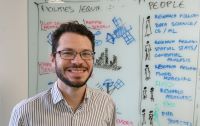
Can you do a self-introduction about yourself and your research interest / areas of expertise?
My name is David Lallemant. I am an Assistant Professor at ASE and Principal Investigator at EOS. My research interest lies in large scale hazard and risk analysis, and developing hazard and disaster models. I used to be a structural engineer, looking at how buildings are affected by disasters. But now I am more interested in looking at how cities or regions are affected by disasters.
What made you want to pursue this area of research?
I was inspired by my family to have a career that is focused on addressing major societal challenges. Also, during a vacation trip to the southern coast of India when I was an undergraduate, the plane that I was in landed in Chennai within the same hour or maybe minutes of the 2004 Indian Ocean Tsunami. Witnessing the impact of the disaster was quite shocking for me, which led me to pursue studies in earthquake engineering and subsequently research in large scale hazard and risk analysis.
How does participating in the post-disaster response and recovery help you in your work?
Having worked in post-disaster response and recovery, for example in Haiti and Nepal, I know that it is critical to have a good understanding of the impact quickly after disasters so that decisions regarding financial aid and food distribution can be made. That drives me to want to develop better models for rapid assessment of disaster impacts. Also, participating in disaster response and recovery allowed me to witness the complex societal problems that led to the creation of extremely vulnerable cities, and turn that into research.
What would you like to say to aspiring environmental / earth scientists that are thinking about applying to ASE?
We try to identify and address some of society’s greatest challenges. What we learn and what we teach are really interesting and important, and our students have a lot of fun in the process. There is a need for people who are passionate and knowledgeable about the earth, environmental and human systems, which I think are very exciting fields and career, and ASE is a good place to start.