
Climate change affects biodiversity through plant-soil feedbacks
In preparation for the United Nations Climate Conference COP25, which starts in Madrid on Dec 2, the journal Science Advances has solicited a special collection of papers on the climate change effects on biodiversity titled "Transformations in Climate and Biodiversity". The purpose of this special issue is to ensure that that those responsible for formulating policies to address climate change have a solid and updated scientific basis for informing their decisions regarding biodiversity and climate during and following COP25, and the Editors of Science Advances will be distributing it widely at the meeting.
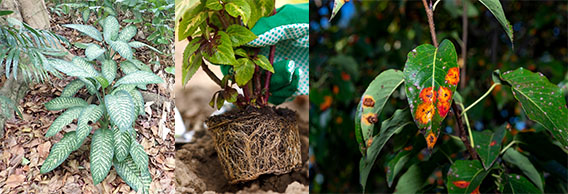
Invasive plant, roots with mycorrhizae and leaf with fungal pathogen.
The special issue includes an article authored by eight experts in five continents, including ASE Professor David Wardle, and deals with the effects of climate change on feedbacks between plants and soil, a topic that has implications not only for conservation but for restoration of degraded land (e.g. peatlands), forest management and agricultural production. All plants are in close connection with the soil they grow in and this includes the bacteria and fungi that live in the soil, acting as decomposers. Soil bacteria and fungi can interact with plants in ways that are either beneficial (e.g. mycorrhizal symbiosis) or harmful (pathogens) to the plant. Soil bacteria and fungi in turn, are adapted to decompose litter from or interact with certain plants, so when climate change causes redistribution and/or shift in plant composition, these interactions can be modified, reorganized or lost.
Climate change will bring higher frequency of extreme weather events. One of the conclusions of the paper is that promotion of the fungal component in soils can help to create better resistance to extreme extreme drought and rainfall, because soils with large fungal networks are more stable under extreme droughts and also more able to retain nutrients, which is good for both plants and soil health. For example, when restoring degraded land by planting seedlings, the seedlings can be prepared with beneficial mycorrhizal fungi. Another conclusion is that plants that are ‘held back’ by fungal pathogens in their native region could colonise new areas thanks to global warming and become dominant and invasive in their new environment due to lack of natural ‘enemies’.
Read the article (open access): Pugnaire, F.I., et al. 2019. Climate change effects on plant-soil feedbacks and consequences for biodiversity and functioning of terrestrial ecosystems. Science Advances 5: eaaz1834.