
Characterization of plankton communities in Singapore coastal waters reveals vast differences between Johor and Singapore Straits
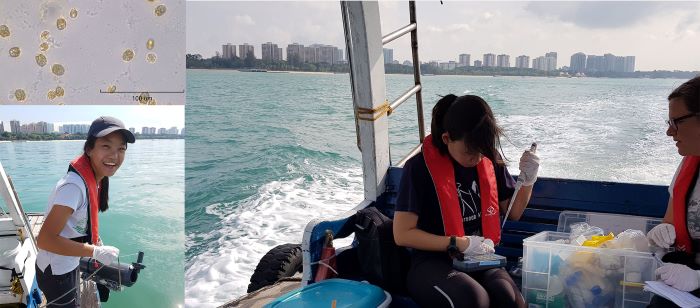
Over the past two years, a group of researchers from Assoc Prof Federico Lauro’s lab (Link to: https://slimelauro.wordpress.com/who-we-are/the-man/), including Dr. Caroline Chénard, Winona Wijaya and Avneet Kaur, have used DNA sequencing technology to characterize the coastal plankton communities on either side of Singapore, in Johor Strait and Singapore Strait. The amount of data generated is unprecedented for Singapore waters, and enabled the researchers to follow the changes in abundance of thousands of plankton species. ASE researchers Asst. Prof. Adriana Lopes Dos Santos, Asst. Prof. Patrick Martin and Prof. Daniel Vaulot are also co-authors of the study, which was recently published in the journal Scientific Reports (https://www.nature.com/articles/s41598-019-52648-x) . “Time series such as the one we set up in Singapore coastal waters are important to monitor perturbations in ocean heath in response to climate change and environmental stresses", explains Caroline Chenard, lead author on the paper. The results also provide insights into the role of specific marine microbial species on ecosystem function at a time where Singapore is investing into major sustainability and conservation projects.
Plankton is a diverse group of small marine organisms with key roles in marine nutrient cycling. But plankton are also highly sensitive to variations in the environment. Both chemical changes like nutrient availability or salinity, and physical ones, such as light availability, temperature, tides, currents etc., cause the composition of plankton communities to change, acting as environmental indicators that informs us about the environmental conditions in a particular body of water. Originally, the study was set up to identify pre-conditions that trigger algal blooms in the Johor Strait, as algal blooms pose a problem for the aquaculture industry in Singapore. Though there were no major algal blooms during the study period, other interesting results emerged, telling a story of two very different marine environments just a few km apart.
It turned out that plankton communities in Johor Strait and Singapore Strait both vary over time, but in different ways. While the plankton community in Singapore Strait is typical of coastal marine habitats, with annual fluctuations following the monsoon seasons, Johor Strait has a plankton community that fluctuates on a monthly basis, linked to the salinity of the water and the sporadic input of nutrients. The Johor Strait waters signal a high level of human impact in the form of nutrient enrichment, displaying nutrient concentrations generally 2 – 10 times higher than Singapore Strait. Limited tidal exchange of water and freshwater inflow has created a new type of marine habitat in Johor Strait, characterized by the impact of human activities. This type of environment with low mixing, stratified water and high nutrient concentration is more prone to algal blooms that the open continuously mixed waters of Singapore Strait. Associate Professor Lauro, who holds a joint appointment at the Singapore Centre for Environmental Life Sciences Engineering (SCELSE) and the Asian School of the Environment (ASE), says about the study: “It is fascinating to observe how rapidly the plankton communities change in Singapore and Johor strait in response to environmental fluctuations. Microbial life is the true thermometer of the marine environment telling us when the ‘patient’ is sick or healthy”.