
ASE undergrads Way Lin and Zhang Meilun accepted to summer internships with ERI Tokyo


Congratulations to ASE undergraduates Way Lin and Zhang Meilun who have been accepted into the summer research internship program at Earthquake Research Institute (ERI), University of Tokyo, Japan. Way Lin and Meilun are both Y2 students in the geoscience specialisation with a keen interest in earthquakes. They will be spending 3 weeks in Tokyo, where they are hosted by local researchers, carrying out research projects. The internship also includes a two-day fieldtrip to the famous Fuji-Hakone-Izu National Park. The internships are supported by the SAKURA exchange program in Science of Japan Science Technology Agency (JST).
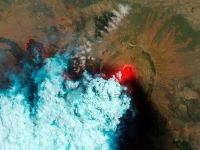
Way Lin’s proposed research topic is ‘Using remote sensing to quantify pre and post volcanic eruption parameters’. Part of her motivation in undertaking this research topic is that the use of remote sensing technologies (such as InSAR, infrared imagery and GIS analysis) provides a cost effective way to obtain almost real time data which can assist in post disaster relief as well as improving future hazard predictions. Through this opportunity to engage in research overseas she expects to gain a deeper understanding of volcanology as well as to be exposed to other research areas at the Earthquake Research Institute.
Meilun’s research topic is about applying machine learning techniques to predict long-term aftershocks from mega earthquakes. For example, in the case of 1976 Tangshan, China earthquake (7.6 Ms), aftershocks can still be felt by people living in Tangshan 40 years after the earthquake took place. Due to the prolonged and detrimental effects of earthquake aftershocks, it is vital to find an effective way to predict them, Meilun explains. She thinks machine learning has great potential to improve earthquake prediction in the future, and this is what her research project will explore. By doing this project, she also wants to realize a seismic hazard assessment by seismic monitoring of the Beijing-Tianjin-Tangshan area, China, which is also her birth place, and where her passion for earthquake studies began. In a broader view, she wishes to gain a better understanding of intracontinental seismic activities, earthquake mechanism, and seismic monitoring. We all know that subduction zone and volcanic arc are sensible areas of earthquake events. However, by studying the cases of mainland China earthquakes, she hopes to investigate the formation and heterogeneity of intracontinental seismic zones.
We wish Meilun and Way Lin all the best with their research projects and an enjoyable stay in Japan!