
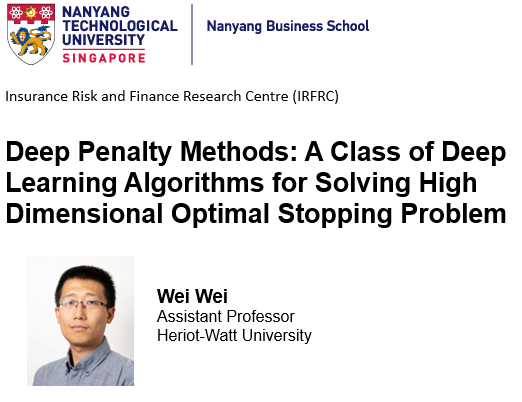
Deep Penalty Methods: A Class of Deep Learning Algorithms for Solving High Dimensional Optimal Stopping Problem
15 Oct 2024
10.30 AM - 12.00 PM
Current Students, Industry/Academic Partners
Tuesday, 15 October 2024
10:30 AM – 12:00 PM
Venue: Gaia Lecture Theatre 5 (#ABS-02-LT5)
Chairperson: Asst Prof Jinggong Zhang
Abstract
High dimensional optimal stopping models (e.g., American option pricing) and corresponding free boundary PDEs have been a long-standing computational challenge. We propose a deep learning algorithm similar in spirit to penalty methods for solving free boundary PDEs. The penalized PDE is approximated within the Deep BSDE framework proposed by \cite{weinan2017deep}. Thus we call the algorithm a “Deep Penalty Method (DPM)''. We show that the error of the DPM can be bounded by the loss function and $O(\frac{1}{\lambda})+O(\lambda h) +O(\sqrt{h})$, where $h$ is the step size in time and $\lambda$ is the penalty parameter. This result cations one from blindly choosing the penalty parameter and suggests the discretization error has convergence rate of order $\frac{1}{2}.$.
About the Speaker
I am an Assistant Professor at the Department of Actuarial Mathematics and Statistics,
Heriot-Watt University. I obtained my PhD degree in the Mathematical and Computational
Finance Group, part of the Mathematical Institute, Oxford University. My research is focused
on developing new theory, methods and algorithms to solve challenging control problems
arising from actuarial science, finance and economics. My research interests lie in the areas of deep learning and its applications on dynamic models; stochastic control; behavioural economics, finance and insurance; tme-inconsistent decision making; credit risk.