



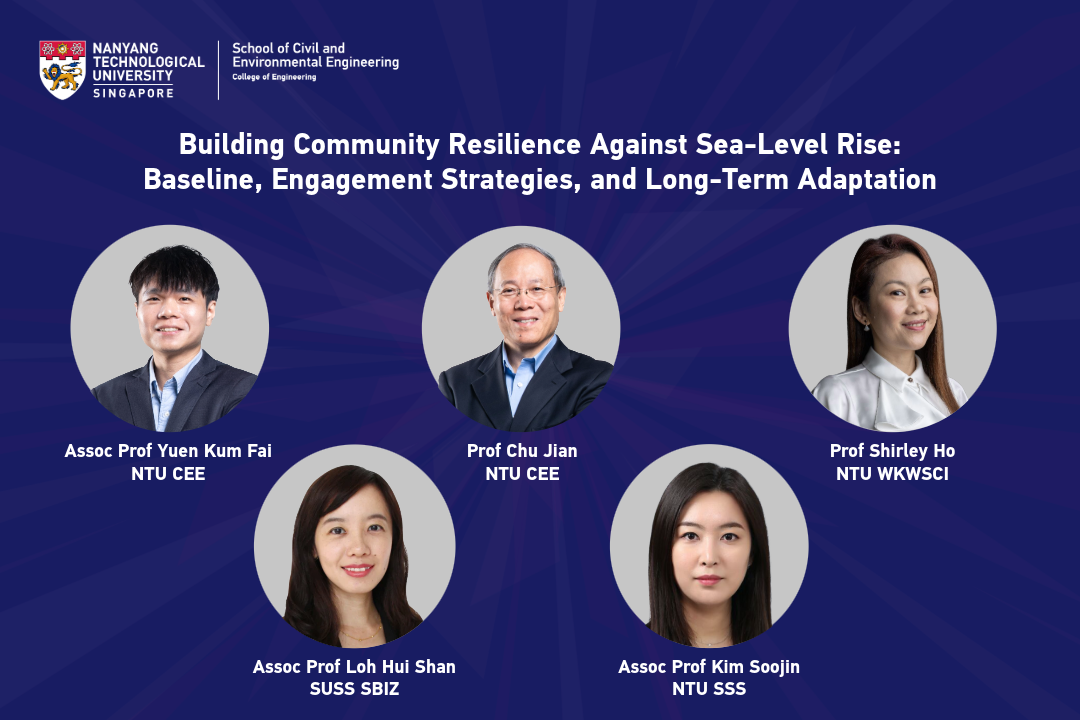
The School is pleased to announce that the project, “Building Community Resilience Against Sea-Level Rise: Baseline, Engagement Strategies, and Long-Term Adaptation”, has been awarded under the RIE2025 Marine Climate Change Science (MCCS) Programme.
This initiative is sponsored by the National Research Foundation and led by the National Parks Board and the Centre for Liveable Cities, with key participation from the Housing and Development Board, Public Utilities Board, and Sentosa Development Corporation, reflecting a strong multi-agency collaboration.
The project is driven by an interdisciplinary team, bringing together expertise across the fields of engineering, communication, and social sciences:
- Associate Professor Yuen Kum Fai (NTU School of Civil and Environmental Engineering)
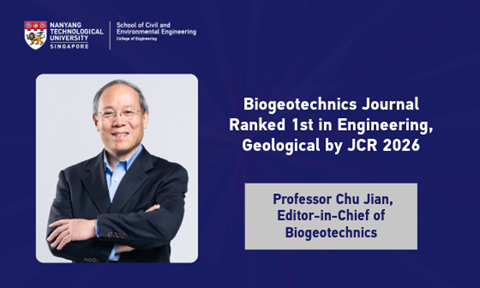
- Professor Chu Jian (NTU School of Civil and Environmental Engineering)
- Professor Shirley Ho (NTU Wee Kim Wee School of Communication and Information)
- Associate Professor Loh Hui Shan (SUSS School of Business)
- Associate Professor Kim Soojin (NTU School of Social Sciences)
This project aims to achieve the following:
- Establish a baseline of public risk perception and adaptation readiness
- Develop targeted engagement strategies for communities and businesses
- Forecast long-term behavioural responses to sea-level rise using advanced modelling
This research will generate evidence-based, policy-relevant insights to support Singapore’s long-term climate adaptation strategy. By bridging behavioural science, data analytics, and policy design, it aims to strengthen community-driven resilience and inform scalable solutions for coastal cities globally.
About the RIE2025 Marine Climate Change Science (MCCS) Programme
Set up in 2021, the programme serves as a national focal point for multi-disciplinary marine climate change research. It aims to advance the core sciences of marine climate change and develop solutions to help address the challenges faced by our coastal and marine environment arising from climate change, such as sea level rise, increasing sea surface temperatures, and extreme storm events.