
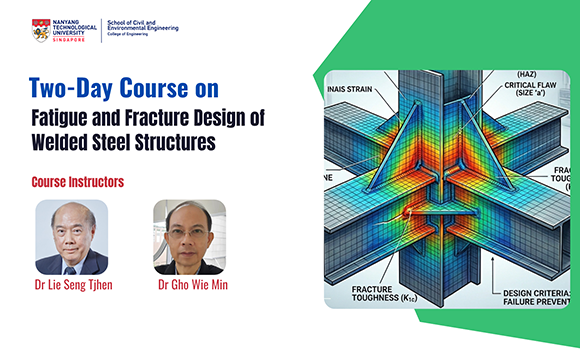
Short Course on Fatigue and Fracture Design of Welded Steel Structures
click here
Organized By
School of Civil and Environmental Engineering
Topic
Blast Loading on Structures: Design, Simulation and Mitigation Strategies
For Whom
This short course is specifically designed for practicing engineers and industry professionals to deepen their understanding of fatigue and fracture design in structural steelworks. It is particularly suited for experienced design engineers, consultants, and technical specialists involved in the design, analysis, assessment, or maintenance of steel structures who seek to strengthen their competence in this critical area. Participants will gain insight into the fundamental mechanisms of fatigue crack initiation and propagation, the effects of cyclic loading, and key aspects of fracture behaviour. The course also covers material toughness and the influence of loading and environmental conditions on the risk of brittle failure.
Registration Fee
| Public | SGD $900* / pax |
| NTU Alumni | SGD $800* / pax |
| * Fees inclusive of prevailing GST, tea breaks & buffet lunch | |
| Cancellation:The organisers reserve the right to amend any details relating to the seminar, revise the seminar fees without prior notice, cancel or postpone the seminar. | |
Abstract
Fatigue and fracture are critical safety considerations in steel building structures. Fatigue failure is associated with repeated loading at relatively low stress levels, such as those induced by wind and vibration, which can cause small cracks to initiate and grow over time. Once a crack initiates, it may propagate, potentially leading to rapid, catastrophic failure (fracture). This short course, based on Singapore Standards SS EN 1993-1-8, SS EN 1993-1-9, and SS EN 1993-1-10, provides participants with the necessary technical background, supported by worked examples, to better understand fatigue and fracture assessment of structural members and joints in steel structures subjected to cyclic loading. In addition, the strength and integrity assessment of cracked hollow-section joints using a fracture-mechanics approach will be demonstrated.
About the Speakers
Speaker 1: Dr Lie Seng Tjhen
Dr Lie is formerly an Associate Professor in the School of Civil and Environmental Engineering at the Nanyang Technological University, Singapore. He has been lecturing in the design of steel structures using
BS5950: 2000 for many years, and he was the task force leader in developing the Singapore National Annex for EC3: Part 1-9: Fatigue. His main research interests have been in the field of fatigue and fracture of welded joints since his earlier time as a research student at UMIST in U.K. The research interest is focused on damage and fracture mechanics, developing failure assessment diagram for cracked welded structures, in particular its direct practical application to fatigue and fracture assessment of cracked onshore/offshore welded structures.
For the past decades, he has also been associated with research related to welding technology, weld defects, size effects, weld ability of high strength steels and residual stresses. He is a Senior Member of The Welding Institute and a registered Chartered Engineer with the Engineering Council, UK, and he had secured several industrial funded projects from Singapore Maritime Institute. In this related research field, he had published more than 120 journal and conference papers.
Speaker 2: Dr Gho Wie Min
Dr. Gho has over 35 years of experience in civil engineering, marine offshore, and energy industries. He is currently Vice President of Engineering at LNG Alliance and Aslan Energy Capital, where he leads engineering and technology initiatives for LNG terminals, hydrogen and ammonia production, and renewable energy infrastructure, driving innovation to enhance efficiency and support sustainable growth.
His extensive background includes leadership positions involving FPSOs, FLNG facilities, offshore platforms, and major civil engineering structures. He has also pioneered innovative technologies such as floating LPG terminals, deep-water jack-ups, eccentric steel jackets, and predictive failure systems for CNG cylinders.
Dr Gho has more than 25 years of experience in the fatigue assessment of civil and offshore structures. He is also a guest lecturer at NTU, where he teaches a postgraduate module on fatigue and fracture of steel structures. He holds a BEng (First Class Hons) in Civil and Structural Engineering from the University of Sheffield, an MSc (DIC) in Earthquake Engineering and Structural Dynamics from Imperial College London, and a PhD from NTU.
Course Outline
| Day 1 - Thursday, 25 June 2026 | ||
| Time | Theme | Speaker |
| 09:00 | Fatigue of Materials
| Gho Wie Min |
| 10:00 | Tea Break | |
| 10:15 | Fatigue Stresses and Stress Ranges
| Gho Wie Min |
| 12:15 | Lunch | |
| 13:15 | Fatigue Design to Eurocode 3
| Gho Wie Min |
| 15:15 | Tea Break | |
| 15:30 | Verification of Fatigue Resistance
| Gho Wie Min |
| 17:00 | End of First Day | |
| Day 2 - Friday, 26 June 2026 | ||
| Time | Theme | Speaker |
| 09:00 | Material Selection and Criteria
| Gho Wie Min |
| 10:00 | Tea Break | |
| 10:15 | Fracture Mechanics and Parameters
| Lie Seng Tjhen |
| 12:15 | Lunch | |
| 13:15 | Application of Fracture Mechanics
| Lie Seng Tjhen |
| 15:15 | Tea Break | |
| 15:30 | Safety Assessment of Cracked Structures
| Lie Seng Tjhen |
| 17:00 | End of Course | |
Registration
Click here for registration
- Please register by 3 June 2026.
- The payment details/link will be sent separately, after we have confirmed your registration.
- Please note that there is no refund of fees for cancellation.