Can AI be used to detect Mental Health Risk from Speech and Language?: Research
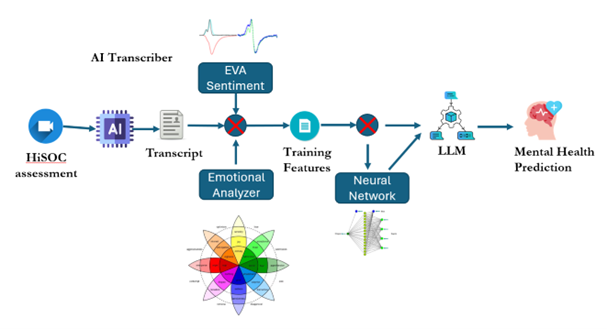
In the research, “Emotion-Informed Associative Learning in Large Language Models for Mental Health Detection from Speech” co-lead by Asst. Prof Wilson Goh and Dr Jimmy Lee from IMH, researchers are working to design a clinically useful next-generation speech and sentiment/emotional markers with strong predictive performance that also generalize across different mental health conditions, populations, and clinical settings. They aim to overcome the challenge of how people can express distress in highly diverse and nuanced ways.
The team has developed a new LLM/LRM framework, Latent Emotion proxy for Mental health detection (LEMon) which is privacy-protecting and able to outperform out-of-box LLMs in predicting clinical high risk individuals. LEMon is trained by teaching a foundation model which aspects of emotions constitute important risk factors. Few-shot learning with limited examples further push performance limits.
Although the models are not yet safe for clinical deployment without appropriate supervision, if successfully developed, it may significantly improve mental healthcare through earlier detection of warning signs from everyday speech, improve screening tools to support early diagnosis and allowing continuous monitoring of speech patterns via phone calls, therapy sessions or digital platforms that could help track mental health changes over time.
Team:
Matheus Calvin Lokadjaja
Jordon Junyang Kho
Zixu Yang
Jimmy Lee (co-PI)
Wilson Wen Bin Goh (PI)
C-AIM Lead:
 | GOH Wen Bin Wilson |
Related Research Domain: Mental Health
Keywords: Mental Health; Large Language Models; Sentiment Analysis; Emotion-Aware AI; Ultra-High Risk
.tmb-listing.jpg?Culture=en&sfvrsn=2a62f216_1)