Advancing Precision Medicine: Leveraging Genomic and Aging Biomarkers for Enhanced Cancer Risk Prediction
Early cancer detection by screening improves cancer treatment and control. Current screening recommendations based solely on age and gender overlook other vital factors and are non-optimal. Precision medicine advocates for discriminative clinical risk models. Polygenic risk scores (PRSs), which incorporate information about inherited genetic risk for cancer from common genetic variants in the population show promise but are debatable to be sufficiently robust on their own for cancer prediction. Other risk prediction models also suggest improvements in cancer risk stratification when common polygenic risk burdens are jointly modelled with rare, coding defects as well as lifestyle and clinical risk factors. Additionally, ageing biomarkers such as leukocyte telomere lengths (TL) have emerged as potential causal biomarkers for cancer risks.
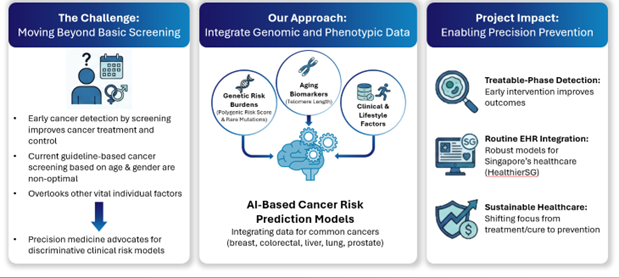
The project aims to create more accurate, personalised cancer risk predictions by combining 3 types of data:
- Genetic Risk
- Polygenic Risk Scores (PRS): many small genetic variants that together raise cancer risk
- Rare genetic mutations: strong, harmful mutations in cancer‑related genes - Ageing Biomarkers
- Telomere length: a measure of how fast your cells age
- Lifestyle + Health Records
- Clinical data already stored in the Electronic Health Record (EHR)
Early and preclinical interventions improve long-term health outcomes and reduce costs. By developing robust cancer risk models for routine EMR use in Singapore, this project enables treatable-phase detection and provides data-driven evidence for policy initiatives like HealthierSG to shift the focus from treatment/cure to prevention.
C-AIM Lead:
 | Joanne NGEOW Yuen Yie |
Related Research Domain: Implementation, Ageing/ Frailty, Cancer
Keywords: Electronic Health Record; Cancer Risk Model; Polygenic Risk Score; Precision Prevention
.tmb-listing.jpg?Culture=en&sfvrsn=2a62f216_1)