
About SCRIPTS
What We Do
SCRIPTS specialises in privacy-preserving technologies (PP-Tech) that are computing techniques used to preserve individual’s privacy while allowing maximum value and insight to be extracted from available data. These technologies enable organisations to carry out data mining, analysis and sharing in compliance with data protection regulation enacted in various jurisdictions. PP-Tech will provide solutions and knowledge on how to best utilise data collected to benefit Singapore’s advancement towards a Smart Nation without compromising privacy.
The Centre focuses on the research, development and application of customised privacy-preserving technologies aligned with the national priorities of Singapore in the Services and Digital Economy of the Research, Innovation, and Enterprise (RIE) 2020 plan. Our work is funded by a $15.3 million grant from the Infocomm Media Development Authority (IMDA), and supported by the National Research Foundation, Singapore (NRF).

Research Focus
Learn moreWe explore the following PP-Tech with the aim of providing solutions to government and industry, adding value to the digital economy, and promoting social adoption.

Student Testimonial
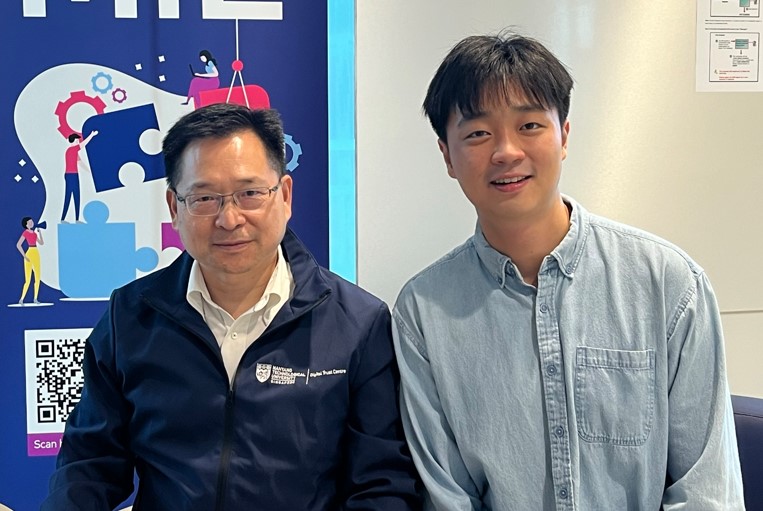
I enrolled at NTU in 2022 to pursue a M.Eng degree under the supervision of Prof. Lam Kwok Yan. I am thrilled to share that I have recently graduated and started my next journey as a data scientist at a German company. I am deeply grateful for Prof. Lam’s unwavering support and thoughtful guidance. His mentorship provided me with an excellent opportunity to explore advanced topics, complemented by his invaluable insights, extensive knowledge, and vast experience. Under his supervision, I had the privilege of working in a conducive environment with ample time to delve into meaningful and impactful research. The dedication and rigorous approach to research that Prof. Lam instilled in me will remain a lifelong treasure and a cornerstone of my future career journey.
Shen Jiyuan, SCRIPTS Scholarship Recipient in AY2022/2023



Events
View all eventsSeminar by Dr Maggie Liu, RMIT University, Australia on 19 Feb 2025, RTP Harvard Room
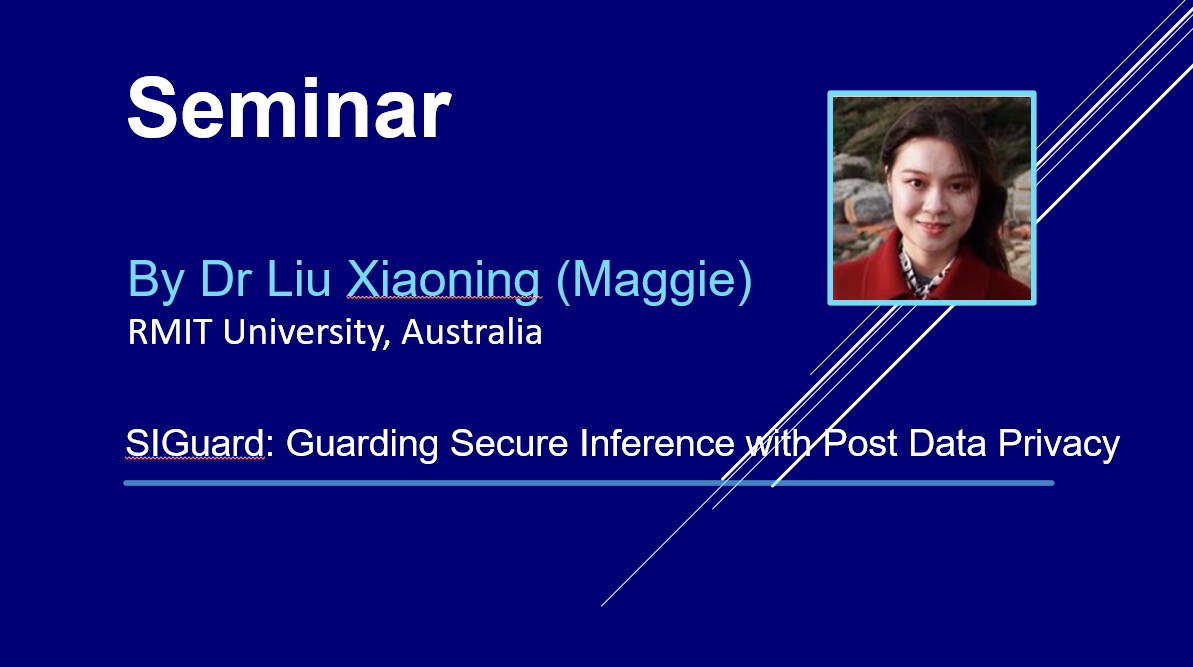
Time: 19 Feb 2025, 3pm to 4pm
Venue: Research Techno Plaza, Level 2, Harvard Room
Title: SIGuard: Guarding Secure Inference with Post Data Privacy
Bio: Dr Xiaoning (Maggie) Liu is a Lecturer (aka Assistant Professor) at the School of Computing Technologies, RMIT University, Australia. Her research pivots on data privacy and security related to machine learning, cloud computing, and digital health. Her current focus is on designing practical secure multiparty computation protocols and systems to its applications in privacy-preserving machine learning. In the past few years, her work has appeared in prestigious venues in computer security, such as USENIX Security Symposium, NDSS, and European Symposium on Research in Computer Security (ESORICS), IEEE Transactions on Dependable and Secure Computing (TDSC), IEEE Transactions on Information Forensics and Security (TIFS). Her research has been supported by Australian Research Council, and CSIRO. She is the recipient of the Best Paper Award of ESORICS 2021.
Abstract: Secure inference is designed to enable encrypted machine learning model prediction over encrypted data. It will ease privacy concerns when models are deployed in Machine Learning as a Service. For efficiency, most of recent secure inference protocols are constructed using secure multi-party computation (MPC) techniques. However, MPC-based protocols do not hide information revealed from their output. In the context of secure inference, prediction outputs (i.e., inference results of encrypted user inputs and models) are revealed to the users. As a result, adversaries can compromise output privacy of secure inference, i.e., launching Membership Inference Attacks (MIAs) by querying encrypted models, just like MIAs in plaintext inference. In this talk, I will first share our observations on the vulnerability of MPC-based secure inference to MIAs, though it yields perturbed predictions due to approximations. Then I will report on our recent research effort in guarding the output privacy of secure inference from being exploited by MIAs. I will also discuss the future research along with the line of privacy-preserving machine learning and deep learning.
Patents
Lam Kwok Yan, et. al. Privacy-Preserving Neural Network Based on FHE Scheme, Fast Track Provisional Filing, 24 February 2022. Singapore provisional patent application number 10202201824W.
Lam Kwok Yan, et. al. Optimization Of FHE Scheme For Non-Linear Functions: An Efficient Design For LUT-Based Non-Linear Function Evaluation, Fast Track Provisional Filing, 13 May 2022. Singapore provisional patent application number 10202205037W.
Lam Kwok Yan, et. al. Privacy-Preserving Neural Network Model And Privacy-Preserving Prediction Using The Privacy-Preserving Neural Network Model, PCT Patent International Filing (claiming priority to earlier SG application nos. 10202201824W & 10202205037W), 15 February 2023, PCT Application No: PCT/SG2023/050085. International Publication No: WO 2023/163652 A2, 31 August 2023.
Lam Kwok Yan, et. al. Efficient FHE-Based Training On Encrypted Data, 23 January 2024, Singapore provisional patent application number 10202400198U.
Lam Kwok Yan, et. al. Two-Party Privacy-Preserving Subgraph Checking Over Unlabeled Graphs, 15 April 2024, Singapore provisional patent application number 10202401083W.