
About SCRIPTS
What We Do
SCRIPTS specialises in privacy-preserving technologies (PP-Tech) that are computing techniques used to preserve individual’s privacy while allowing maximum value and insight to be extracted from available data. These technologies enable organisations to carry out data mining, analysis and sharing in compliance with data protection regulation enacted in various jurisdictions. PP-Tech will provide solutions and knowledge on how to best utilise data collected to benefit Singapore’s advancement towards a Smart Nation without compromising privacy.
The Centre focuses on the research, development and application of customised privacy-preserving technologies aligned with the national priorities of Singapore in the Services and Digital Economy of the Research, Innovation, and Enterprise (RIE) 2020 plan. Our work is funded by a $15.3 million grant from the Infocomm Media Development Authority (IMDA), and supported by the National Research Foundation, Singapore (NRF).

Research Focus
Learn moreWe explore the following PP-Tech with the aim of providing solutions to government and industry, adding value to the digital economy, and promoting social adoption.

Student Testimonial
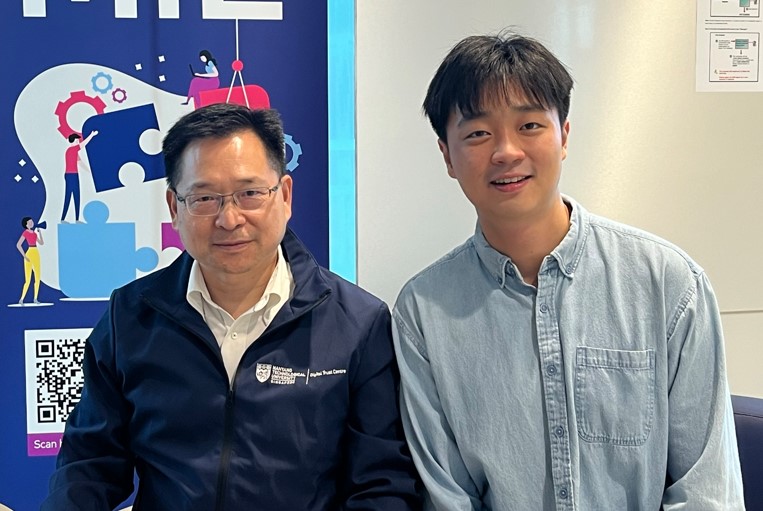
I enrolled at NTU in 2022 to pursue a M.Eng degree under the supervision of Prof. Lam Kwok Yan. I am thrilled to share that I have recently graduated and started my next journey as a data scientist at a German company. I am deeply grateful for Prof. Lam’s unwavering support and thoughtful guidance. His mentorship provided me with an excellent opportunity to explore advanced topics, complemented by his invaluable insights, extensive knowledge, and vast experience. Under his supervision, I had the privilege of working in a conducive environment with ample time to delve into meaningful and impactful research. The dedication and rigorous approach to research that Prof. Lam instilled in me will remain a lifelong treasure and a cornerstone of my future career journey.
Shen Jiyuan, SCRIPTS Scholarship Recipient in AY2022/2023




Events
View all eventsSeminar by Dr Xu Yanhong, Shanghai Jiao Tong University, China, RTP Harvard Room
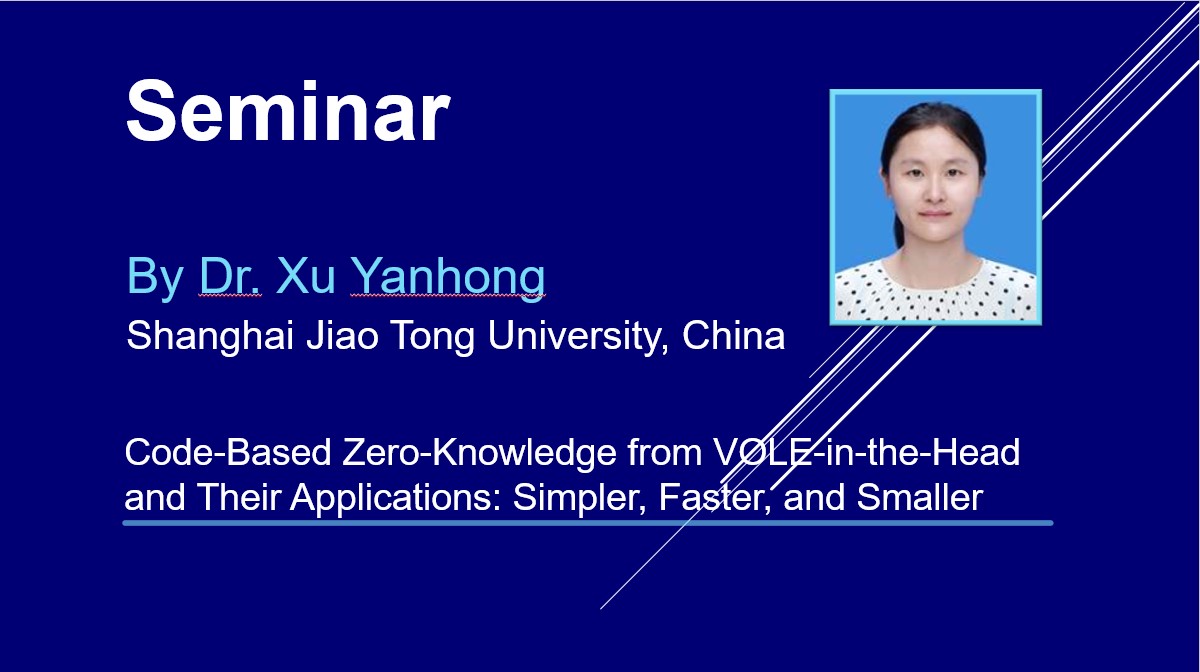
Time: 2 Dec 2024, 11.30am to 12.30pm
Venue: Research Techno Plaza (RTP), Level 2, Harvard Room
Title: Code-Based Zero-Knowledge from VOLE-in-the-Head and Their Applications: Simpler, Faster, and Smaller
Bio: Yanhong Xu is currently a research assistant professor in Shanghai Jiao Tong University. Before joining SJTU, she was a postdoc at university of Calgary, and pursued a PhD on lattice-based cryptography from NTU. Her research interests include lattice-based and code-based cryptography, particularly zero-knowledge protocols and its applications to privacy-preserving protocols. She has published several papers on Asiacrypt, PKC, Theoretical Computer Sciences etc
Abstract: Zero-Knowledge (ZK) protocols allow a prover to demonstrate the truth of a statement without disclosing additional information about the underlying witness. Code-based cryptography has a long history but did suffer from periods of slow development. Recently, a prominent line of research have been contributing to designing efficient code-based ZK from MPC-in-the-head (Ishai et al., STOC 2007) and VOLE-in-the head (VOLEitH) (Baum et al., Crypto 2023) paradigms, resulting in quite efficient standard signatures. However, none of them could be directly used to construct privacy-preserving cryptographic primitives. Therefore, Stern's protocols remain to be the major technical stepping stones for developing advanced code-based privacy-preserving systems.
This work proposes new code-based ZK protocols from VOLEitH paradigm for various relations and designs several code-based privacy-preserving systems that considerably advance the state-of-the-art in code-based cryptography. Our first contribution is a new ZK protocol for proving the correctness of a regular (non-linear) encoding process, which is utilized in many advanced privacy-preserving systems. Our second contribution are new ZK protocols for concrete code-based relations. In particular, we provide a ZK of accumulated values with optimal witness size for the accumulator (Nguyen et al., Asiacrypt 2019). Our protocols thus open the door for constructing more efficient privacy-preserving systems. Moreover, our ZK protocols have the advantage of being simpler, faster, and smaller compared to Stern-like protocols. To illustrate the effectiveness of our new ZK protocols, we develop ring signature (RS) scheme, group signature (GS) scheme, fully dynamic attribute-based signature scheme from our new ZK. The signature sizes of the resulting schemes are two to three orders of magnitude smaller than those based on Stern-like protocols in various parameter settings. Finally, our first ZK protocol yields a standard signature scheme, achieving ``signature size + public key size'' as small as $3.05$ KB, which is slightly smaller than the state-of-the-art signature scheme (Cui et al., PKC 2024) based on the regular syndrome decoding problems.
Patents
Lam Kwok Yan, et. al. Privacy-Preserving Neural Network Based on FHE Scheme, Fast Track Provisional Filing, 24 February 2022. Singapore provisional patent application number 10202201824W.
Lam Kwok Yan, et. al. Optimization Of FHE Scheme For Non-Linear Functions: An Efficient Design For LUT-Based Non-Linear Function Evaluation, Fast Track Provisional Filing, 13 May 2022. Singapore provisional patent application number 10202205037W.
Lam Kwok Yan, et. al. Privacy-Preserving Neural Network Model And Privacy-Preserving Prediction Using The Privacy-Preserving Neural Network Model, PCT Patent International Filing (claiming priority to earlier SG application nos. 10202201824W & 10202205037W), 15 February 2023, PCT Application No: PCT/SG2023/050085. International Publication No: WO 2023/163652 A2, 31 August 2023.
Lam Kwok Yan, et. al. Efficient FHE-Based Training On Encrypted Data, 23 January 2024, Singapore provisional patent application number 10202400198U.
Lam Kwok Yan, et. al. Two-Party Privacy-Preserving Subgraph Checking Over Unlabeled Graphs, 15 April 2024, Singapore provisional patent application number 10202401083W.