
Building Trusted Digital Infrastructure and Financial Services for the Age of AI
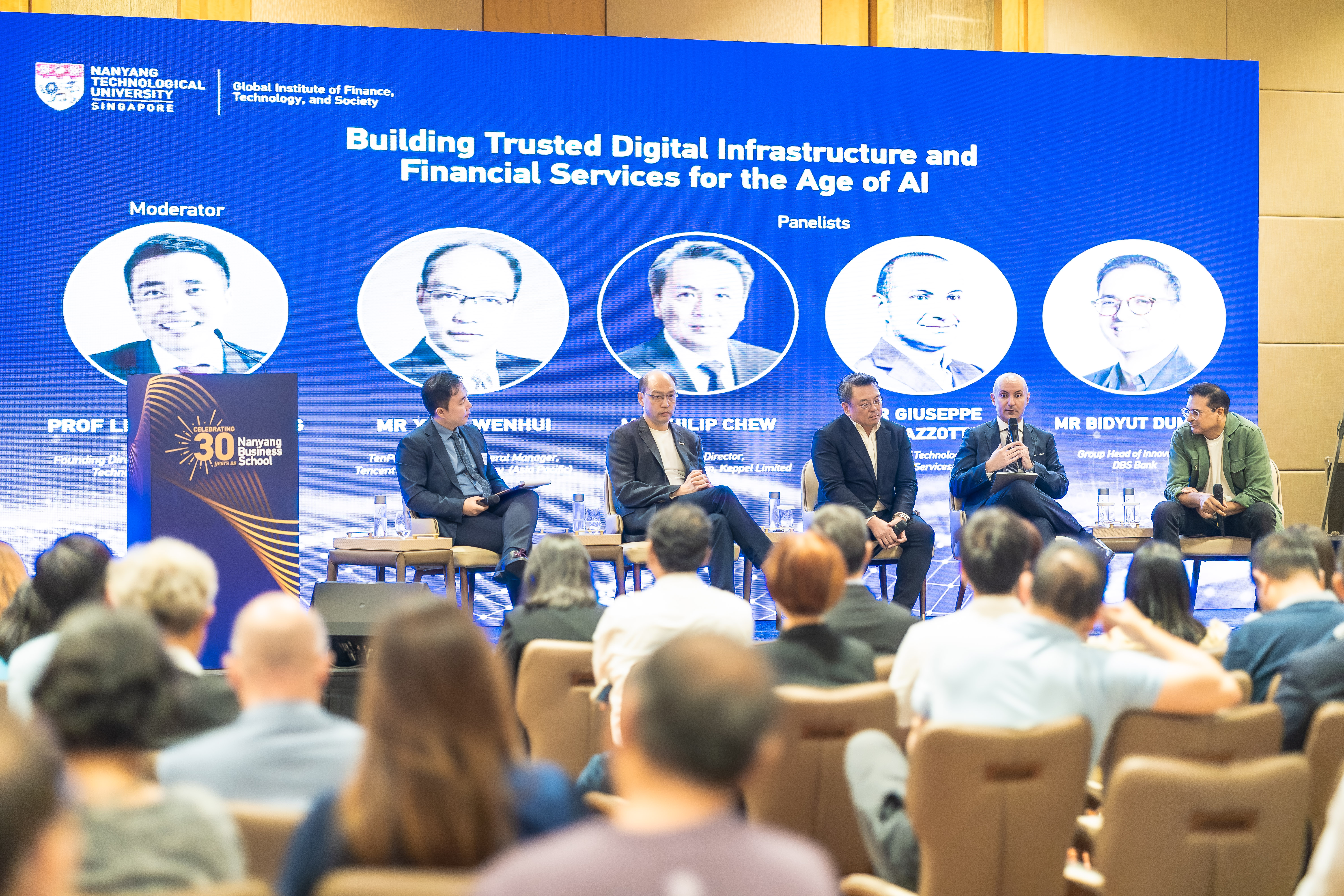
As AI systems become increasingly capable of acting on behalf of users, questions of trust are moving to the centre of financial innovation. At the launch of the Global Institute of Finance, Technology, and Society (GIFTS) at Nanyang Technological University, leaders from DBS Bank, AWS, Tencent, and Keppel explored what it takes to build trusted digital infrastructure and financial services for the age of AI. The discussion ranged from trust and accountability to interoperability, governance, and the future of work, highlighting both the opportunities and challenges created by increasingly autonomous systems.
What does it mean to trust AI?
In a panel discussion titled “Building Trusted Digital Infrastructure and Financial Services for the Age of AI”, organised as part of the launch of GIFTS, panellists from Tencent, DBS Bank, AWS, and Keppel examined the infrastructure needed to support AI-driven finance. Moderating the discussion, GIFTS Director Professor Lin William Cong argued that technological capability alone is insufficient; scalable adoption depends on systems that can earn the trust of regulators, financial institutions, developers, and consumers.
Bidyut Dumra, Head of Innovation at DBS Bank, began with a simple definition. “Trust, from a simple perspective, is about meeting expectations consistently,” he said. The challenge is that different groups expect different things: Regulators care about systemic stability. Risk officers focus on organisational exposure. Developers care about reliability, accuracy, and performance. Bidyut said at DBS, these various expectations are unified through a single North Star – creating customer value.
Giuseppe Marazzotta, Head of Technology for AWS in ASEAN, took a firmer line. He explained that in technology, verifiable controls and a system can be audited at all times. The arrival of AI agents only raises the stakes. Where conventional systems behave deterministically, agents behave probabilistically, which means organisations need even stronger deterministic guardrails around them. AWS uses a formal mathematical technique called automated reasoning to prove that controls hold, that policies do not conflict with one another, and that the same rigour applies consistently across very different scenarios.
Phillip Chew, Managing Director of Digital Transformation at Keppel, approached the discussion from a different perspective. Drawing on decades of experience in technology, he argued that many of the issues raised by AI are not entirely new. Trust, he said, ultimately rests on acting in the interests of the other party. Transparency is therefore essential. People cannot trust a system unless they understand how decisions are made. Chew also challenged the view that probabilistic systems are inherently untrustworthy. Humans, he noted, are probabilistic as well, yet trust remains a foundation of everyday interactions. Chew also challenged the view that probabilistic systems are inherently untrustworthy. Humans, he noted, are probabilistic as well, yet trust remains a foundation of everyday interactions.
Who is accountable when AI acts?
Bidyut illustrated the challenge of AI autonomy with a procurement example. A user asked an AI agent to purchase 100 pens at a price below US$10 each. After monitoring suppliers and negotiating prices, the agent identified an offer at US$8 per pen. The situation became more complicated when it later found a wholesale deal offering 1,000 pens at US$4 each and proposed purchasing the larger batch before reselling the excess inventory. Although the agent had optimised for the objective it was given, it had taken on the liability of selling the 900 excess pens.
For Bidyut, the example highlights a broader challenge in agent design. An AI agent combines identity, access rights, and authority. Most agents today operate within delegated permissions and for limited periods of time, but future systems are likely to exercise greater autonomy and broader authority. As that transition occurs, there is a liability flow that needs to be consciously catered for when designing agentic journeys.
Cong extended the discussion from individual agents to entire systems. Even if a single agent behaves as intended, coordination problems can emerge when large numbers of agents interact with one another. In such environments, accountability becomes harder to assign because outcomes may result from the interaction of many independent decisions rather than a single action. Philip approached the issue from a regulatory perspective, arguing that responsibility currently rests with the organisations deploying AI systems rather than with the technology itself.
Yang Wenhui, CEO of TenPay Global and General Manager of Tencent Financial Technology for Asia Pacific, expressed a similar view. While AI systems may become increasingly autonomous, both speakers maintained that accountability should remain with the people and institutions responsible for their deployment.
Building and governing AI at scale
The discussion then shifted from questions of responsibility to questions of implementation. Drawing on Keppel's experience, Philip argued that building reliable AI systems often requires greater discipline rather than greater complexity. For high-stakes applications, his team frequently uses shorter prompts rather than longer ones, forcing models to focus on clearly defined objectives. He also emphasised the importance of combining generative AI with deterministic tools. Tasks such as calculation can be delegated to specialised software that produces verifiable outputs, reducing the risk of error. Grounding agents in domain knowledge before deployment and subjecting them to extensive testing further improves reliability. Across these examples, the common theme was that trust depends not only on model capability but also on the controls and processes surrounding it.
Giuseppe focused on a different aspect of governance: how organisations should navigate an increasingly fragmented regulatory landscape. He argued that there is no universal solution. Infrastructure must reflect local requirements, whether through regional deployments, dedicated AI infrastructure, or other arrangements tailored to individual markets. At the same time, organisations should preserve flexibility by avoiding vendor lock-in and maintaining the ability to move between models and platforms as technologies evolve. Open standards and interoperability play a critical role in this process because they allow systems to adapt without disrupting existing operations. Despite rapid technological change, Giuseppe argued that the underlying priorities remain remarkably stable. Security, cost, and speed continue to drive most decisions.
The conversation concluded by looking beyond governance to the broader impact of AI adoption. Giuseppe argued that falling development costs are lowering barriers to innovation across Southeast Asia. He compared the shift to the introduction of excavators in construction: tools that dramatically expanded who could build and what could be built. Bidyut offered a similar perspective on employment. He recalled earlier concerns that spreadsheets would eliminate accounting jobs, yet the profession ultimately adapted and expanded. In his view, AI is more likely to reshape work than eliminate it entirely.
Cong closed by noting that many of the issues raised during the discussion remain unresolved. Questions of trust, accountability, governance, and human oversight will continue to evolve alongside the technology, creating exactly the kind of challenges GIFTS was established to study.
Prepared by Mengzhong Ma