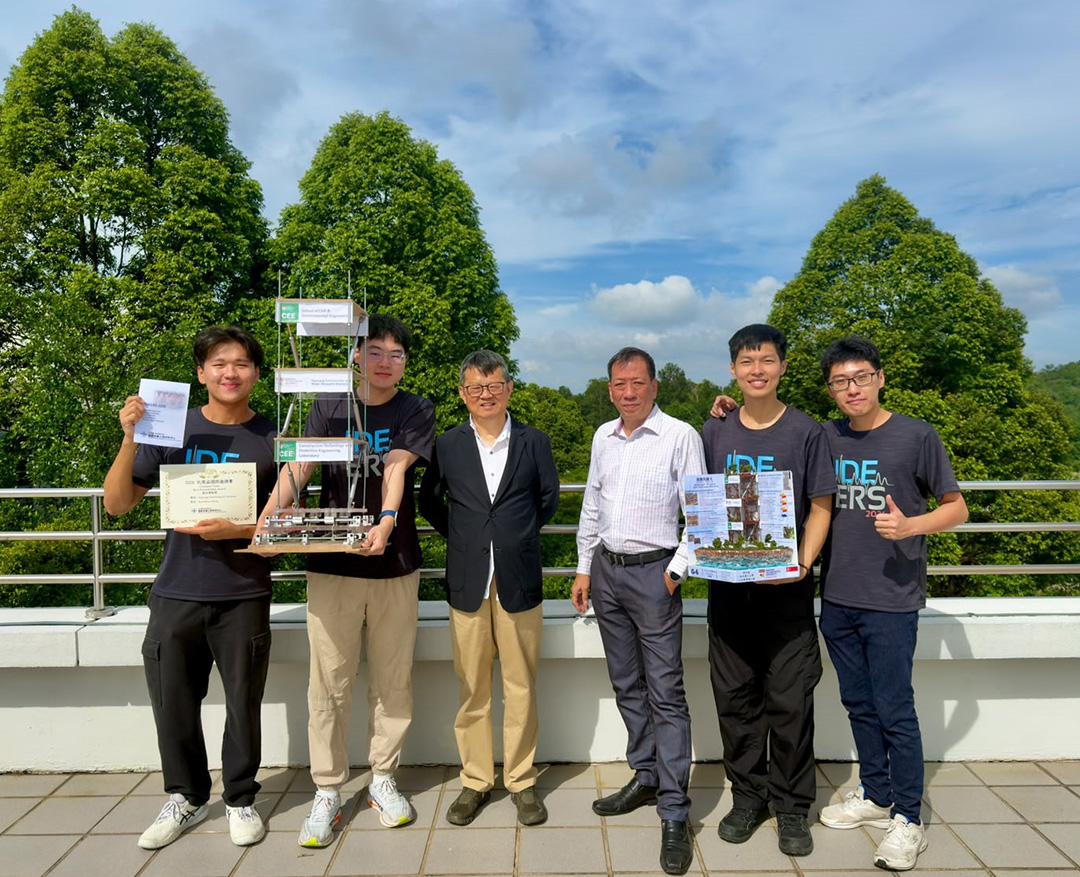
From left: Wiranto Winata, Ye Zining, Assoc Prof Li Bing, Choi Siew Pheng, Wu Chia-Ho and Er. Kong Kok Khuen
A team of postgraduate students from NTU’s School of Civil and Environmental Engineering (CEE) achieved fifth place overall and won three awards at the Introducing and Demonstrating Earthquake Engineering Research in Schools (IDEERS) 2026 Competition. The competition was held at the National Centre for Research on Earthquake Engineering (NCREE) in Taipei, Taiwan.
Comprising Er. Kong Kok Khuen, Wiranto Winata, Ye Zining and Wu Chia-Ho, the team received the Design-Concept Exhibition Award, Best Presentation Award and Aesthetic Architecture Award.
The programme included an international conference with design concept presentations, structural model construction and review, and shake-table testing using simulated earthquake ground motions.
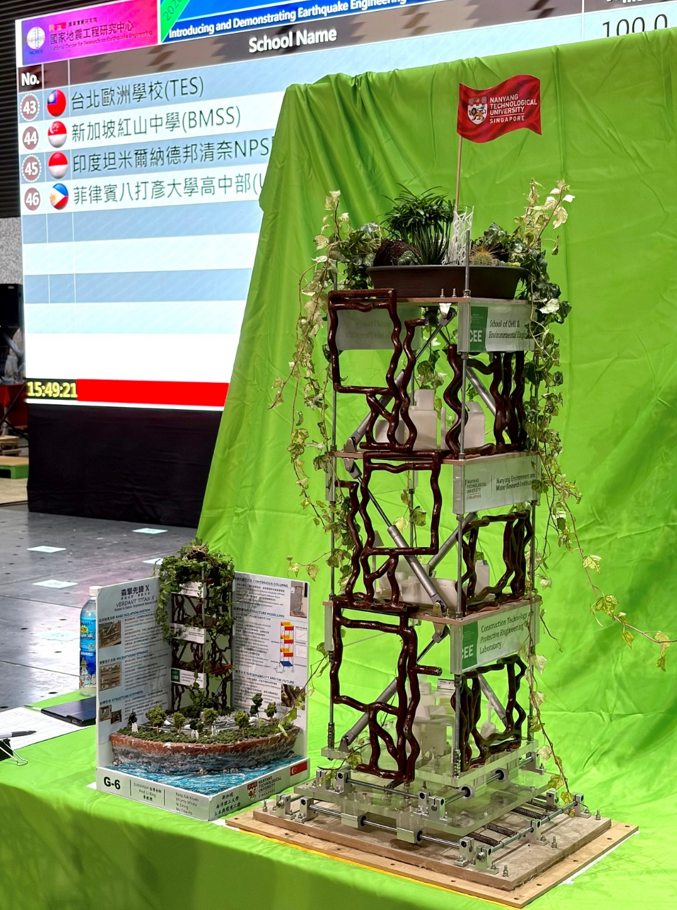
The team’s exhibition model (left) and structural model featuring a base seismic isolation system (right)
For their entry, the team developed a structural model incorporating a two-directional base isolation system designed to reduce the transmission of earthquake-induced ground motion to the superstructure.
In addition to its structural performance, the model incorporated an architectural concept inspired by the trees lining NTU’s pedestrian pathways. Using 3D printing, the team developed an irregular, tree-inspired façade complemented by climbing greenery to create a natural and visually distinctive architectural expression.
The project provided the team with an opportunity to apply concepts in structural dynamics, earthquake engineering and seismic isolation to a physical structural system, integrating numerical analysis, structural design and experimental testing.
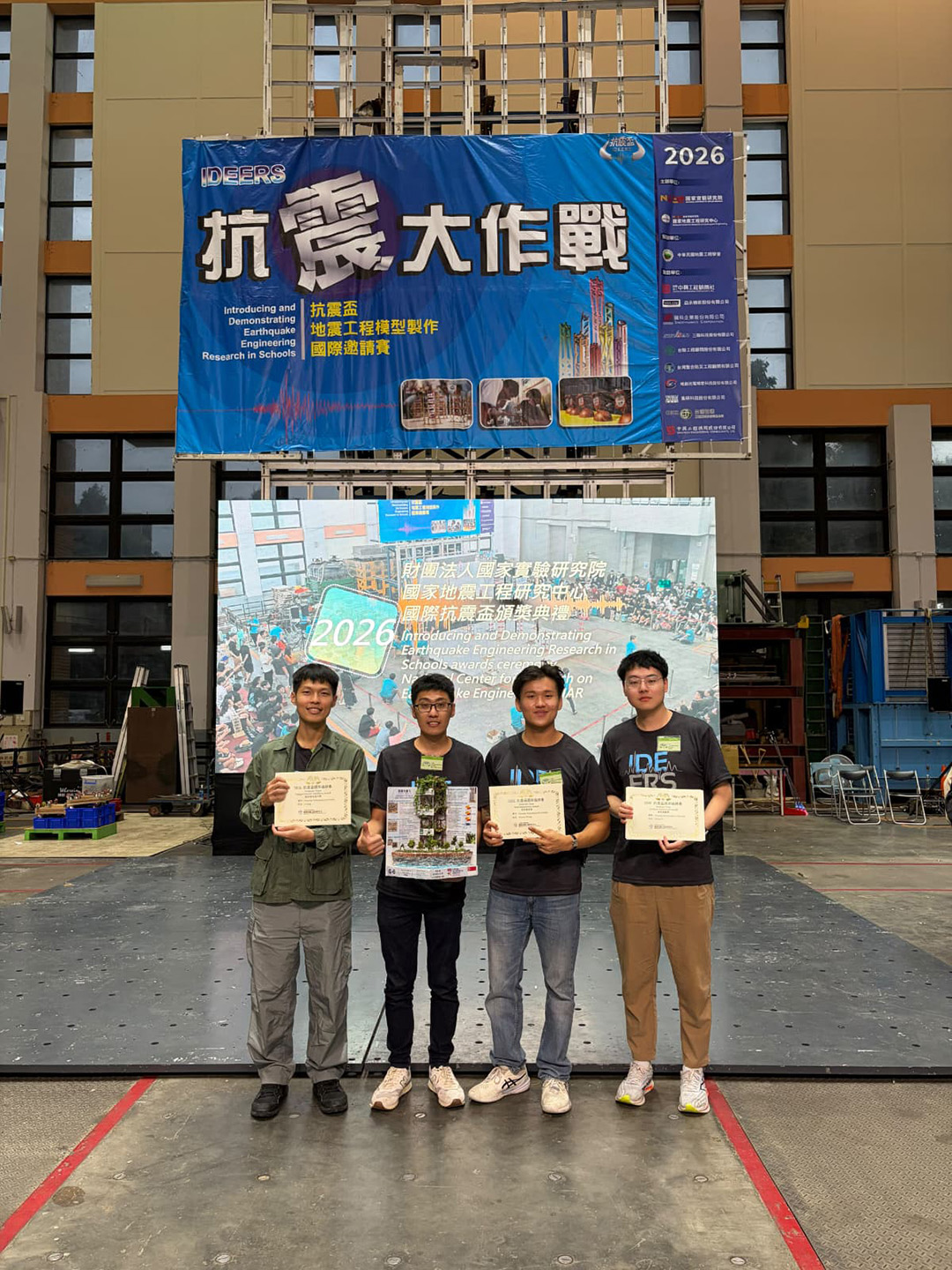
From left: Wu Chia-Ho, Er. Kong Kok Khuen, Wiranto Winata and Ye Zining at the National Centre for Research on Earthquake Engineering (NCREE) in Taiwan
The team was supervised by Associate Professor Li Bing, with assistance from Choi Siew Pheng from CEE’s Construction Technology and Protective Engineering (CTPE) Laboratory. The team is grateful for their guidance and support, as well as the contributions of the Nanyang Environment & Water Research Institute (NEWRI).