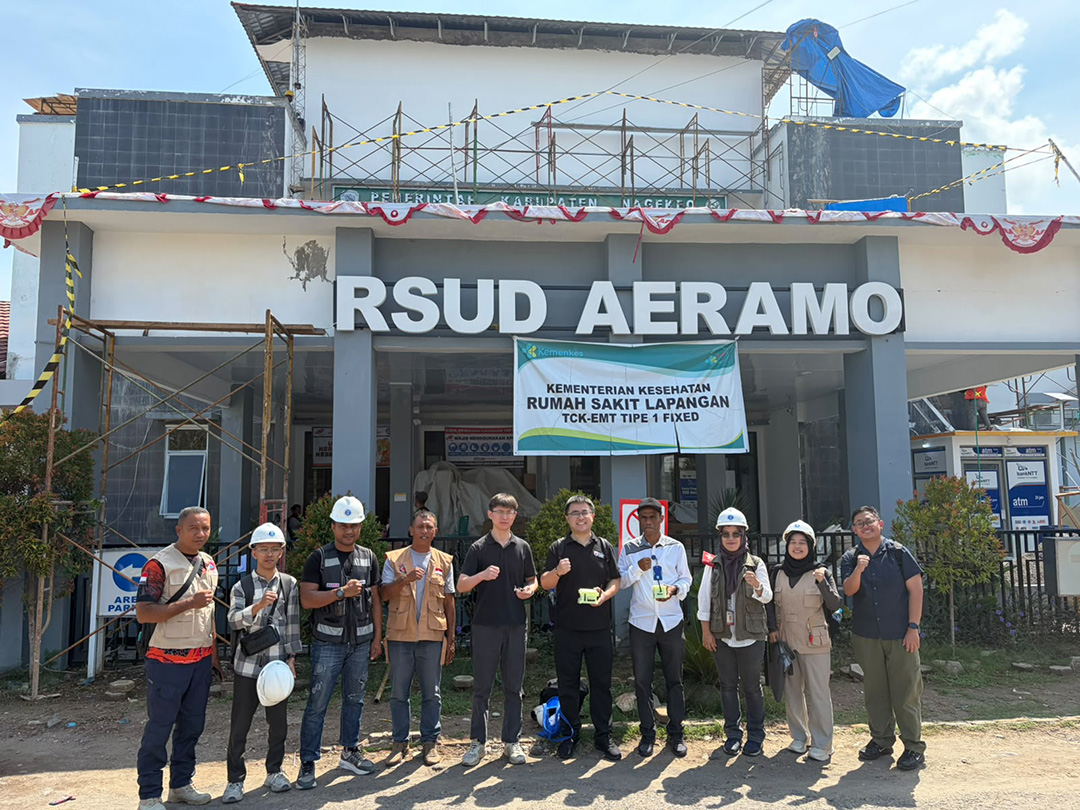
Researchers during the field visit to RSUD Aeramo in Flores, Indonesia
Following the 7.7-magnitude earthquake that struck off the coast of the island of Flores in East Nusa Tenggara, Indonesia, in August 2026, a team from NTU’s School of Civil and Environmental Engineering (CEE) travelled to the island in November to deploy and test technologies for aftershock detection and post-earthquake building inspection.
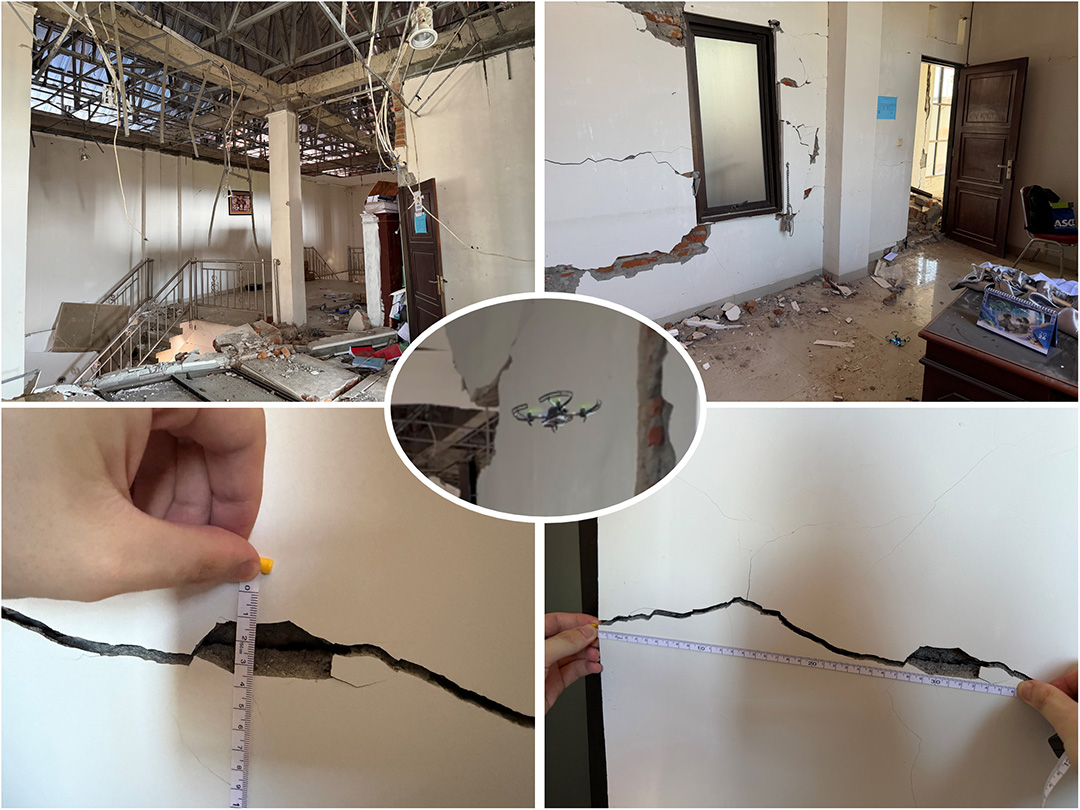
The field deployment involved assessing critical infrastructure, including a hospital, several schools and government office buildings, to determine their condition and safety following the earthquake.
The CEE team, comprising Assistant Professor Fu Yuguang and Dr Yu Xuewen, worked alongside students and researchers from Institut Teknologi Bandung (ITB) and Indonesia’s National Research and Innovation Agency (BRIN). NTU students Cui Shuaiwen and Wen Jiaru also provided remote support for the site investigation.
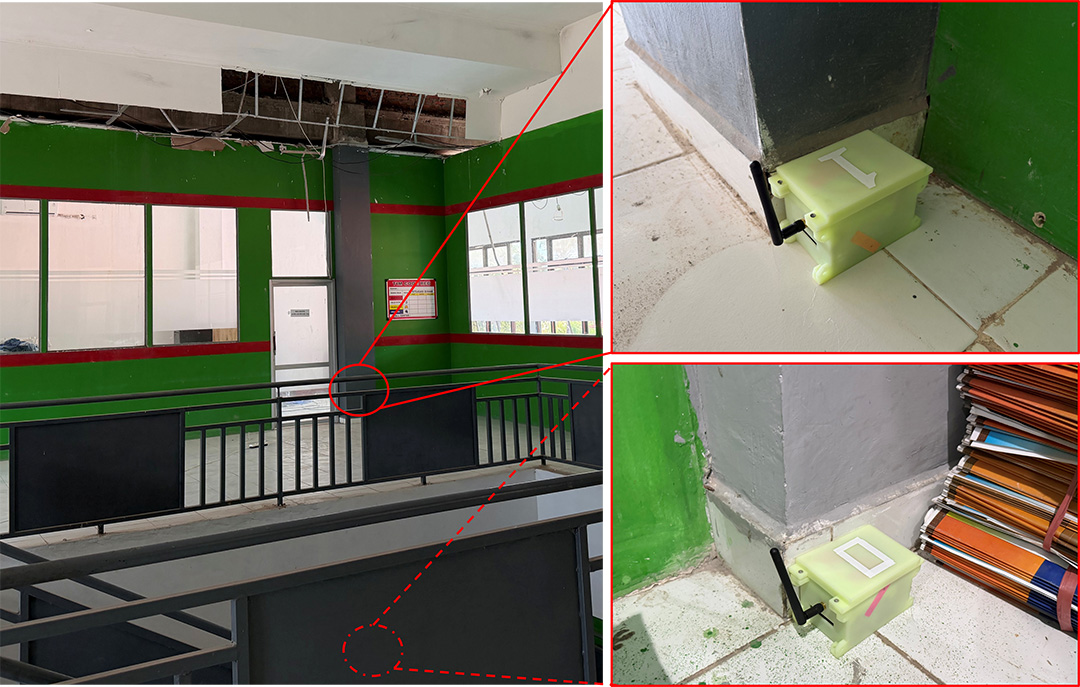
LiftNode IoT monitoring
During the visit, the team tested their research innovations in real-world applications, supporting infrastructure safety and disaster resilience. The team deployed two LiftNodes, low-cost, edge-intelligent Internet of Things (IoT) sensing platforms, at RSUD Aeramo, a local hospital under reconstruction. The sensors were used to support continuous and remote monitoring of aftershocks.
SmartBee nano-drone inspection
The team also tested SmartBee, a miniature drone designed for inspections in confined spaces, through indoor flights at several local high schools and an office building, exploring its potential for post-earthquake building condition assessment.
By testing the technologies under real-world conditions, the field deployment enabled the researchers to assess their practical application in environments where resources may be limited and operating conditions unpredictable. The visit also contributed to ongoing research in structural health monitoring and disaster resilience, while strengthening collaboration between CEE and its research partners.