
Long before recent disruptions exposed the vulnerability of global energy supply chains, researchers at Nanyang Technological University (NTU) College of Engineering were developing technologies to strengthen energy resilience. Their work spans renewable fuel production, advanced materials and intelligent power grids, laying the foundations for more resilient energy systems both locally and globally.
When tensions around the Strait of Hormuz escalated earlier this year, the effects rippled across global energy markets. Oil and gas prices rose, shipping routes became less certain, and governments were reminded how quickly a single geopolitical flashpoint can disrupt interconnected energy systems.
Less visible, however, is the longer-term shift already underway: growing recognition that future energy security will depend not only on where energy comes from, but also on how resilient energy systems are by design.
Researchers at Nanyang Technological University (NTU) College of Engineering have been working towards that goal for years. Their research spans renewable fuel production, advanced materials and intelligent power grids. It addresses three interconnected challenges: generating energy from more diverse sources, storing it efficiently until it is needed, and ensuring electricity networks remain stable under changing conditions.
.jpeg?sfvrsn=f897c91f_1 "Straits of Hormuz (2)") The Strait of Hormuz carries roughly one-fifth of global oil and 19 per cent of LNG trade. Shipping was disrupted in early 2026 following escalating conflict in the region.
The Strait of Hormuz carries roughly one-fifth of global oil and 19 per cent of LNG trade. Shipping was disrupted in early 2026 following escalating conflict in the region.
What Makes an Energy System Resilient?
“The key to energy resilience lies in diversifying and adopting local energy sources rather than relying on a single supply stream,” explained Assistant Professor Virgil Andrei from the School of Materials Science and Engineering (MSE). “In the long term this means producing more energy locally through renewable energies.”
Andrei joined NTU from the University of Cambridge in 2025, bringing with him extensive research on artificial leaves and solar fuel technologies.
Professor Wen Changyun from NTU’s School of Electrical and Electronic Engineering (EEE) approaches the challenge from a different perspective. Drawing on decades of research in smart grids, adaptive control and complex energy networks, he defines energy resilience as "the ability of a power or energy system to maintain safe, stable and economical operation under uncertainty and disturbances."
The two perspectives illustrate the need for both distributed energy production and systems that can remain stable and adaptable during disruptions.
 From left to right: Prof Wen Changyun (School of Electrical & Electronic Engineering), Assistant Prof Wu Dongshuang (School of Materials Science & Engineering) and Assistant Prof Virgil Andrei (School of Materials Science & Engineering).
Storing Renewable Energy
Wen explained that modern power systems depend on a stable and continuous energy supply, making heavy reliance on imported fossil fuels a critical vulnerability. However, shifting towards renewable energy also introduces new challenges. Unlike conventional fuels, solar and wind power generate electricity intermittently, making it more difficult to maintain a stable energy supply.
To remain reliable, renewable electricity must be stored when supply exceeds demand.
One promising solution is green hydrogen: hydrogen produced from water using renewable electricity. This converts that electrical energy into a chemical form which can later be transported, stored for long periods, or converted into fuels such as ammonia or methanol, explained Andrei.
One of the greatest barriers to making green hydrogen practical at scale is catalyst durability. The catalyst-coated electrodes that split water into its constituent hydrogen and oxygen must operate for years in highly corrosive environments, where gradual degradation reduces efficiency and increases costs.
Assistant Professor Wu Dongshuang from NTU’s MSE is working to overcome this challenge. A materials scientist whose research bridges fundamental catalysis and emerging energy applications, Wu studies how catalyst materials can be designed to remain stable, efficient and affordable for long-term hydrogen production.
Wu and her team recently discovered that engineering multi-element alloys with trace additions of palladium can significantly improve catalyst durability. When dispersed at the atomic level, palladium alters the electronic structure of the surrounding metals, strengthening their bonds and slowing oxidation. The resulting catalysts could operate for longer while reducing costs and improving the reliability of green hydrogen technologies.
Beyond Green Hydrogen
Using electricity to make green hydrogen is one way of storing renewable energy.
Researchers are also exploring technologies that use sunlight to convert small molecules directly into chemical fuels, eliminating the intermediate step of first generating electricity.
One such approach is Andrei's artificial leaves. These devices combine materials science, chemistry and engineering to convert sunlight, water and carbon dioxide into chemical fuels through artificial photosynthesis. To mimic the way plants capture and store solar energy, they use ultrathin semiconductor layers and integrated catalysts to produce renewable fuels and valuable chemicals – a process called artificial photosynthesis.
These hydrogen and carbon containing fuels also store renewable energy in chemical form, allowing them to be transported, stored and used when needed.
To improve efficiency, Andrei's team designs device architectures that maximise light absorption and charge separation by pairing advanced light-harvesting materials with catalysts. These include promising semiconductors such as lead halide perovskites, bismuth oxyiodide (BiOI) and bismuth vanadate (BiVO₄).
The resulting devices are lightweight and flexible, using less material and requiring simpler support structures than conventional technologies. This could reduce costs, particularly in land-constrained settings such as Singapore.
 An artificial leaf photographed in River Cam, Cambridge. Photo courtesy of Assistant Professor Virgil Andrei.
In his latest research, Andrei's team addressed one of the biggest barriers to bringing artificial photosynthesis beyond the laboratory: scalability.
The researchers developed a perovskite-based photoanode—a light-absorbing component of an artificial leaf—that can be manufactured using industry-compatible screen-printing techniques instead of conventional laboratory methods.
By replacing expensive noble metals like gold, silver, and platinum with lower-cost materials and introducing an automated testing platform to evaluate performance under changing sunlight conditions, the work moves artificial photosynthesis a step closer to large-scale manufacturing and real-world deployment.
Keeping the Grid Running
Generating and storing clean energy is only part of the challenge. Power systems must also respond to rapidly changing electricity demand, equipment failures and increasingly sophisticated cyber threats while continuing to operate safely and reliably.
Smart grids support this by combining sensors, communication networks and real-time data to enable adaptive, learning-based control of electricity systems.
However, greater reliance on digital technologies also creates new vulnerabilities. Inaccurate, delayed or manipulated data can mislead control systems and disrupt operations, making data quality and cybersecurity increasingly important.
As Wen puts it, "the more important the data, the more critical its quality and security become."
To address these challenges, Wen has developed resilient control systems that help power grids continue operating even when communications are disrupted or sensor data has been compromised.
Using adaptive control strategies, these systems automatically adjust operating parameters in response to disruptions such as false data injection attacks, which manipulate sensor measurements, and denial-of-service attacks, which interrupt communications. This enables power systems to maintain voltage stability, fair power sharing and reliable operation even when parts of the network have been compromised.
In a recent paper published in IEEE Transactions on Smart Grid, Wen and his team developed a distributed control framework that enables microgrids to detect and compensate for false or manipulated control signals. By restoring stable operation even during malicious cyberattacks, the system represents an important step towards more secure and resilient power networks.
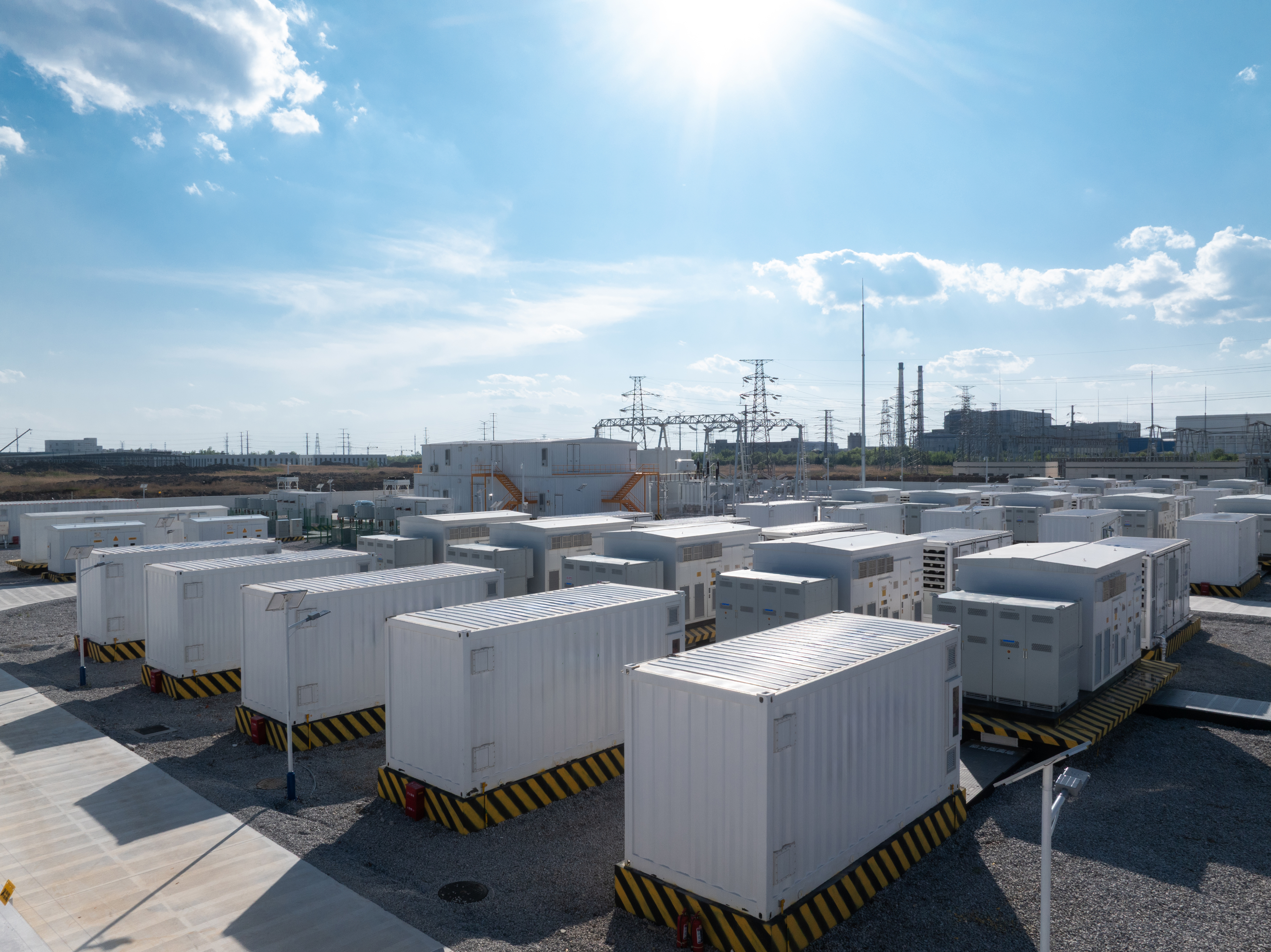 Containerised energy storage systems designed to enhance grid reliability and energy resilience.
The Road Ahead
For now, reliance on fossil fuels remains significant despite rapid progress in renewable technologies.
“Eighty per cent of current energy needs are still covered by fossil fuels,” Andrei stated. “The high energy density of fossil fuels makes them the current practical choice for heavy shipping, aviation, and industrial activities.”
“Transitioning to renewable energy systems will still take time,” he added.
The shift will require advances across every part of the energy ecosystem, from renewable energy generation and durable catalyst materials to long-duration energy storage and intelligent grid management.
And for places like Singapore, the challenge is shaped by unique constraints. Limited land and natural resources restrict the scale of domestic renewable energy production, making innovation, efficiency and international collaboration increasingly important.
“Even with limited resources, it is important to develop a deep understanding of how energy systems work, from generation to the root causes of disruptions,” said Wu.
Although Singapore's circumstances are distinctive, the engineering challenges it faces are increasingly shared around the world. As geopolitical uncertainty, climate change and rising energy demand reshape power systems, the ability to generate, store and manage energy more effectively is becoming increasingly important.
Whether the next disruption stems from the Strait of Hormuz, climate change or elsewhere, NTU researchers will remain at the forefront of efforts to strengthen energy resilience through advances in energy generation, storage and intelligent grid management.
Story by Anika Cokro and Laura Dobberstein, NTU College of Engineering

.tmb-listing.jpg?sfvrsn=a1405aee_1)