
For more than a decade, Nanyang Technological University (NTU) material scientist and professor Eason Chen has been chasing the universe's smallest element through the hidden structures of metals. His latest research brings him, and the world, closer to understanding its elusive behaviour.
Professor Eason Chen has spent over a decade studying the smallest and simplest element in the universe: hydrogen.
“When I tell people what I study, they're usually confused at first,” laughed the researcher and Nanyang Assistant Professor. “A former colleague even nicknamed me Mr. Hydrogen.”
His fascination began during his doctoral research at the University of Oxford in 2014, when he set out to investigate the element's behaviour inside metals.
At the time, scientists knew that hydrogen could enter metals and alter their properties, but observing exactly where its atoms resided was extraordinarily difficult.
“When I started my PhD, nobody believed this project was going to work,” Chen recalled.
Later, at the University of Sydney, he established a US$3 million research programme investigating how hydrogen interacts with steels. In 2024, Chen joined NTU’s School of Materials Science and Engineering (MSE), where he continues to investigate the behaviour of hydrogen in metals.
Small atom, big trouble
Hydrogen can enter metals during manufacturing, corrosion or exposure to hydrogen-rich environments. Because its atoms are exceptionally small, they can occupy the spaces between atoms in a metal's crystal lattice and move through the material.
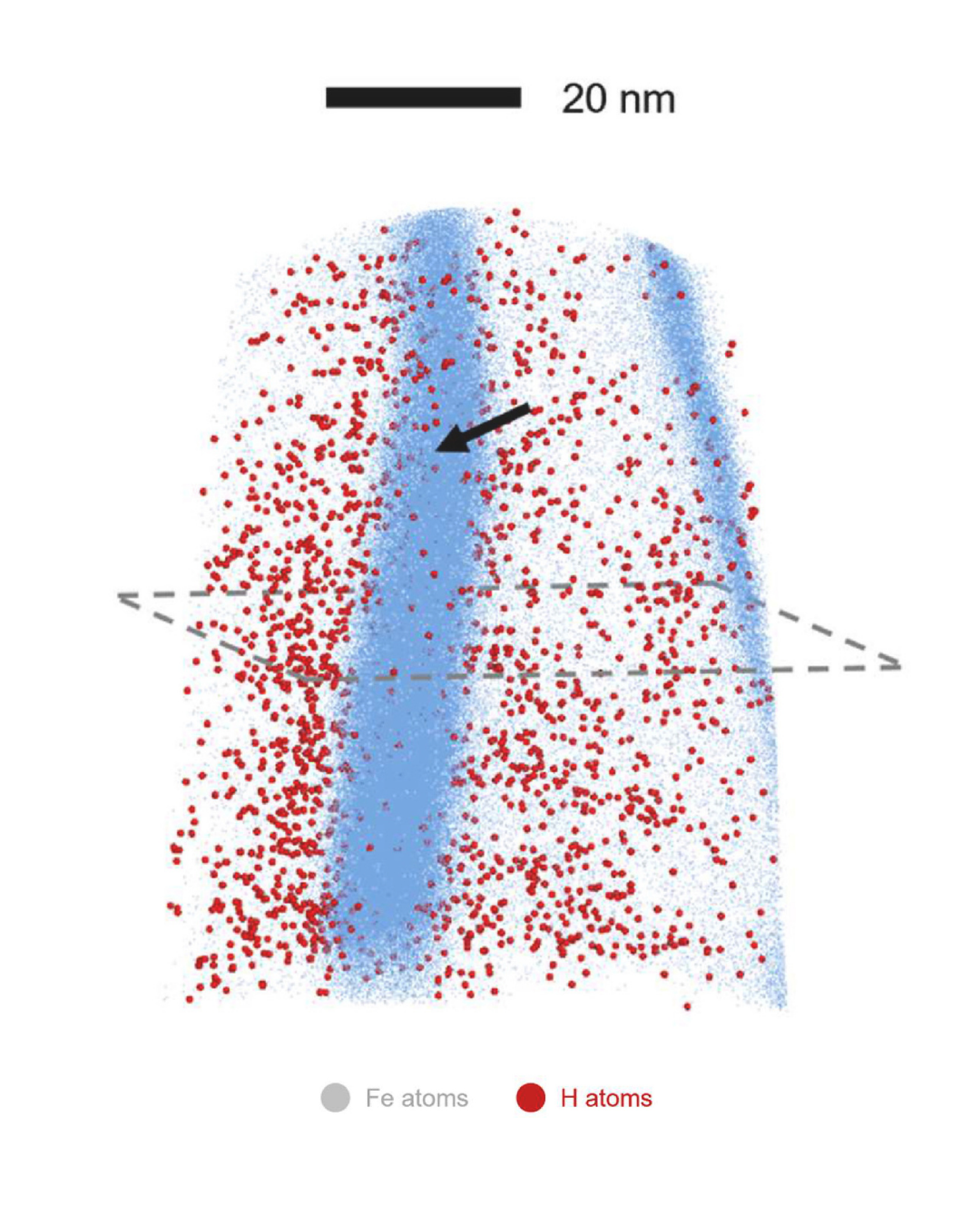 Hydrogen can accumulate at defects in metals but can also be found freely in the material
Some hydrogen atoms become trapped at defects or irregularities in the metal's structure. Under certain conditions, hydrogen can contribute to crack formation and growth, weakening a component without giving any visual signal.
“The existence of hydrogen in materials is a bit like the existence of black holes,” Chen explained. “We know it's there, but it's very difficult to observe.”
The phenomenon, known as hydrogen embrittlement, poses a serious challenge for industries ranging from aerospace to hydrogen energy storage, where the failure of metal components can have potentially catastrophic consequences.
In 2009, a Boeing 737 lost a nose wheel at Melbourne Airport after its landing gear axle fractured, with hydrogen embrittlement likely contributing to the initial fatigue crack. A few years later, in 2013, hydrogen embrittlement caused 32 steel anchor rods to fracture during construction of the San Francisco–Oakland Bay Bridge.
For Chen, incidents like these illustrate why understanding hydrogen's behaviour inside metals matters.
 Oakland Bay Bridge, San Francisco
Catch me if you can
Hydrogen is notoriously difficult to detect using conventional techniques, including electron microscopy. Chen's laboratory uses cryogenic atom probe tomography (APT), a technique that identifies individual atoms and reconstructs their positions in three dimensions, allowing researchers to investigate where hydrogen resides within a metal.
The process begins by shaping a tiny piece of metal into an extremely sharp needle and applying an electrical current that generates hydrogen at its surface. Some of the hydrogen atoms enter the metal.
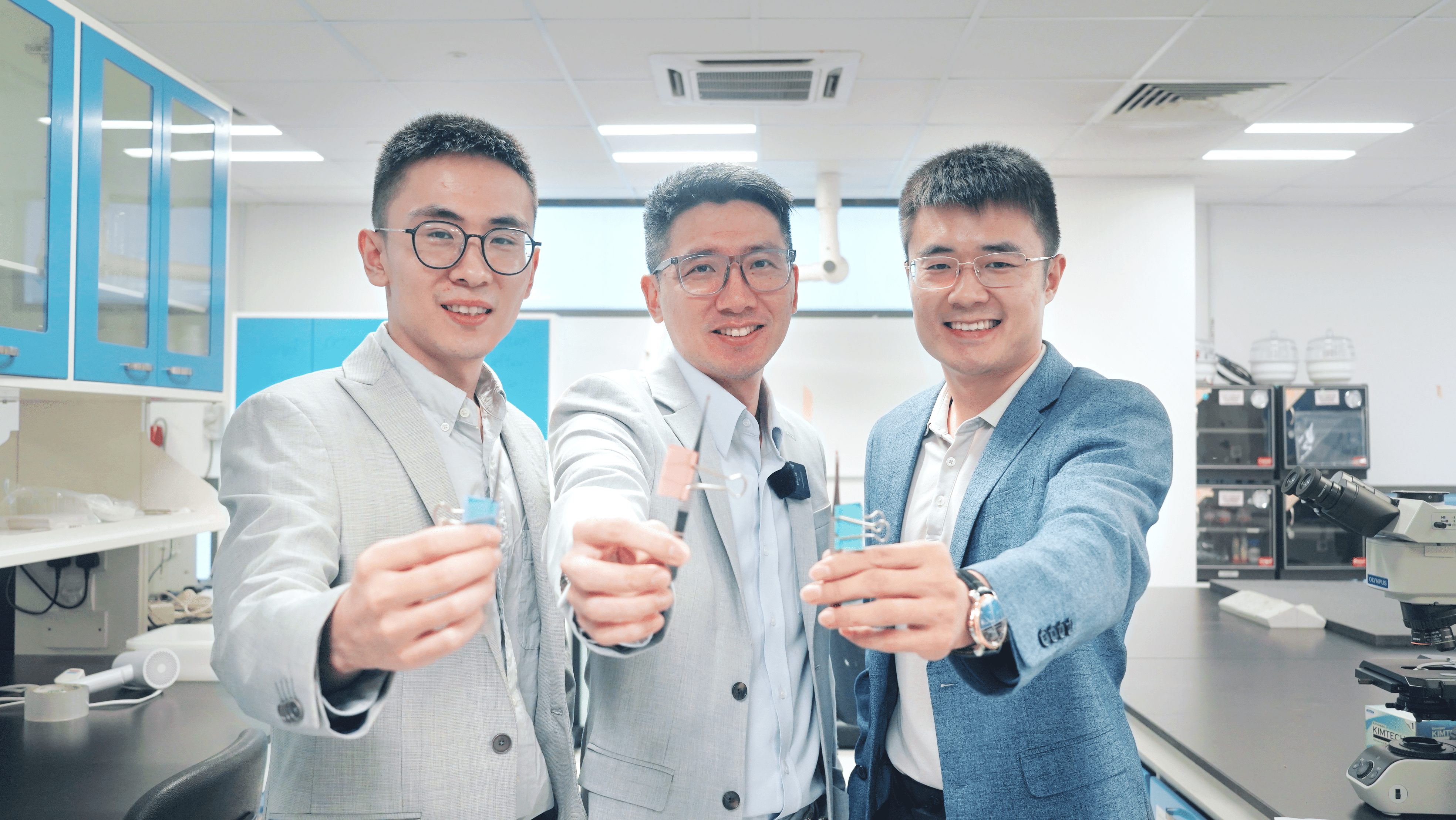
 Professor Eason Chen holding a micro-scale needle with precision tweezers
The specimen is then immediately plunged into liquid nitrogen, at a shockingly cold −196°C, to slow hydrogen movement and minimise its escape. It must then be transferred under carefully controlled conditions to the atom probe, where an intense electric field removes atoms from the needle's tip, one by one.
By measuring how long the resulting ions take to reach a detector, the instrument identifies their mass-to-charge ratios. Their positions are then reconstructed to create a three-dimensional map of the specimen's atomic composition.
The technique has enabled scientists to investigate hydrogen concentrated at defects in metal materials. However, as the element is particularly mobile, it has long remained difficult to observe hydrogen simply dissolved and existing freely in a metal’s crystal lattice.
Even with sophisticated cryogenic equipment, some atoms could escape before they were measured.
For Chen's lab, a breakthrough came when Dr Shi Rongjian, a collaborating researcher, brought him a sample of a high-entropy alloy, a mixture of several metals in substantial proportions.
The material had a particularly useful property. Its locally distorted crystal lattice could slow the movement of hydrogen atoms, helping preserve them long enough for researchers to observe their distribution.
“We thought this alloy could give us a better chance of observing hydrogen before it escaped,” said Shi. “The challenge was finding a material that could hold onto the hydrogen long enough for us to measure it.”
Using cryogenic APT, the team examined the alloy and obtained evidence of hydrogen dissolved within its crystal lattice.
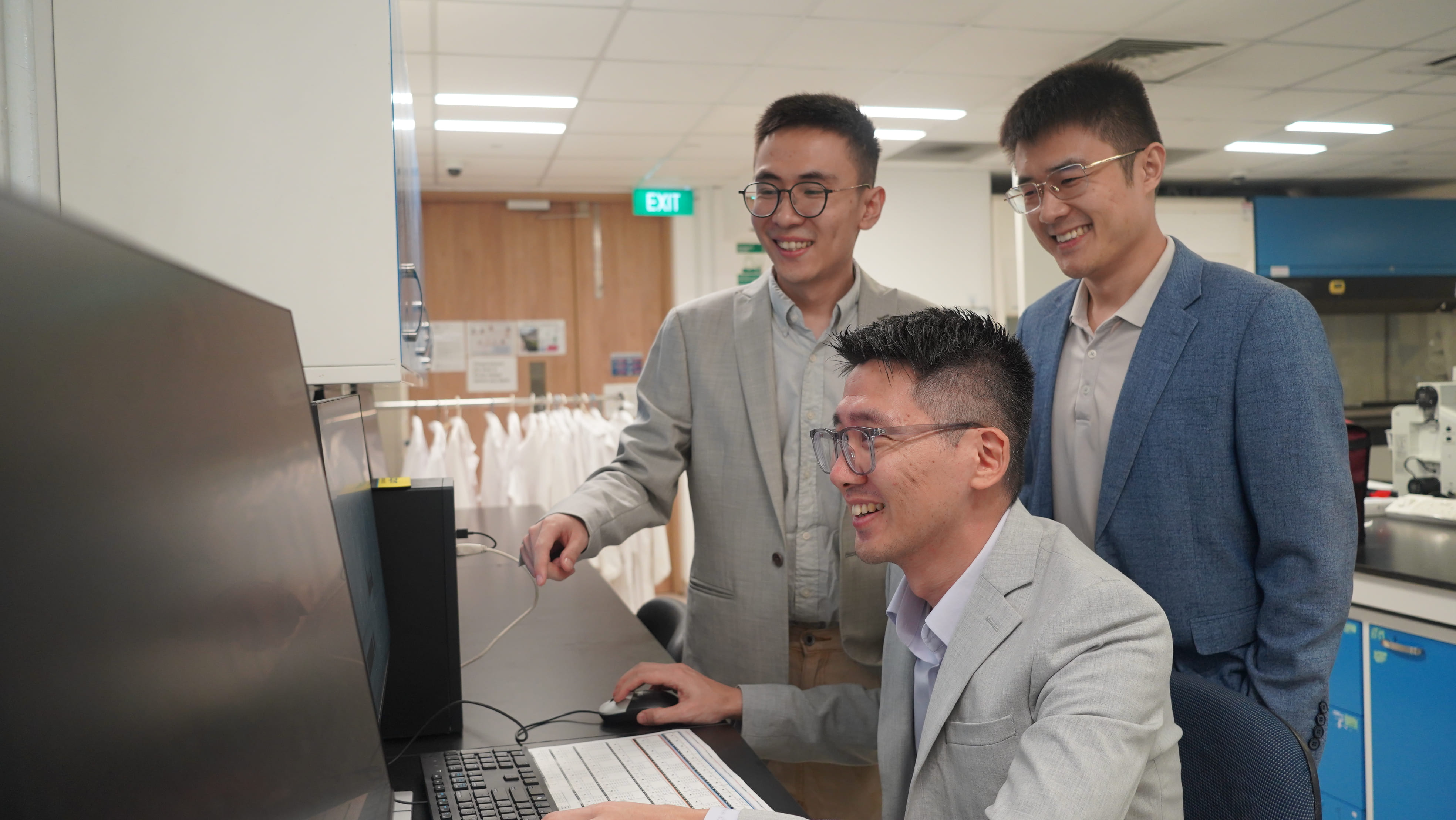 Professor Eason Chen, alongside Dr. Shen Shangkun and Dr. Shi Rongjian, analysing experimental results
Time for a toast
The findings, published in Nature, could help engineers design materials better suited to hydrogen-rich environments.
The team was elated. They celebrated with champagne instead of their usual after-work basketball game. There was another reason to raise a glass: the breakthrough coincided with the birth of Shi's first child.
“It's been a busy few months, but a very happy time for me,” said Shi.
For Chen, the discovery is an important milestone in his decade-long pursuit of hydrogen, a passion he loves to share.
“If you have a year, I'll be happy to offer you a degree,” he offered. “And if you have five minutes, I'll be happy to just tell you hydrogen is cool.”
Sometimes, quite literally.
Story by Laura Dobberstein, NTU College of Engineering