Green hydrogen is often held up as a cornerstone of a low-carbon future, but its progress has been slowed by a performance problem in a key material. New work from NTU researchers shows how durability-challenged catalysts used to produce the fuel can be made both low-cost and to last.
Hydrogen fuel has long shown promise as an alternative to fossil fuels, particularly in sectors where electricity alone is insufficient. When produced using renewable electricity, green hydrogen can power energy-intensive industries such as steelmaking and shipping without adding carbon emissions.
However, its use and demand remain sluggish due to challenges in price and scaling production. A study in February 2025’s Journal of the American Chemical Society (JACS) suggests a small change in the materials used during production could help overcome these barriers.
How green hydrogen works
Green hydrogen is produced using renewable electricity to convert water into hydrogen and oxygen, thus storing electrical energy in chemical form. The process takes place in a device called an electrolyser, which relies on specialised catalysts, materials that speed up chemical reactions without being consumed.
As electricity passes through water and over catalyst-coated electrodes, two reactions occur. Hydrogen is produced on one side, while oxygen is released on the other through the oxygen evolution reaction (OER). Unlike electricity, which must be used immediately or stored briefly in batteries, hydrogen can store energy for weeks or months.
Once produced, hydrogen can be compressed, liquefied or converted into fuels such as ammonia or methanol, making it easier to transport and store at scale. In this way, green hydrogen allows renewable energy to be captured, stored and reused in sectors that are otherwise hard to decarbonise.
Seeking durability
One main reason green hydrogen has struggled to scale is that the catalysts driving these reactions must operate continuously for years in corrosive, chemically aggressive environments. This issue leads to gradual degradation that increases costs and undermine reliable long-term operation.
The oxygen-producing half of the process to split water is particularly harsh. The OER operates at high voltages in oxygen-rich conditions that accelerate oxidation and material loss.
“Durability is what really decides whether a catalyst can be used in the real world,” explained study author Professor Wu Dongshuang from NTU’s School of Materials Science and Engineering (MSE).
Wu has spent her career studying what happens inside catalysts as they drive chemical change. Using advanced X-ray spectroscopy and electron microscopy, her team examines how nanoscale materials behave while producing green hydrogen, as well as while helping hydrogen react with captured carbon dioxide to form fuels such as methanol.
 Professor Wu Dongshuang
The usual catalysts
Drawn by their availability, affordability and ability, researchers have long turned to earth-abundant metals such as iron, cobalt, nickel and copper — and their oxides — as the basis for OER catalysts. Under real operating conditions, however, these materials eventually oxidise and fail.
More durable options exist, but they rely on rare elements such as iridium and ruthenium. While effective, these metals are scarce and expensive, making them impractical for large-scale deployment.
This trade-off between stability and scalability has haunted green hydrogen from the start. In recent years, however, researchers have begun exploring multi-element alloys. These materials are made from several principal elements as to take advantage of blended properties rather than relying on a single metal or simple two-metal mixtures. Such alloys have shown promise in reducing oxidation, improving thermal stability, and tuning catalytic behaviour.
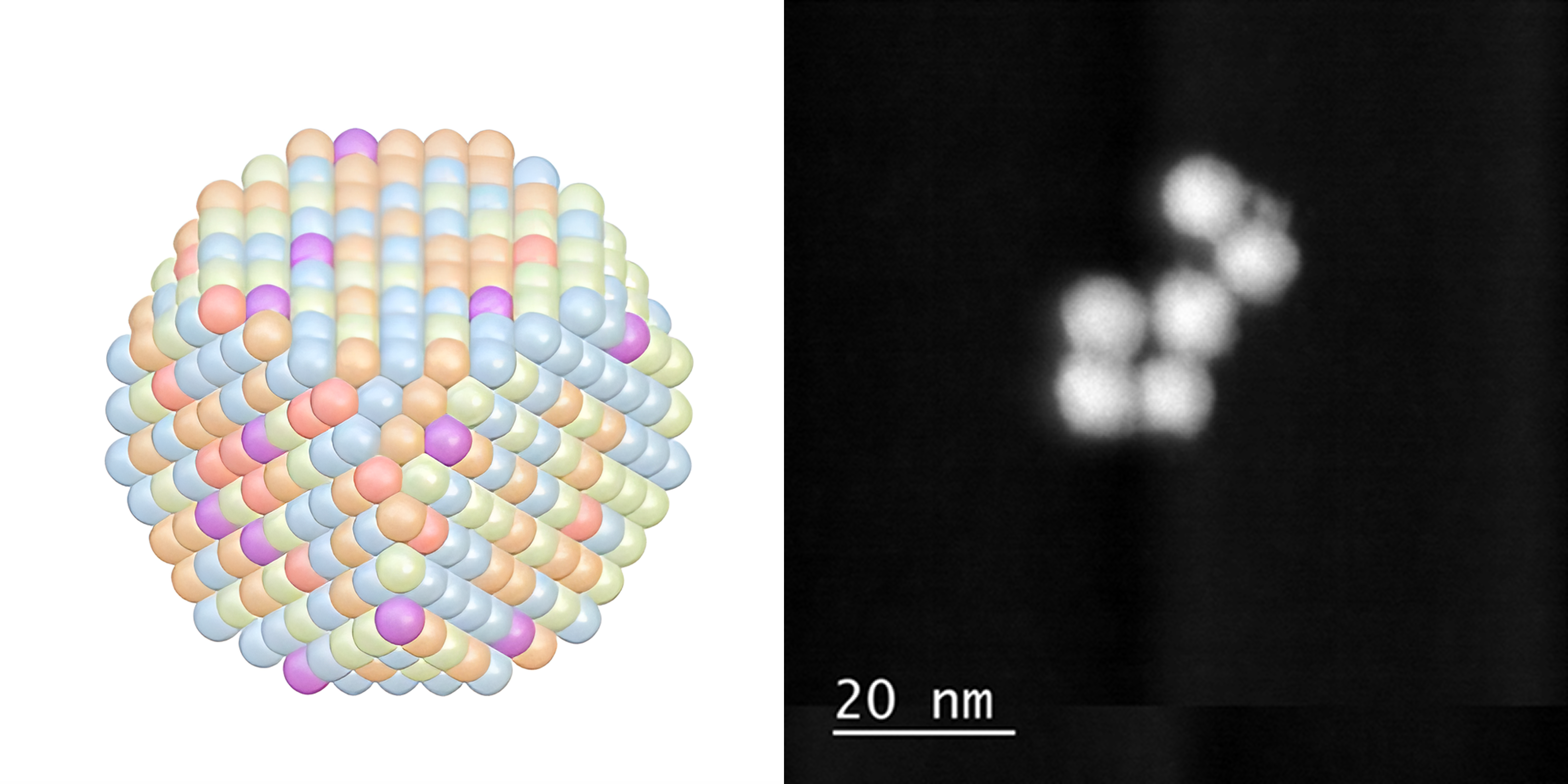 Left: The palladium-doped catalyst, known as PdFeCoNiCu, as seen through Scanning Transmission Electron Microscopy. Right: A model showing multi-element alloy nanoparticles, where colours represent different constituent elements.
A poison as the cure
Wu’s co-investigators, who included researchers from NTU, China and Japan, are among a growing group reframing green hydrogen’s durability problem as a design challenge.
Their work involves fine-tuning multi-element alloys so their atomic structure resists degradation when used as catalysts.
Their solution came from an unlikely, counterintuitive source: the addition of palladium. The metal is not typically used for OER, as it degrades under the reaction’s harsh conditions.
“The interesting thing is that palladium itself actually is not stable,” said Wu. “And it’s expensive.”
But when introduced into an alloy in trace amounts of just 0.3 atomic per cent, or roughly three atoms in every thousand, these concerns disappeared.
Dispersed atom by atom within the alloy, the palladium subtly reshaped the electronic structure of the surrounding metals. Chemical bonds were strengthened, oxidation slowed, and material loss was dramatically suppressed. The catalyst retained high activity and, more importantly, kept going.
In testing, the palladium-doped catalyst, known as PdFeCoNiCu, sustained operation for more than 1,000 hours at industrially relevant current densities.
Under accelerated stress conditions, it degraded hundreds of times more slowly than its palladium-free counterpart.
In the paper, the researchers wrote that their multi-element alloy ranked “among the most stable OER catalysts reported so far.”
Testing on the fast track
A second, less visible breakthrough in Wu’s study lies not in the materials themselves, but in how their durability was tested.
Traditionally, proving that a catalyst will survive real-world conditions is a matter of endurance. Researchers run materials continuously for up to 6,000 hours under fixed operating conditions, waiting to see when performance declines. These tests can take months, even more than half a year, tying up equipment and slowing progress.
“It can feel like torture,” Wu said. “We even joke that the students in our lab can finally graduate once the stability test is over.”
Instead of relying solely on long-term stress tests, her team turned to hard X-ray photoelectron spectroscopy (HAXPES) to probe how atoms and electrons change under operation. By tracking shifts in the electronic structure of the catalyst during accelerated tests, the researchers could watch degradation begin long before the catalyst visibly failed.
These early signals closely matched chemical measurements of material loss, allowing the team to predict long-term durability without waiting thousands of hours for physical breakdown to occur.
The equipment needed to carry out this fast-tracked work exists at only a handful of facilities worldwide. For the study, Wu worked with a synchrotron facility near Kobe, Japan, where she has long-standing access to specialised beamlines and is now helping to develop new experimental set-ups for operando testing, experiments conducted while the catalyst is actively at work.
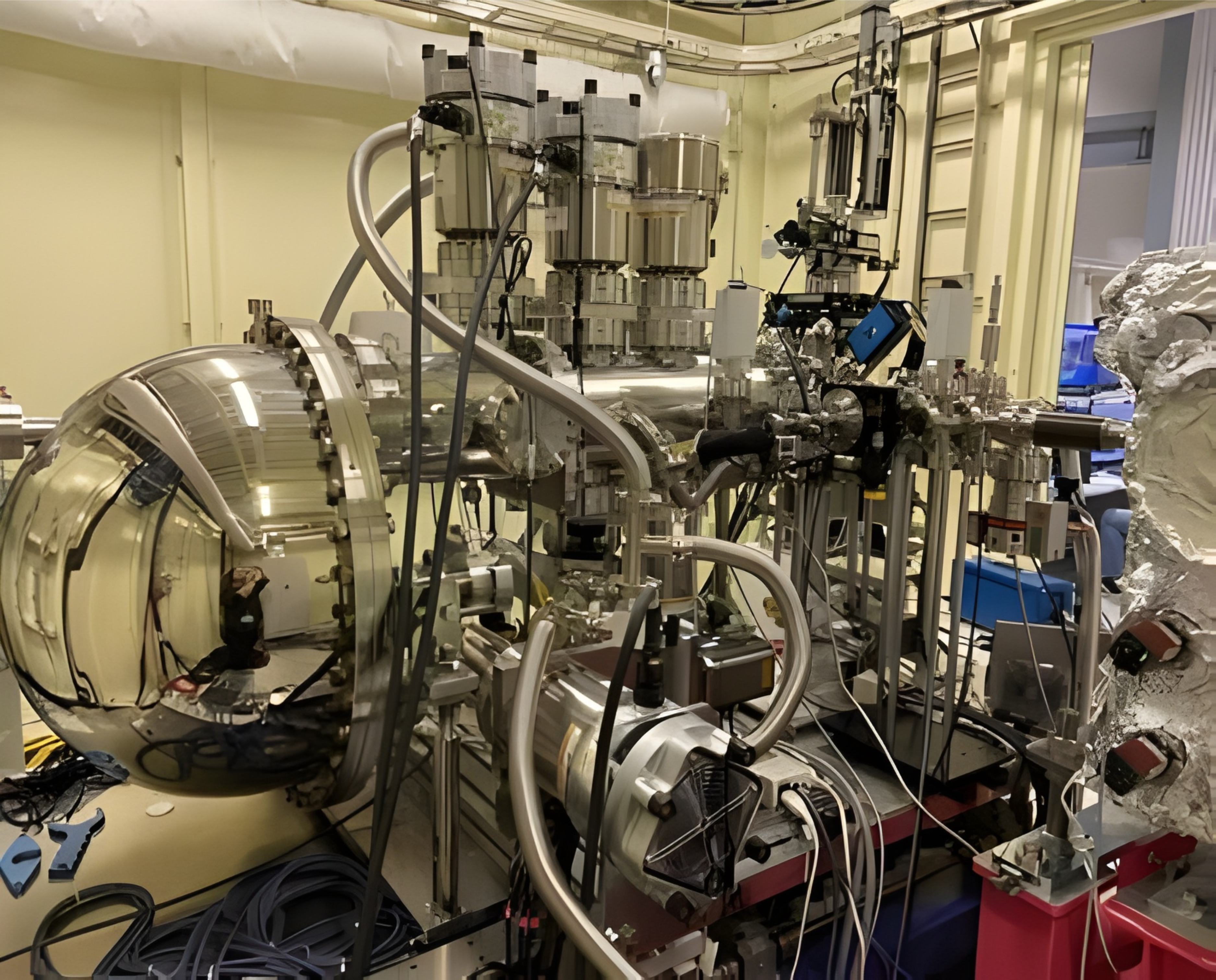 HAXPES setup at the SPring-8 synchrotron in Kobe, Japan
Embracing AI, responsibly
Wu now hopes to expand this work by incorporating artificial intelligence and machine learning into catalyst discovery, albeit cautiously.
Algorithms, she argues, are only as useful as the data they are trained on. With access to advanced spectroscopy facilities, her aim is to build high-quality datasets that link catalyst design to real-world performance at the
atomic level.
Rather than retreating to idealised model systems, Wu wants to apply these tools to real catalytic environments, where materials are pushed to their limits and durability is put to the test.
Story by Laura Dobberstein, NTU College of Engineering
This story also appeared in the 2026 NTU Engineering Annual Magazine.


.tmb-listing.jpg?sfvrsn=a1405aee_1)