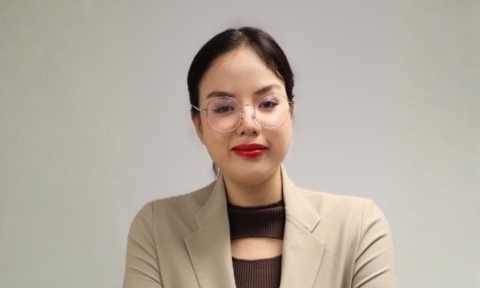

From Thailand to Singapore, follow Slocha Sapasakulvanit’s path as she progressed from undergraduate studies to pursuing a PhD and research at Nanyang Technological University.
I was raised in the vibrant city of Bangkok, Thailand in a joyful Thai-Chinese family. My parents decided to send me to an international school, a decision that had me surrounded by a colourful tapestry of culture.
Upon completing the school’s requirements, I attended Bangkok’s Chulalongkorn University, an institution regularly ranked as Thailand’s top university. I studied applied chemistry with a major in materials science.
My most memorable experience during this time is the four months spent on my Final Year Project (FYP) at Kansai University in Osaka, Japan. My chosen topic was Methacryloyl-Functionalised Extracellular Matrix for Cardiovascular Regeneration. I not only achieved a Bachelor of Science with first honours degree, I also made a few life-long friends and found inspiration to embark on graduate studies.
---edited.jpg?sfvrsn=bc8b4949_2 "During FYP (bachelor) - Edited") Sapasakulvanit presenting her research outcomes.
Sapasakulvanit presenting her research outcomes.
To my elation, I managed to secure a full scholarship at The Petroleum and Petrochemical College, Chulalongkorn University. Within two years, I obtained a Master of Science in Polymer Science. Despite difficulties that arose from COVID-19, I completed my research on Development of Bacterial Cellulose-Based Wound Dressing Incorporated with Curcumin-Loaded Carbon Nanoparticles.
Besides academics, I volunteered to organise international conferences hosted by my institute, which put me in touch with professors from various fields. Thanks to The Information Technology Project under the Initiative of H.R.H. Princess Maha Chakri Sirindhorn, I was awarded a full scholarship at Nanyang Technological University, Singapore (NTU) in a PhD programme under the School of Mechanical and Aerospace Engineering (MAE).
Under the supervision of Associate Professor Hortense Le Ferrand, I am researching sustainable processing of ceramic-reinforced polymer composites fabricated from a new manufacturing technique called magnetically assisted slip casting (MASC).
By analysing the natural growth of common biological ceramic composites, such as human bone, I identified key elements involved in their formation. I then sought to replicate these aspects in the fabrication of synthetic ceramic composites with bioinspired structures based on MASC, and followed up with mechanical testing for comparison. I gained valuable scientific insights from my thesis and was able to present my work at local and overseas conferences.
I published my studies in journals, including Bioinspiration and Biomimetics and Matter. More importantly, my research group’s unwavering support helped me become more resilient. It highlighted to me the necessity of a nurturing environment during the PhD process.
Outside of my own work, I mentored several undergraduate students on their final year projects as well as assisted in teaching small lab courses. I am a member of the MAE Graduate Students’ Club (MAEGSC), and previously held the position of President. I enjoyed meeting students, representing them, and serving as their representative to NTU administration.
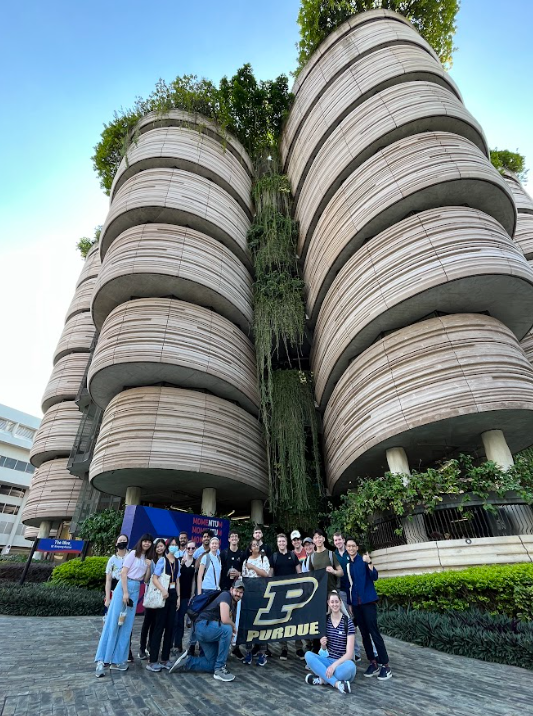 Visiting students from Purdue University tour NTU campus
While it’s been hard work, it was beyond worth it to graduate this year. Many people have helped me get here, including my supervisor, my research group, my scholarship committee, my best friend and fellow PhD candidate, Suchaya Chaiworn, and my family back home. To any graduate student reading this, even though diamonds are made under pressure, please remember to prioritise your own well-being first. And be proud of the hard work you put into your research!
This story also appeared in the 2026 NTU Engineering Annual Magazine.