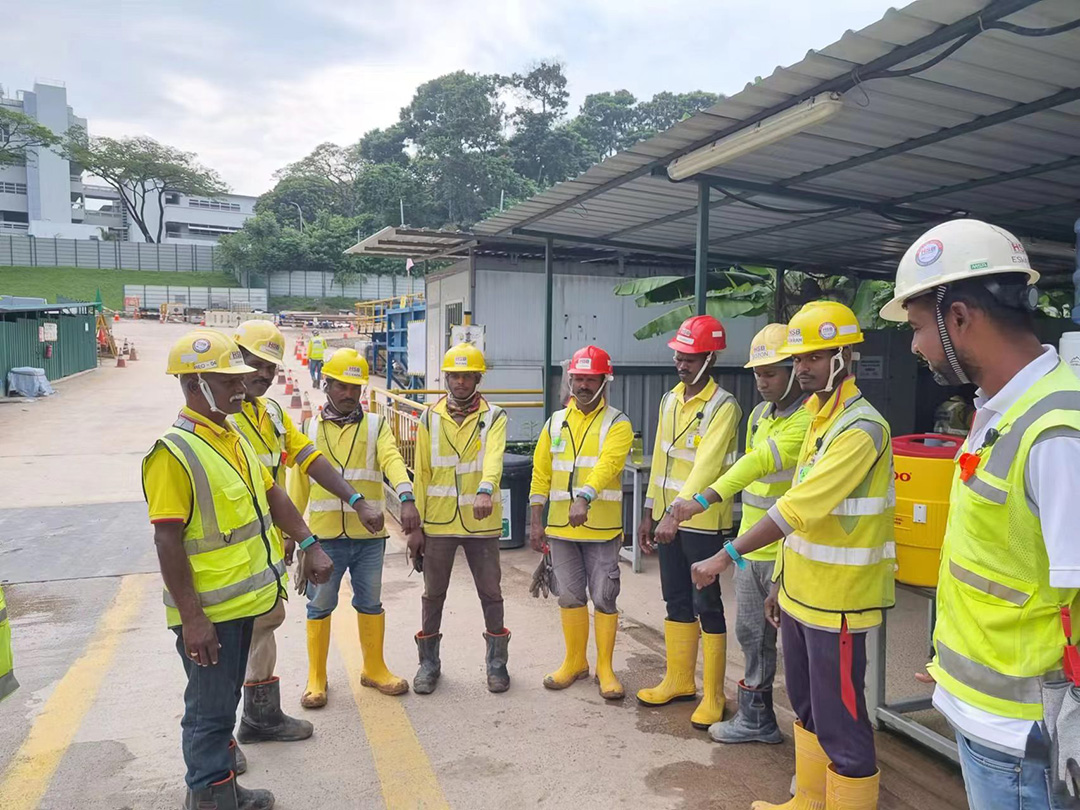
In sectors such as construction, workers routinely perform physically demanding tasks under variable and sometimes extreme conditions, as featured in Science.
AI-based models may help assess individual risk, including susceptibility to heat stress, as well as capacity for different levels of physical workload.
To simulate the impact of varying conditions on workers, researchers at NTU have been developing AI-based human digital twins. “Our human digital twin is a computational model of an individual construction worker that is continuously informed by physiological activity and environmental data, allowing it to estimate the worker’s current condition and predict how that condition may evolve under heat and workload,” says Yamo Cao, a postgraduate student in the laboratory of Yuguang Fu in the School of Civil and Environmental Engineering at NTU.
Today, construction managers often rely on generalized measures such as heat index charts to determine when conditions may become unsafe. These metrics capture heat stress—the external environmental load—but do not account for how an individual’s body responds. The prototype human digital twin model takes a complementary approach by assessing heat strain, or the body’s internal response to those conditions. This distinction is important because two workers wearing similar clothing and performing similar tasks under the same hot sun may experience very different levels of strain depending on factors such as age, hydration, and fitness.
The model relies on data collected from wearable and environmental sensors, including heart rate, skin temperature, motion, activity intensity, and ambient conditions. “The data we’re collecting operate at different time scales and levels of abstraction, making it non-trivial to integrate them into a unified and reliable representation of a worker’s state,” says Yawen Cao, who is also a postgraduate student in Fu’s laboratory. AI helps the human digital twin capture and learn dynamic patterns to keep workers safe.
About Science
Science has been at the center of important scientific discovery since its founding in 1880—with seed money from Thomas Edison. Today, Science continues to publish the very best in research across the sciences, with articles that consistently rank among the most cited in the world.