NTU researchers revealed a millimetre-scale magnetic soft robot designed to navigate inside the body, cut tissue, dispense drugs, grip and store biological samples, and heat remotely — all while operating wirelessly under weak magnetic fields.
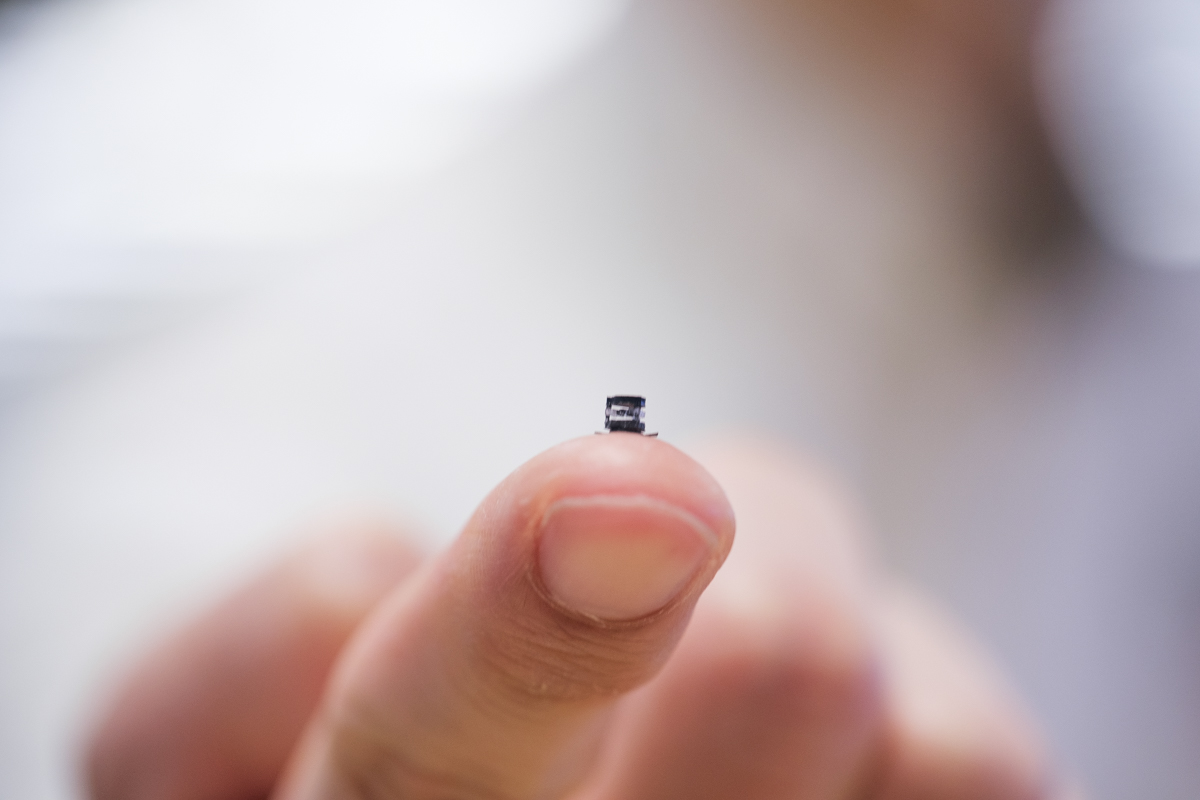 This robot prototype measures 4.4 mm and can be produced at 1.5 mm
In a lab at Nanyang Technological University (NTU)'s College of Engineering, situated between bright yellow electromagnetic coils, sits a robot small enough to be mistaken for a mosquito. Measuring just 4.4 mm in length, the miniature device responds to invisible magnetic fields through locomotion and deployment of specialised surgical tools.
A tiny blade emerges from its body, allowing it to cut through biological tissue. The robot quickly switches mode to dispense drugs, grip and store tissue samples, or generate localised heat for hyperthermia treatment. It switches functions in under a second.
“Most magnetic robots like this can perform only one function. Some can do two. Ours can do five,” said Associate Professor Guo Zhan Lum from NTU’s School of Mechanical and Aerospace Engineering (MAE). His team’s work was recently published in Advanced Materials.
“The dream is that one day we can insert these miniature actuators into the body, navigate them to a targeted location to perform treatments,” he explained.
Lum has spent the past 15 years working on miniature robotics, a field he first encountered while pursuing his PhD. Over time, his work shifted toward biomedical applications and the challenge of navigating confined spaces inside the human body using untethered magnetic systems.
In 2021, his team overcame a longstanding locomotion problem by enabling miniature magnetic robots to incorporate six degrees-of-freedom (DOF), meaning it could rotate in three directions known as roll, pitch and yaw, giving them greater mobility across uneven terrain. Four years later, the researchers developed a grain-of-rice-sized robot capable of dispensing four separate drugs.
Their latest system combines mobility with five distinct surgical functions in a single millimetre-scale device. Those five functions — gripping, sample storage, tissue cutting, drug dispensing and localised heating — were selected after consulting medical professionals to determine which capabilities would be most clinically useful.
Legacy constraints
Building multifunctional robots at millimetre scale presents a series of engineering challenges.
One of the biggest problems is that magnetic fields applied at small scales tend to affect the entire robot uniformly, causing the whole structure to behave like a single magnet that can move in only one mode of motion.
This makes it difficult to independently control different parts of the robot or selectively activate multiple functions within the same device.
As a result, most existing magnetic miniature robots can typically perform only one or two functions, such as grasping or drug delivery. Many also struggle to navigate uneven or unstructured environments inside the body, limiting their practical use in realistic biomedical settings.
For Lum’s team to unlock multiple functions while remaining mobile, the magnetic actuator needed to combine six DOF movement and reprogrammable magnetisation profiles — all within a device so tiny it must be assembled with tweezers under a microscope.
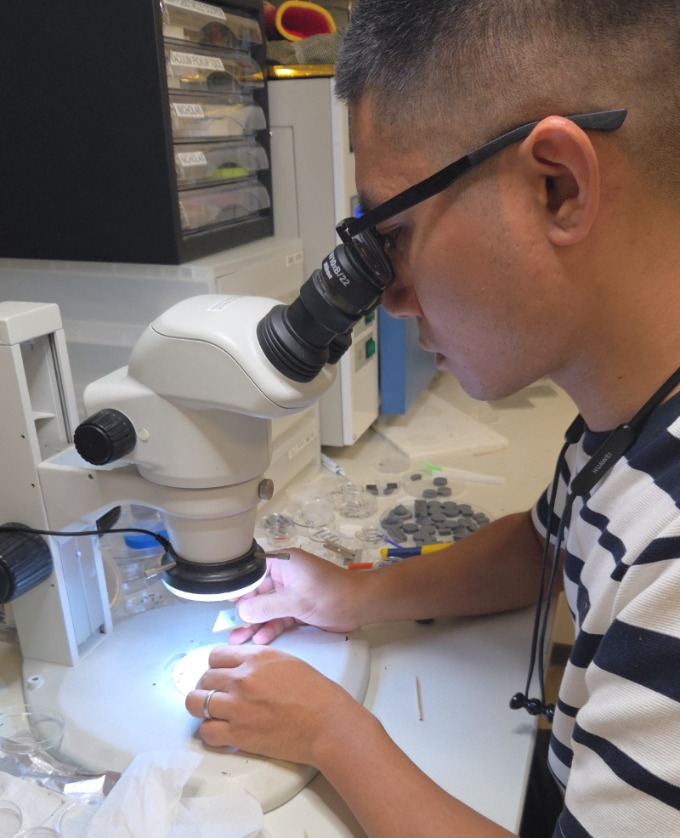 A researcher hand-assembles a robot prototype under a microscope
Selective control through geometry
Rather than treating the robot as a single magnetic structure, the NTU researchers designed it more like a miniature mechanical system with different regions engineered to respond selectively under the same magnetic field.
At the centre of the robot is a reprogrammable magnetic module that can be magnetised, demagnetised and remagnetised in different directions in under a second. Surrounding this core are carefully arranged flexible structures, magnetic beams and gripping components, each designed to activate only under specific magnetic conditions.
This distributed magnetic architecture allows the robot to switch between distinct operating modes. In one configuration, flexible tentacle-like appendages deform to enable locomotion. In another, magnetic beams deploy a miniature blade capable of cutting biological tissue. Other magnetic states activate gripping jaws for collecting tissue samples, trigger the release of drugs or enable heat treatments.
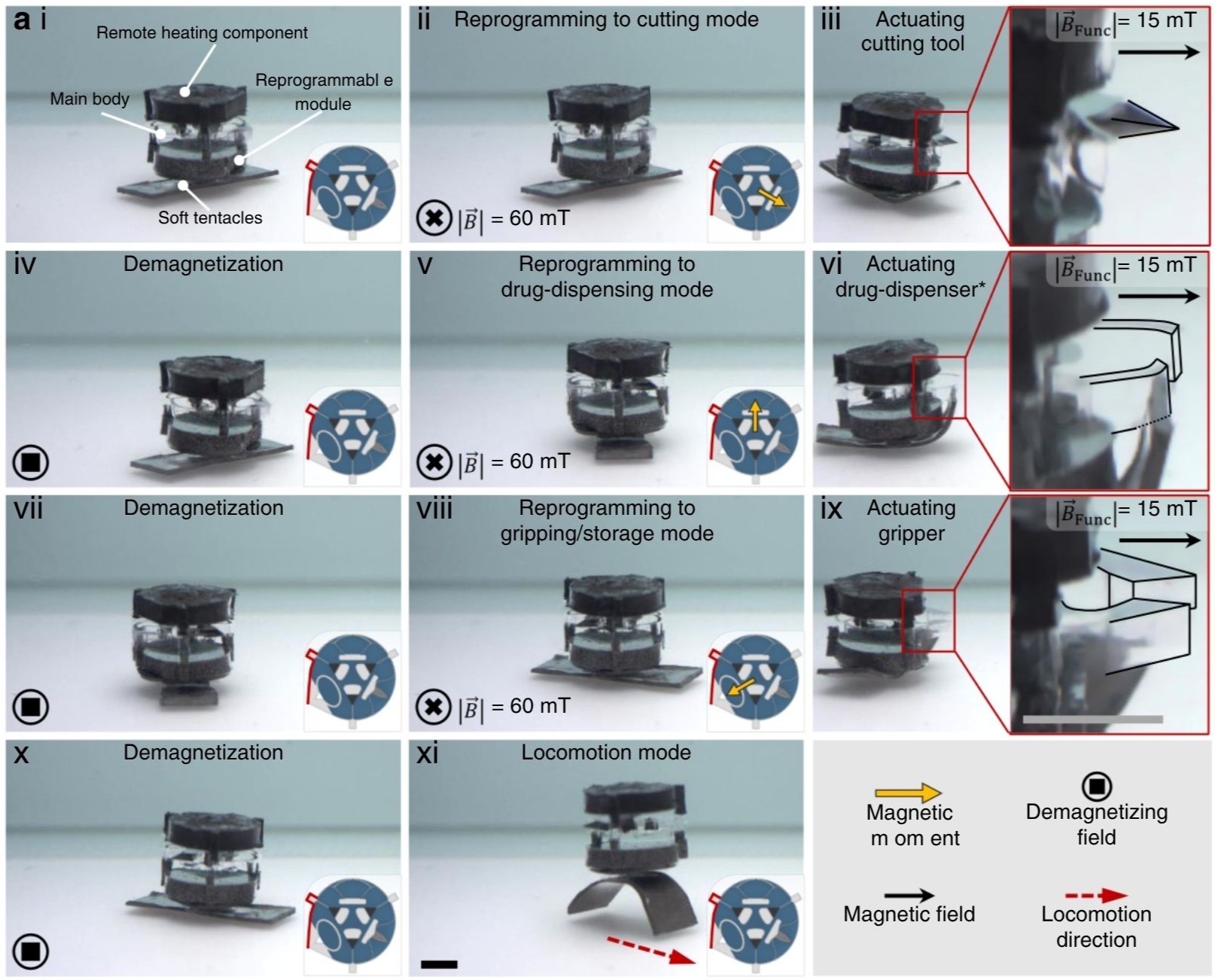 Robot architecture and function
A key part of the design is its carefully engineered symmetry, which acts as a built-in control system. When magnetic fields are applied from particular directions, forces generated in some parts of the robot cancel each other out while forces in other regions reinforce one another. Some structures therefore remain stable while selected components deform and activate.
“Because of symmetry and our reprogramming strategy, we can decouple the locomotion and function modes,” said researchers and co-authors Chelsea Ng Shan Xian, Yeoh Yu Xuan and Nicholas Yong Wei Foo.
The same distributed magnetic architecture also improves the robot’s mobility. The device can continuously roll and perform a two-anchor crawling motion across uneven terrain, allowing it to navigate confined and unstructured environments more effectively than many conventional miniature magnetic robots.
In practice, this means one magnetic field can trigger locomotion without deploying the cutting blade, while another can activate gripping jaws without causing the entire robot to deform unintentionally.
The same magnetic architecture also improves mobility. Not only can the device perform a two-anchor crawling motion across uneven terrain, it can also continuously roll, allowing it to navigate confined and unstructured environments more effectively than many conventional miniature magnetic robots. By allowing the robot to rotate and orient itself more freely under magnetic control, the system gains greater precision while traversing obstacles and narrow spaces inside biological tissue.
In effect, the robot’s geometry becomes part of its control system. The physical arrangement of magnetic structures determines which parts move, which remain fixed and which functions activate under different magnetic conditions.
Locomotion and four reprogrammable surgical functions on a biological phantom
Testing phase
The researchers tested the robot’s surgical capability’s using biological tissue models, including chicken liver, as well as gelatin-based materials designed to simulate soft tissue. According to the study, the robot successfully cut through biological tissue, gripped biological material, and generated localised heat under magnetic actuation. It also dispensed drugs and gripped tissue samples at a volume theoretically sufficient for clinical use.
To produce heat, the researchers exposed the robot to a high-frequency alternating magnetic field, causing magnetic materials inside the device to generate localised heat remotely — an approach similar to magnetic hyperthermia techniques explored in some cancer therapies.
While engineering such a device is one accomplishment, making sure it is safe for biomedical use is another. The team therefore evaluated biocompatibility by exposing living cells to the robot’s materials under laboratory conditions. More than 99 per cent of cells remained viable after testing, suggesting the materials used in the system were safe under experimental conditions.
The researchers also reported that the robot maintained its magnetic and mechanical stability after 100 cycles of magnetisation and demagnetisation, an important requirement for future biomedical applications.
Deployment
While the robot remains at the laboratory stage, the team is now exploring how future systems could integrate imaging technologies, sensing systems and clinically realistic artificial organ models designed to mimic the physical behaviour of human tissue.
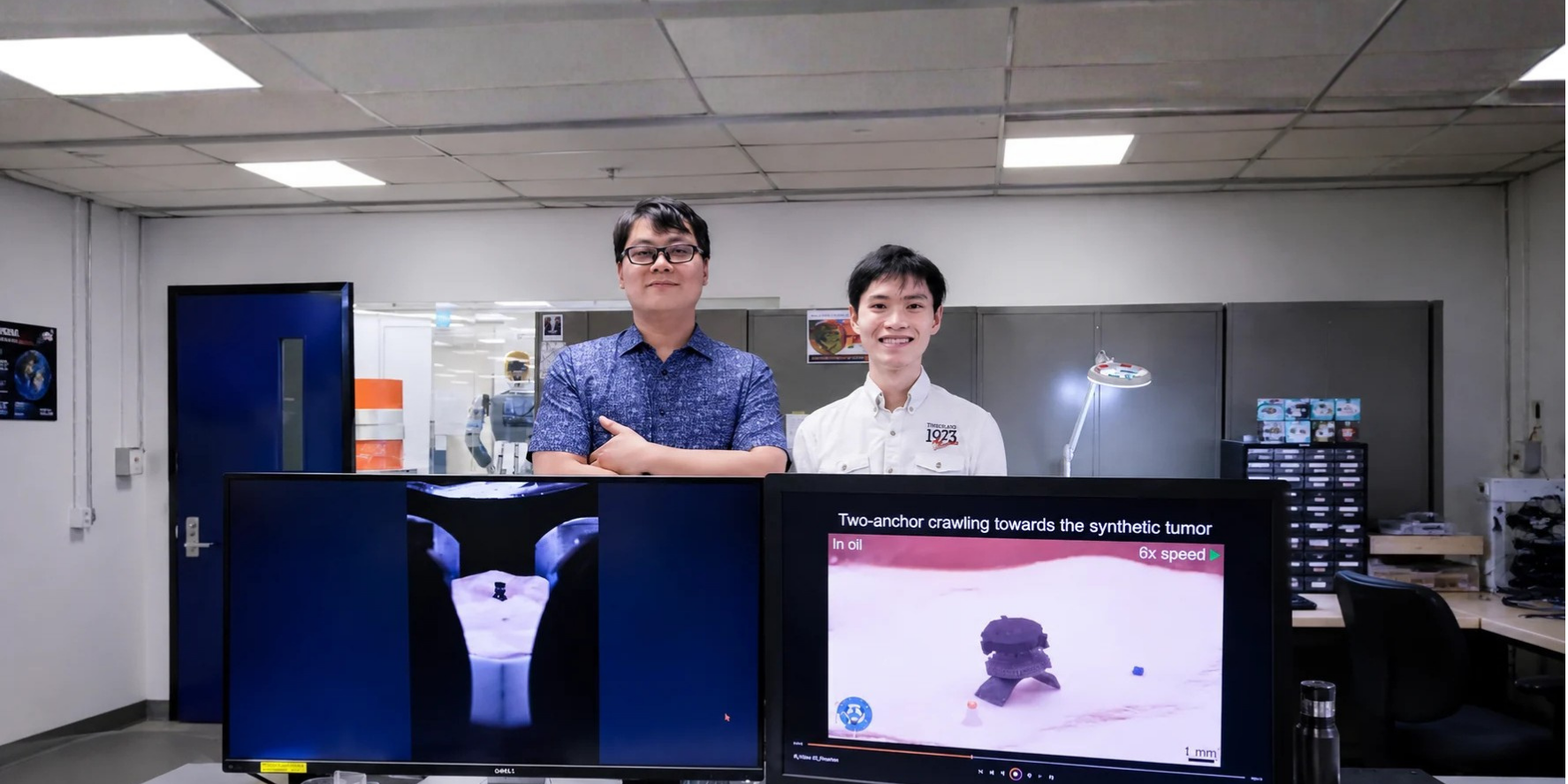
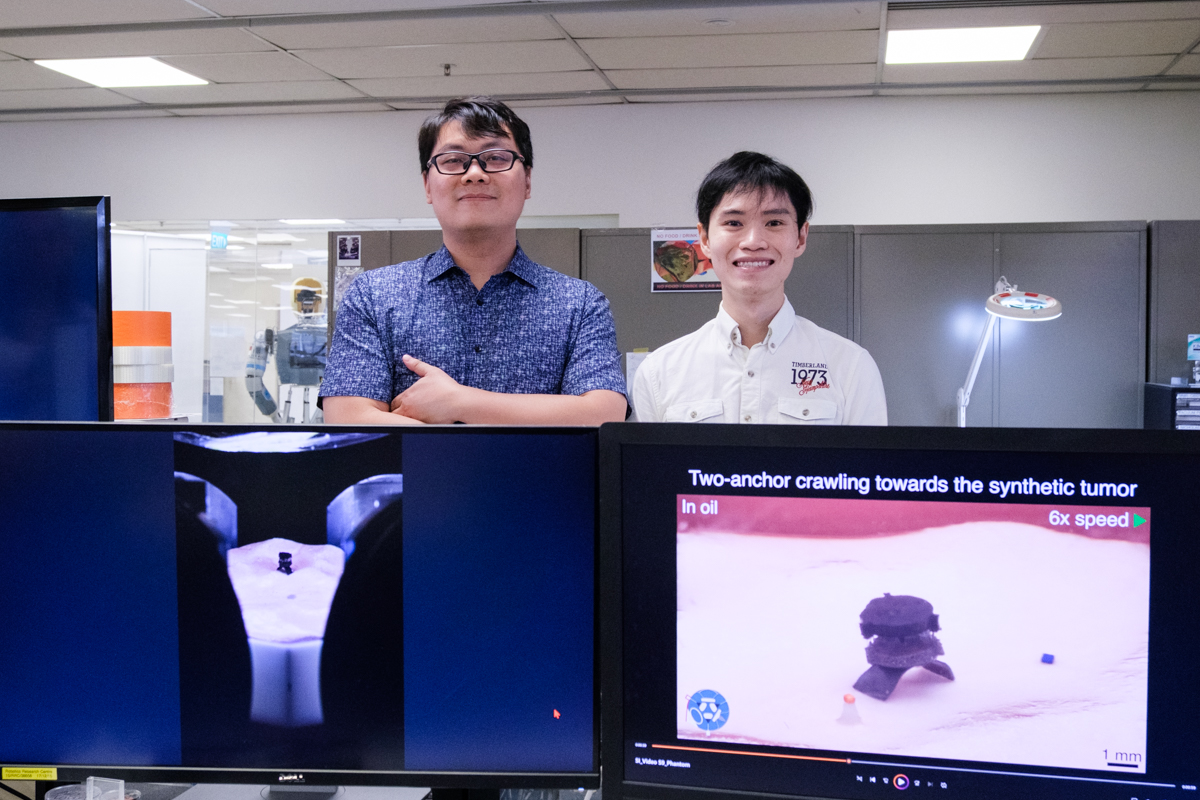 Researchers Guo Zhan Lum and Nicholas Yong Wei Foo pose in front of robot images
Lum is also collaborating with surgeons to better understand how miniature robotic systems could eventually fit into real clinical workflows.
“We want to know how surgeons would actually use these systems,” he said. “That’s the next step.”
Many already see promise.
“These millimetre-scale magnetically guided robots are remarkable in their ability to navigate complex environments while performing tasks such as drug delivery, biopsy and remote therapeutic heating,” said Dr Yeo Leong Litt Leonard, Senior Consultant at Singapore’s National University Hospital (NUH). “They have the potential to become an entirely new therapeutic modality in medicine.”
Story by Laura Dobberstein, NTU College of Engineering
Click here [VIDEO] to "Meet Your Future Surgeon."


.tmb-listing.jpg?sfvrsn=a1405aee_1)